

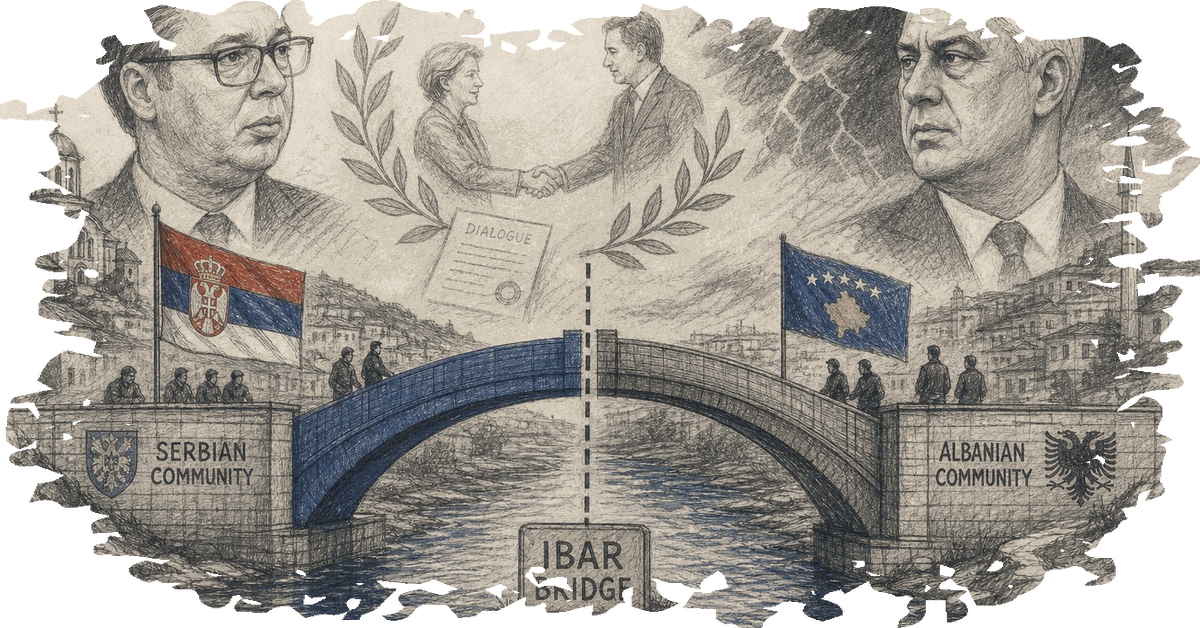
Serbian President Aleksandar Vučić has announced his intention to appeal to European and U.S. leaders to prevent the opening of the Ibar Bridge in Kosovska Mitrovica for traffic. This move comes amid concerns over the withdrawal of KFOR troops from the bridge, a development Vučić fears could compromise the safety of the Serbian population in Kosovo. The Ibar Bridge has long been a point of contention between Serbian and Albanian communities, and its management has been a politically charged issue in the region.
Vučić, who was involved in the dialogue where the bridge’s opening was initially agreed upon, expressed his apprehension about the potential security risks associated with the withdrawal of KFOR troops. “I am afraid, and everyone is afraid. Therefore, we will plead and seek assistance,” Vučić stated, emphasizing his commitment to reaching out to international leaders to garner support. He plans to first address European leaders, followed by an appeal to Washington, in hopes of preventing the bridge’s opening.

The Serbian President’s statements have sparked varied reactions from political figures and analysts. Vladimir Radosavljević, Vice President of the Serbian Democracy party, commented that Vučić’s pleas seem desperate, noting that his previous promises have often been unfulfilled. “People no longer take him seriously,” Radosavljević remarked, contrasting Vučić’s actions with those of Kosovo’s Prime Minister Albin Kurti, who he claims has followed through on his commitments.
Aleksandar Ivanović, Vice President of the People’s Movement of Serbia, criticized Vučić’s approach as a political maneuver aimed at bolstering his domestic standing. Ivanović accused Vučić of using patriotic rhetoric to obscure the outcomes of his policies and to maintain his grip on power. He described Vučić’s actions as a “performance” rather than a genuine diplomatic effort.
Žarko Ristić, founder of the Kosovo Alliance, expressed concern over Vučić’s diplomatic strategies, suggesting they often result in setbacks for Serbia. He advised that Vučić should adopt a more statesmanlike approach to be taken seriously on the international stage.
Zoran Savić from the NGO Aktiv pointed out the inconsistency in Vučić’s policies regarding Kosovo. He highlighted that the agreement to open the bridge was reached in 2015 during talks mediated by the European Union, in which Vučić, then Prime Minister, participated. Savić criticized the portrayal of the bridge’s opening as a new threat, noting that it was part of a longstanding agreement.
The Ibar Bridge, closed to vehicular traffic since 1999, has been a symbol of division in the region. The bridge separates the northern, predominantly Serbian part of Kosovska Mitrovica from its southern, Albanian-majority counterpart. The recent decision by KFOR to reduce its presence at the bridge has heightened tensions, with Serbian communities fearing increased vulnerability.
Vučić’s diplomatic outreach is set against a backdrop of historical tensions and recent developments in Kosovo. The region has seen a series of ethnic tensions and unilateral actions by Kosovo authorities, including property demolitions affecting Serbian communities. Vučić has previously expressed concerns over these actions, linking them to broader geopolitical dynamics and historical grievances.
The response from European and U.S. leaders to Vučić’s appeals remains uncertain. The situation is fluid, and the potential for escalating tensions is significant. Vučić’s efforts to engage international stakeholders underscore the complex interplay of local and international politics in the Balkans, where historical animosities and contemporary geopolitical interests continue to shape the landscape.



0 Comments