

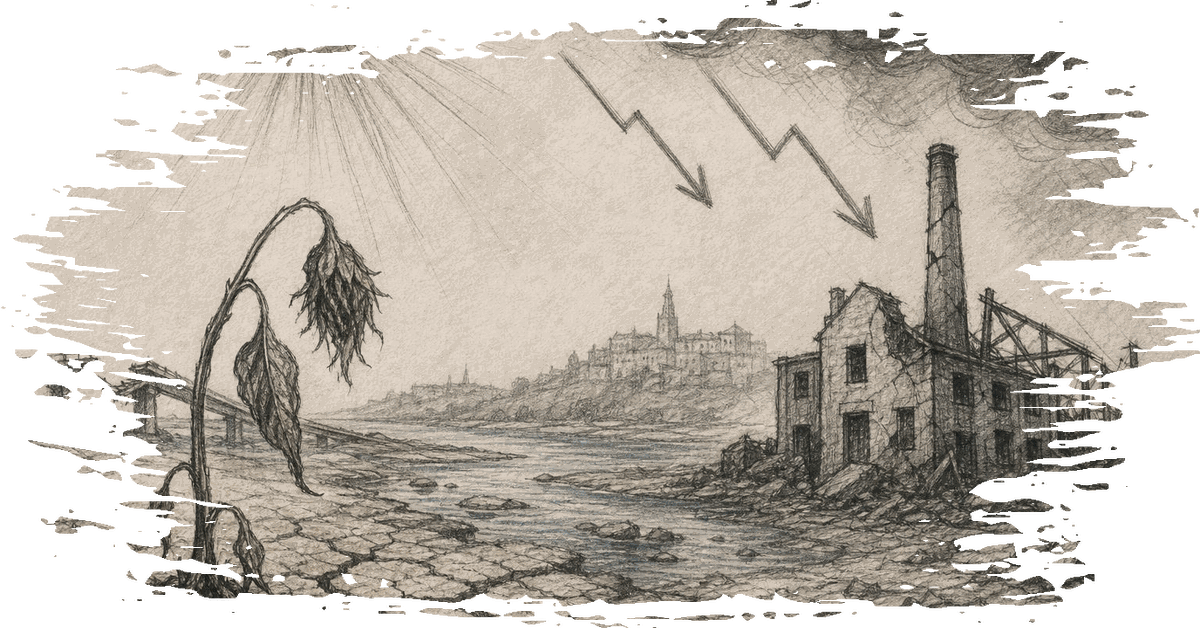
Serbia is grappling with severe economic challenges as a result of ongoing drought and extreme temperatures, which are expected to lead to increased food prices, higher inflation, and slower economic growth. Economists warn that the impact on Serbia could be more severe than in the European Union, where similar climatic conditions are expected to nearly nullify the anticipated economic growth for the year.
The drought has directly affected key sectors such as energy and agriculture, with potential repercussions on tourism and the broader industry. Despite these challenges, the Serbian government has not responded adequately, and there is a noticeable lack of discourse on inflation, even though it is anticipated to rise. Aleksandra Nenadović from Nova ekonomija highlights that the Serbian authorities, including the National Bank, have not addressed the impending inflation, which is a significant concern given the current economic conditions.

The impact of the drought is already being felt by Serbian businesses. Dragoljub Vukadinović, president of Metalac Group in Gornji Milanovac, expressed concerns about the rising inflation and its effect on consumer purchasing power. “The lack of water has forced us to reduce production, almost to a halt. We are now operating with only two shifts instead of three,” Vukadinović explained. He noted that the reduced consumer spending, exacerbated by the heat, poses a threat to their business as customers are less inclined to shop in such conditions.
The drought is also expected to challenge Serbia’s projected GDP growth of 3%. The reduction in agricultural yields, particularly in crops such as corn and fruit, is directly affecting food supply and prices. Ljubodrag Savić, a professor at the Faculty of Economics, described the situation as an unprecedented natural disaster. He emphasized the problems with agricultural yields and the critically low water levels in the Danube, which complicate the transportation of goods and increase costs.
The situation is further complicated by Serbia’s infrastructural issues, which have been neglected over the years. The country’s energy production has been problematic since 2022, with worsening forecasts. The sanctions on the oil giant NIS, electricity imports, and water supply issues have compounded the challenges faced by Serbian businesses this year. Savić pointed out that the damage to Serbia could be proportionally greater than in the EU, given the country’s neglected infrastructure and the specific challenges it faces, such as reduced water supply and power generation issues.
The drought’s impact on Serbia’s economic growth is significant, with the potential to disrupt trade relations with Germany, Serbia’s largest trading partner and investor. The global nature of these drought-related disruptions contributes to the overall inflationary pressure felt domestically. According to a Triodos Bank analysis, the damage from extreme heatwaves and wildfires across Europe is estimated at a cumulative 180 billion euros, which could push the EU to the brink of economic stagnation.
Despite these challenges, there are some positive contributions to growth, notably from the construction sector, which includes projects like road infrastructure and the upcoming EXPO. However, these are overshadowed by the broader economic difficulties.
The Serbian government has yet to take decisive action to mitigate the effects of the drought and address the rising inflation. The lack of a comprehensive response raises concerns about the country’s economic resilience and the long-term implications for its economy. As the drought continues, the full extent of its impact remains uncertain, but the immediate effects on food prices, inflation, and economic growth are already apparent.


0 Comments