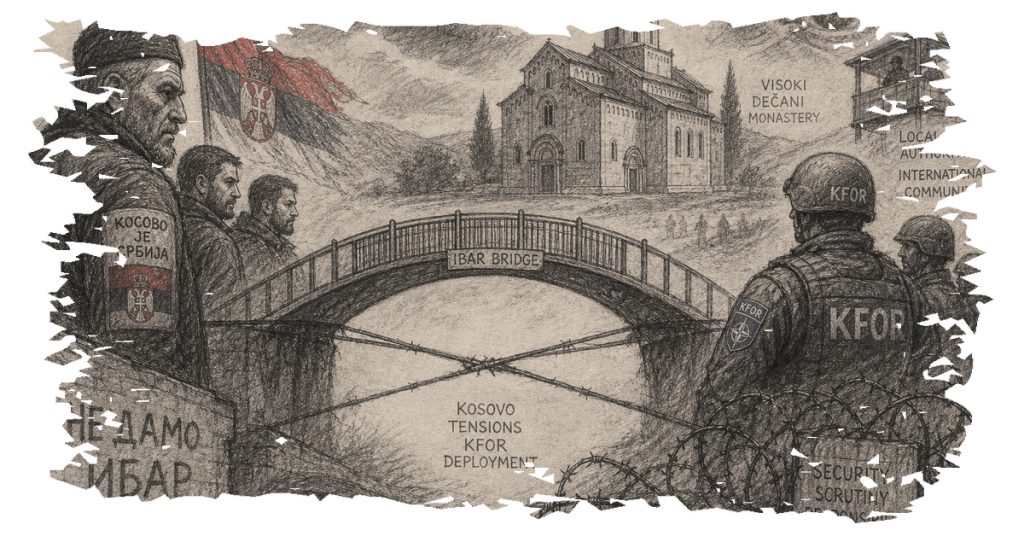
Igor Simić, a member of the Presidency of the Serbian List, has voiced strong opposition to any changes in the presence of KFOR troops at the Ibar Bridge and near the Visoki Dečani monastery, stating that such actions would be detrimental to the interests of Serbs in Kosovo. His comments underscore the ongoing concerns among the Serbian population in the region regarding their safety and treatment by local authorities.

Simić’s remarks were made during an interview with TV Prva, where he emphasized that the stance against altering KFOR’s deployment is not only held by the Serbian List but also reflects the broader sentiment of the Serbian community living in Kosovo and Metohija. He described the potential changes as “absolutely unacceptable,” particularly highlighting the importance of these locations as neuralgic points due to their historical significance and the numerous ethnically motivated attacks that have occurred there.
The case of Nenad Rašković was cited by Simić as an extreme example of mistreatment by the Kosovo police, illustrating the broader issues of harassment and violence faced by Serbs in the area. He claimed that many similar incidents have occurred, but victims are often too afraid to speak out due to concerns for their safety and that of their families.
Simić also expressed alarm over the ongoing police actions in Zubin Potok, where searches and arrests of Serbs are reportedly taking place regularly. He described a pervasive sense of concern among the Serbian population, noting that while fear may no longer be the predominant feeling after years of tension, there is significant worry about what the future holds.
The timing of these developments is particularly critical as the new school year approaches, a period when security concerns are heightened. Additionally, the upcoming verdict in The Hague for members of the Kosovo Liberation Army (KLA), scheduled for September 16, adds another layer of tension to the situation.
Simić’s statements come amidst broader calls for international intervention to ensure the safety and rights of Serbs in Kosovo. He urged organizations such as EULEX and KFOR, as well as representatives from the Quint countries and the European Union, to take decisive action to protect the Serbian community. According to Simić, the international community has been largely inactive, which he argues has allowed the security situation to deteriorate.
The historical context of these tensions is rooted in the longstanding ethnic conflict between Serbs and Albanians in Kosovo. Over the years, there have been numerous reports of violence and discrimination against the Serbian population, leading to repeated appeals for international oversight and intervention.
The Serbian government has also been vocal about these issues. Recently, Serbian President Aleksandar Vučić sent a letter to NATO Secretary General Mark Rutte, urging KFOR to act in accordance with UN Resolution 1244 to halt what he described as the terror against Serbs. Vučić highlighted the continuous persecution of Serbs over the past five years, citing over 800 ethnically motivated attacks and the arrest of 257 Serbs, often accompanied by severe mistreatment.
The situation is further complicated by the political dynamics in Kosovo, where tensions have been exacerbated by the actions of Albin Kurti, the Prime Minister in a technical mandate. Kurti’s policies and actions have been criticized as part of a broader strategy to pressure the Serbian community, with some analysts suggesting that these moves are aimed at driving Serbs out of the region.
As these issues unfold, the role of international organizations and the response of the international community will be crucial in determining the future stability of Kosovo and the safety of its Serbian population. The situation remains delicate, with potential implications for regional stability and international relations.