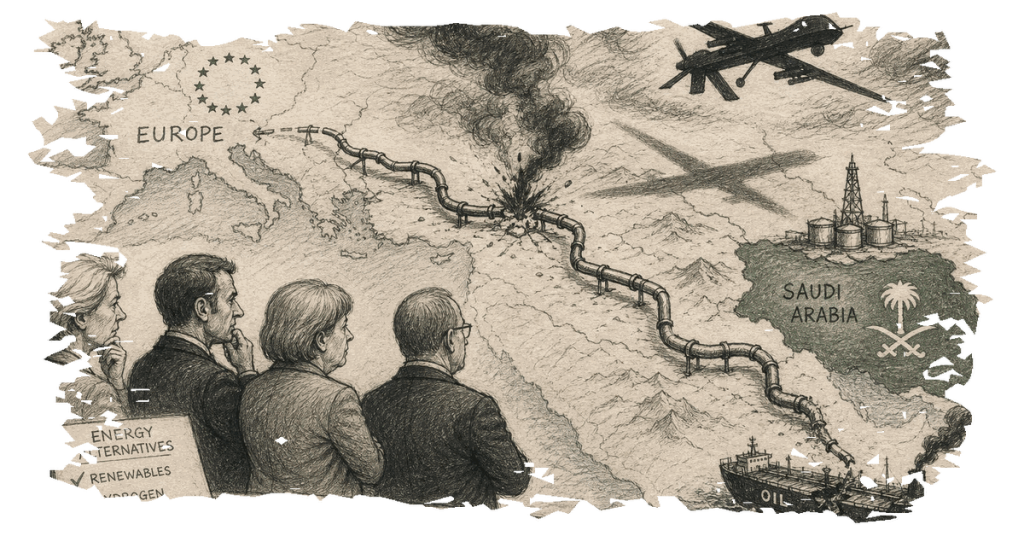
Saudi Arabia has significantly reduced and partially suspended its oil shipments to Europe following a drone attack on its East-West oil pipeline. The attack, attributed to an Iraqi militia, has led to the cancellation of some tanker shipments that were scheduled for September. The pipeline, which runs from the eastern desert to the Red Sea, is a crucial route for Saudi oil exports. The disruption has caused a surge in oil prices, with Brent crude futures trading at approximately $108 per barrel and physical market prices in Europe exceeding $120 per barrel.
The attack has forced Saudi Arabia to explore alternative methods for oil transport, including “secret shipments” through the Strait of Hormuz, a strategy previously employed by the United Arab Emirates and Iraq. This method allows Gulf producers to export between 7 and 9 million barrels per day, which is about 30 to 40 percent of their pre-conflict volumes. The East-West pipeline had been a vital alternative route for Saudi Arabia, especially after the strategic Strait of Hormuz was closed by Iran in response to U.S. military actions against Iranian nuclear facilities.

The suspension of oil shipments has had immediate repercussions for European markets. Polish oil company Orlen, which relies on Saudi Aramco for 40% of its oil needs, is urgently seeking alternative suppliers. Orlen operates refineries in Poland, Lithuania, and the Czech Republic, and the disruption has prompted the company to purchase North Sea crude grades such as Grane, Johan Sverdrup, and Johan Castberg through spot tenders. Additionally, Orlen has placed bids for U.S. WTI Midland and Kazakh CPC Blend crude, and initiated new tenders for North Sea or Algerian oil for October delivery, as well as Guyanese oil for November.
The geopolitical tensions in the Middle East, particularly involving Iran and Iraq, have been a recurring theme affecting global oil supply chains. Previous incidents of attacks on oil infrastructure in the region have historically led to fluctuations in oil prices. The current situation is fluid, and further developments could alter the impact on oil prices and supply. There is also a lack of detailed information from Saudi Aramco regarding the extent of the damage and the timeline for resuming normal operations.
The disruption in oil supply is contributing to broader economic uncertainties. In Germany, fuel prices have already seen significant increases, with diesel reaching up to 2.56 euros per liter. The closure of the East-West pipeline and the potential for prolonged disruptions in oil supply could exacerbate inflationary pressures in Europe, where energy prices have been a significant contributor to rising inflation rates.
As the situation unfolds, European countries may need to reassess their energy policies and supply strategies to mitigate the risks posed by geopolitical tensions in the Middle East. The incident underscores the vulnerability of global oil supply chains to regional conflicts and the potential for significant economic impacts.