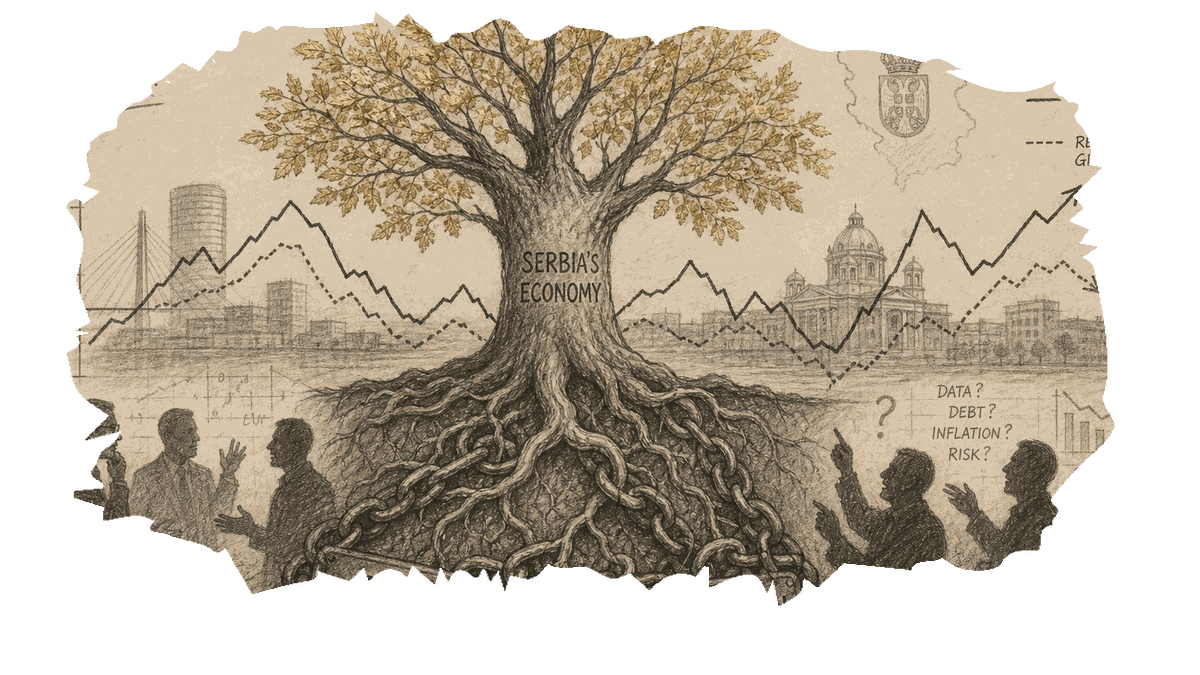
Serbia’s Minister of Finance, Siniša Mali, has claimed that the country’s economy is now three times stronger than it was in 2012, citing a projected GDP of approximately 97 billion euros for 2026 compared to 33.6 billion euros in 2012. This statement is part of a broader campaign to showcase the economic achievements under the leadership of the Serbian Progressive Party over the past 14 years. However, the validity of this claim is being questioned due to the complexities of economic measurement and the impact of inflation.
The nominal GDP figures presented by Mali suggest significant growth, but they fail to account for inflation and other regional economic factors. When adjusted for inflation, Serbia’s real cumulative economic growth over the past 14 years is approximately 40%, placing it in the middle range of Central and Eastern European countries. This adjustment highlights that the nominal increase in GDP does not necessarily translate into a proportionate increase in economic strength or improvement in living standards.

Economist Ljubomir Madžar has criticized the government’s portrayal of economic growth, pointing out that the Serbian dinar has been overvalued against the euro, which inflates the GDP figures when expressed in euros. Madžar argues that a more accurate assessment of economic strength would involve adjusting the GDP for inflation using domestic currency values, which would yield a significantly different and less impressive result.
Furthermore, the comparison of Serbia’s economic growth with its regional peers paints a more nuanced picture. While Serbia has seen an average annual GDP growth rate of 2.4%, this is comparable to that of Bosnia and Herzegovina and Croatia, and slower than the growth rates of Poland, Romania, Albania, and Montenegro. In contrast, Bulgaria, Hungary, and North Macedonia experienced slower growth than Serbia during the same period.
The discussion around public debt also reveals inconsistencies in the government’s narrative. While Mali highlights a decrease in the public debt-to-GDP ratio from over 50% in 2012 to 43.7% in 2025, this comparison does not consider the nominal increase in public debt, which rose by 22 billion euros during this period. The focus on the debt-to-GDP ratio, rather than the absolute level of debt, is seen as an attempt to present a more favorable economic outlook.
Economist Saša Đogović has noted that the government’s economic model relies heavily on public investments, foreign direct investments attracted by subsidies, and increased consumption fueled by monetary injections. This model, according to Đogović, is unsustainable and characterized by a lack of transparency and selectivity, with corruption being a common thread.
The scrutiny of Serbia’s economic claims comes amid a broader context of economic challenges and political maneuvering. The government’s portrayal of economic strength is seen as part of a pre-election campaign strategy, with critics arguing that the reality is more complex and less rosy than presented. As Serbia navigates these economic and political dynamics, the accuracy and transparency of its economic reporting remain critical issues for both domestic and international observers.