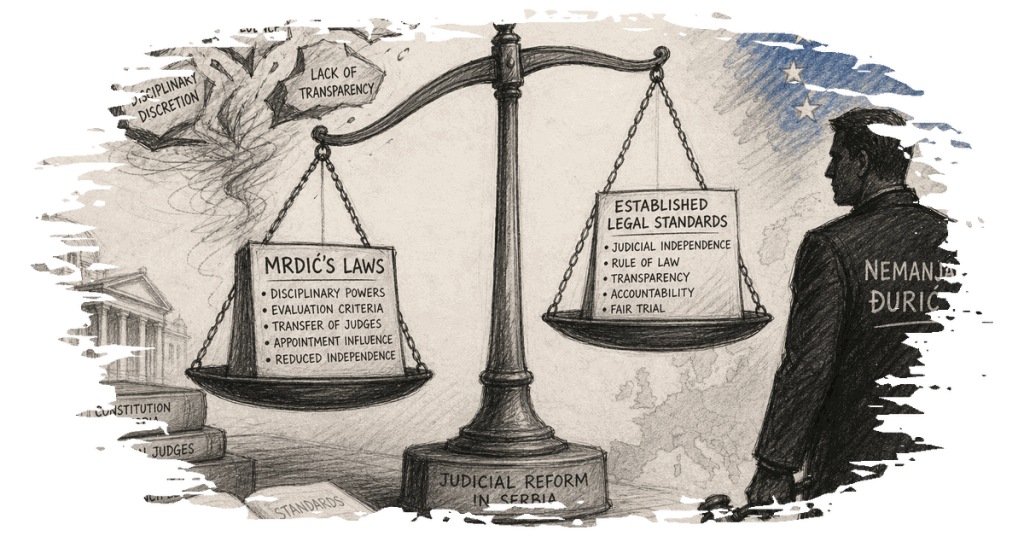
The controversial “Mrdić’s laws” have sparked significant debate in Serbia, with Nemanja Đurić, President of the Judicial Authority Union, criticizing certain amendments as undermining established standards. Đurić expects a negative response from the Venice Commission of the Council of Europe.
Central issues include the appointment of public prosecutors and the method for selecting the acting Supreme Public Prosecutor. Despite pressure, the Ministry of Justice has only retracted seven out of ten disputed provisions. The three remaining provisions, which Đurić describes as “most detrimental,” involve excluding prosecutors from organized crime cases, selecting the acting Supreme Public Prosecutor, and limiting international cooperation.
A preliminary opinion by the Venice Commission noted that nine out of ten provisions fail to meet European standards. Justice Minister Nenad Vujić faces criticism for highlighting one favorable provision while ignoring broader concerns. Đurić insists that the union expects a negative stance on these provisions and calls for their removal from Serbia’s legal framework.
This controversy highlights Serbia’s struggle to align national laws with European expectations. The Venice Commission’s final opinion will significantly impact Serbia’s judicial reforms and its EU accession journey, reflecting ongoing challenges in maintaining judicial independence and prosecutorial autonomy.
Serbia’s judicial reform efforts are integral to its EU membership bid. The legal community is deeply engaged in discussions with the Venice Commission through various platforms, including public demonstrations like the “March for Justice.” While some progress has been made, unresolved issues continue to pose challenges.
The forthcoming opinion from the Venice Commission carries significant implications for Serbia’s judicial reform path and EU prospects. Legal experts and the public are closely monitoring potential long-term impacts on Serbia’s judiciary.
The debate over “Mrdić’s laws” illustrates the complexities facing Serbia as it seeks to balance national sovereignty with European integration goals. The legislative outcome will shape not only Serbia’s legal landscape but also its future in Europe.