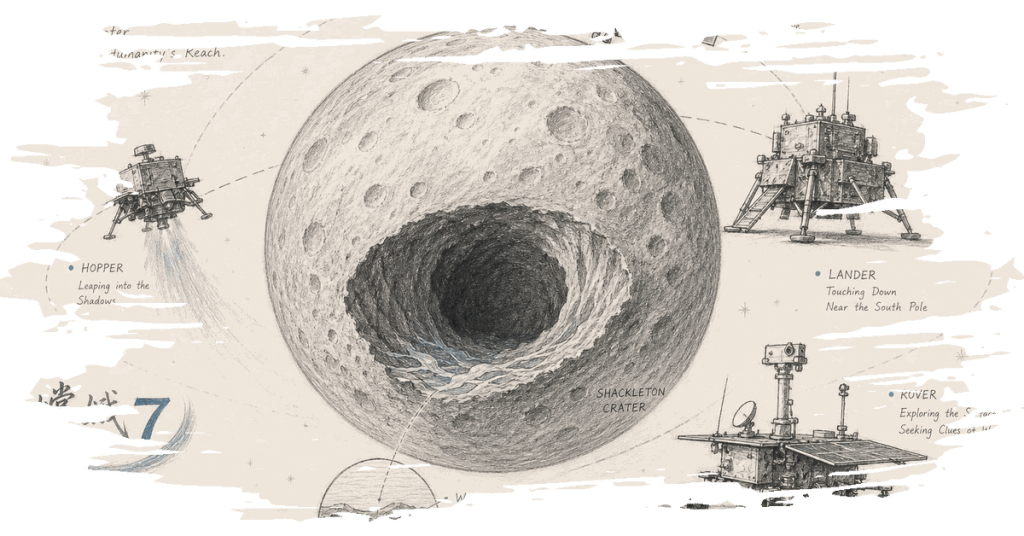
China is preparing to launch its Chang’e-7 mission, an ambitious endeavor aimed at exploring the moon’s south pole for ice water. The mission, which is set to take place between August 24 and August 31, 2026, represents a significant step in China’s lunar exploration efforts. The Chang’e-7 mission will employ a suite of robotic instruments, including an orbiter, a lander, a rover, and a hopper, to investigate the moon’s permanently shadowed craters, particularly near the Shackleton Crater.
The mission’s primary goal is to search for ice water within these shadowed regions, which have not been extensively explored by previous lunar missions. The presence of water on the moon has been a subject of scientific inquiry for decades, with various missions over the past 20 years confirming its existence. In 2009, a NASA mission provided direct evidence of water ice in a lunar crater, and subsequent studies have suggested that water molecules are more widespread than previously thought.
The Chang’e-7 mission is particularly noteworthy as it aims to land near the Shackleton Crater, a 21-kilometer-wide pit located close to the moon’s south pole. This area is of great interest to scientists because the permanent shadows within the crater may contain ancient ice deposits that could offer insights into the moon’s geological history and the origins of water in the Earth-moon system.
The mission’s lander will be equipped with scientific instruments to study the lunar environment, while the rover will analyze rocks and soil at the landing site. The hopper, a small solar-powered craft, will be used to explore the crater by making short flights from the lunar surface. These components will work in tandem to relay data back to Earth, providing valuable information about the moon’s composition and the potential for future human exploration.
The discovery of water on the moon is significant for several reasons. It could provide a resource for future crewed missions, offering a source of drinking water and a means to produce hydrogen for fuel and oxygen for breathing. This would be crucial for sustaining long-term lunar bases and supporting missions to Mars. Additionally, the study of lunar ice could reveal information about the history of water delivery to the moon and Earth, potentially shedding light on the formation of our planet’s oceans.
While the 1967 United Nations Outer Space Treaty prohibits any nation from claiming sovereignty over the moon, it does not explicitly address commercial activities or resource ownership. This leaves open questions about how lunar resources might be utilized in the future, a topic that will likely gain more attention as lunar exploration continues to advance.
China’s Chang’e-7 mission follows other recent efforts to explore the moon’s south pole. In 2023, Russia’s Luna-25 mission aimed to search for frozen water but ended in failure when the spacecraft crashed. In contrast, India’s Chandrayaan-3 mission successfully landed and provided new evidence of water ice in the region. These missions highlight the growing international interest in the moon’s polar regions and the potential resources they may harbor.
As the launch window for Chang’e-7 approaches, the mission is being closely watched by the global scientific community. Its success could pave the way for future lunar exploration and provide critical data that will inform the next steps in humanity’s exploration of the moon and beyond.