

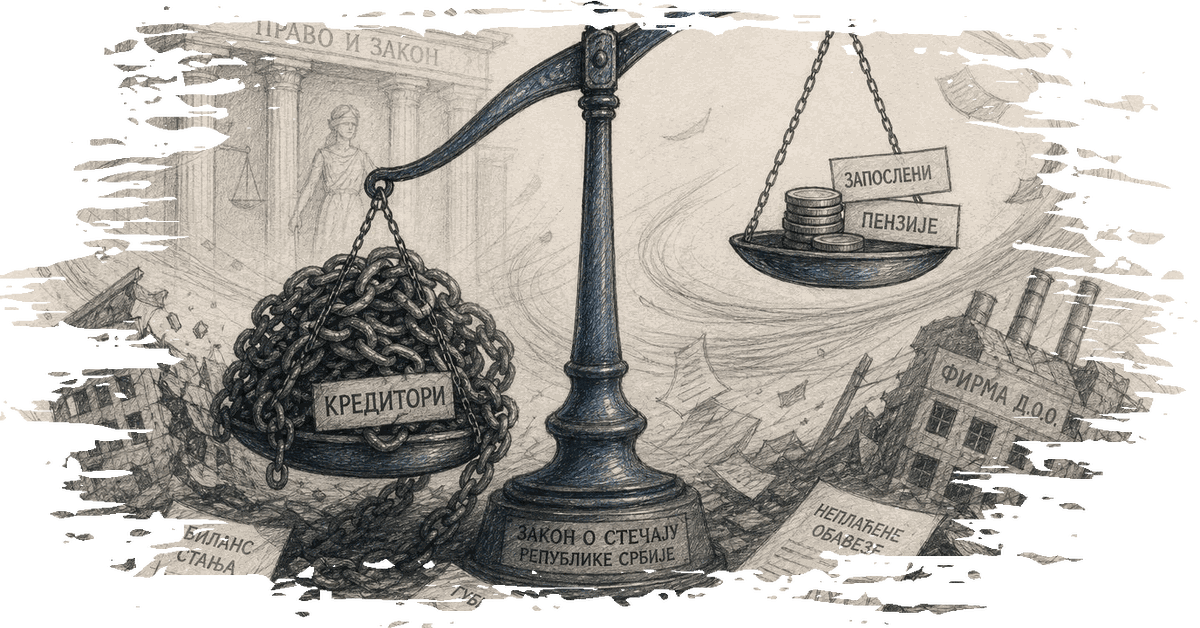
Serbia’s bankruptcy law provides a structured legal framework for handling companies that face severe financial distress. The law identifies four primary reasons for initiating bankruptcy proceedings: permanent inability to pay, threatening inability to pay, over-indebtedness, and failure to execute an approved reorganization plan. These proceedings are overseen by the Commercial Court and the Agency for the Licensing of Bankruptcy Administrators (ALSU).
When a company in Serbia can no longer meet its financial obligations, bankruptcy proceedings are initiated to prevent the uncontrolled dissipation of assets. This process involves either liquidation, where all assets are sold to pay creditors, or reorganization, which allows the company to continue operations under a pre-approved plan. The initiation of bankruptcy proceedings results in significant changes for the company, including the termination of management rights and the closure of existing bank accounts. A new account is opened for the bankrupt entity, and all funds are redirected there.

One of the most immediate consequences of bankruptcy for employees is the termination of their employment contracts. However, Serbian law prioritizes the payment of minimal wages and pension contributions for workers. These payments are given absolute priority in the distribution of funds from the sale of the company’s assets. Specifically, unpaid net wages up to the minimum wage for the last year before the bankruptcy, along with unpaid pension contributions for the last two years, are settled first.
The bankruptcy process also involves a strict payment hierarchy for creditors. After covering the costs of the court proceedings and the bankruptcy estate’s obligations, creditors’ claims are divided into four categories. The first category includes the aforementioned employee wages and pension contributions. The second category covers other public revenues, taxes, and fees due in the three months preceding the bankruptcy. The third category includes all other bankruptcy creditors, such as suppliers and commercial loans, as well as any wage amounts exceeding the minimum wage. The fourth category consists of subordinated claims, such as loans from founders and related parties over the past two years.
Secured creditors, such as banks with mortgages or liens on specific assets, are paid directly from the proceeds of the sale of those assets. This ensures that their claims are prioritized over unsecured creditors.
Despite the severe implications of bankruptcy, it does not necessarily mark the end for a company. Through a pre-prepared reorganization plan or a plan developed during bankruptcy, a company can potentially recover over a period of up to five years. This recovery may involve debt restructuring, partial debt forgiveness, or converting debt into equity stakes. For investors, a key legal provision is that the purchaser of assets in bankruptcy does not inherit the company’s previous debts. The acquired assets are transferred to the new owner free of prior tax, utility burdens, or mortgages.
This legal framework aims to balance the interests of creditors, employees, and other stakeholders while providing a pathway for potentially viable companies to reorganize and continue operations. However, the absence of specific recent case studies or examples in the current discussion limits the understanding of the law’s practical application and its impact on Serbia’s labor market. Insights from legal experts or labor representatives could further illuminate the implications of these bankruptcy laws, offering a more comprehensive view of their effects on businesses and employees in Serbia.



0 Comments