

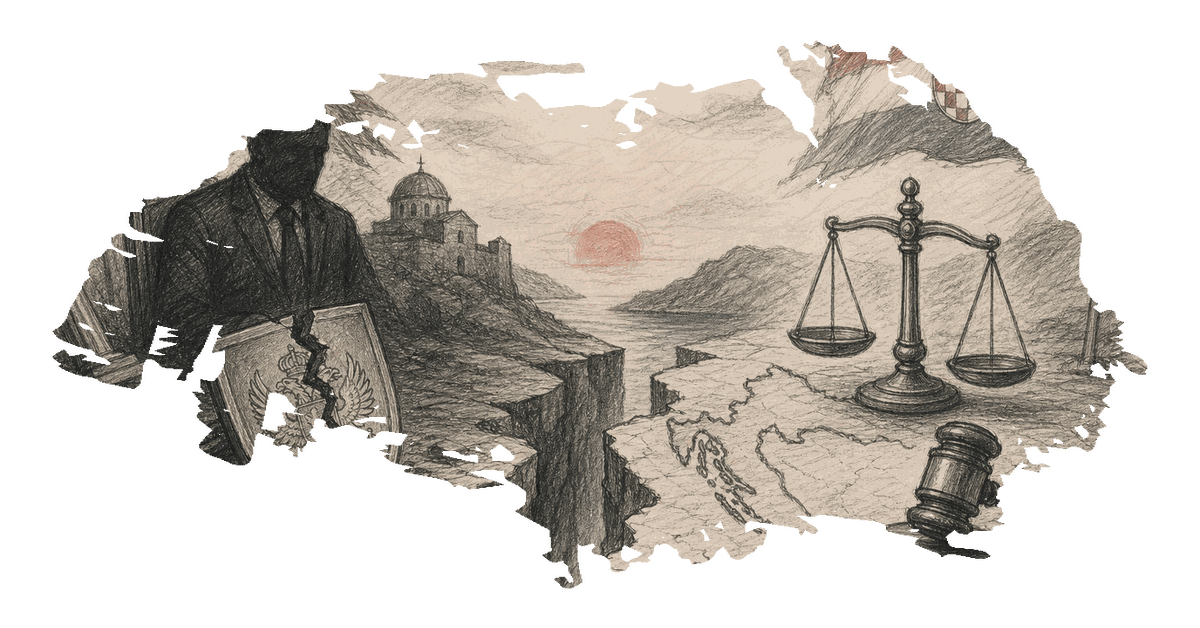
Andrija Mandić, the President of the Assembly of Montenegro, has stirred controversy by sending condolences to the family of Ratko Mladić, the former Bosnian Serb Army commander convicted of war crimes and genocide. This gesture has provoked a strong reaction from Croatian officials, who view it as contrary to the values of the European Union. The Croatian Ministry of Foreign Affairs and Gordan Jandroković, Speaker of the Croatian Parliament, have openly condemned Mandić’s actions, emphasizing the potential negative impact on Montenegro’s aspirations to join the EU.
Mandić’s expression of sympathy was directed towards Mladić’s son, Darko, following the death of Mladić at the age of 84 in a detention facility in The Hague. Mladić was serving a life sentence for his role in the Srebrenica massacre and other atrocities during the Bosnian War. The Croatian Ministry of Foreign Affairs, led by Minister Gordan Grlić Radman, issued a statement criticizing Mandić’s actions as unacceptable and inconsistent with EU values. The statement stressed that such gestures do not contribute to Montenegro’s European path, highlighting the importance of confronting the past, prosecuting war crimes, respecting international court judgments, and fostering good neighborly relations.

Jandroković further articulated his disapproval, stating that Mandić’s public expression of condolences for a convicted war criminal is entirely inappropriate and deserving of condemnation. He argued that when a leader of a legislative body in a country aspiring to EU membership makes such statements, it reflects the principles and policies they promote, which are at odds with those of the EU and the civilized world. Jandroković made it clear that Montenegro could not count on Croatia’s support for its EU accession as long as its leaders continue to make such declarations.
The controversy underscores ongoing tensions rooted in the historical narratives of the Yugoslav Wars of the 1990s, which continue to influence political relations in the region. Mladić’s legacy remains a deeply divisive issue, with some viewing him as a hero and others as a war criminal. The expression of condolences by a high-ranking Montenegrin official has reignited these tensions, particularly given Montenegro’s aspirations to join the European Union, where adherence to democratic values and human rights is a prerequisite.
Mandić, who is also a leader of the New Serbian Democracy party, has been a contentious figure in regional politics. He, along with other Montenegrin politicians, was declared persona non grata in Croatia after the Montenegrin Assembly adopted a resolution on genocide in concentration camps like Jasenovac, Mauthausen, and Dachau. Jandroković questioned whether Mandić’s condolences also implied a denial of the crimes committed under Mladić’s command, including the genocide in Srebrenica.
The incident is likely to have diplomatic repercussions, potentially affecting Montenegro’s relations with Croatia and its EU accession process. The Croatian response reflects a broader concern about the narratives surrounding the Yugoslav Wars and the importance of addressing war crimes and historical grievances as part of the EU integration process.
The situation remains sensitive, with potential for further diplomatic fallout. Croatian officials have made it clear that Montenegro’s path to EU membership will be scrutinized closely, particularly in terms of its leaders’ adherence to EU values and their handling of historical issues. As Montenegro navigates its European aspirations, the controversy over Mandić’s condolences highlights the complex interplay of historical narratives, regional politics, and international relations in the Balkans.


0 Comments