

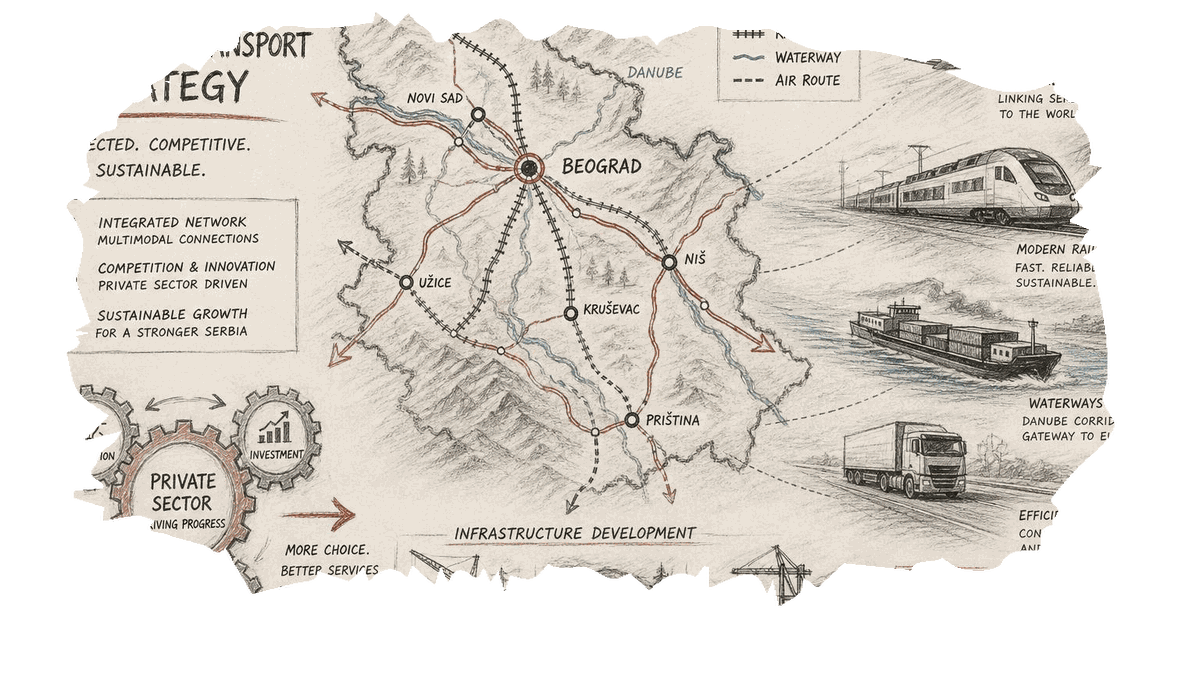
Serbia has unveiled a new national transport strategy, set to be implemented by 2034, which emphasizes the growing role of private companies in the railway sector and aims to enhance regional connectivity through a multimodal approach. The strategy was presented at the Cargo Conference Belgrade, an event that gathered nearly 300 experts from around 20 European countries, underscoring the importance of integrated transport systems for the Western Balkans.
The strategy marks a significant shift from previous sector-specific solutions, focusing instead on integrating road, rail, water, and air transport systems. This approach is expected to foster greater competition and investment in the railway sector, where private firms are increasingly taking a dominant role. For the third consecutive year, the state railway operator “Srbija Kargo” has seen its share in total railway freight transport fall below 50%, as private companies continue to expand their influence.
Talis Linkaits, the new director of the Permanent Secretariat of the Transport Community, highlighted the necessity of an integrated, efficient, and sustainable freight transport system to boost the competitiveness of the Western Balkans and improve connectivity with European markets. He emphasized the need for reforms, transparent and fair access, and independent regulation to ensure the free flow of goods across borders.
The strategy, developed with input from over 40 experts from the Faculty of Transport and Traffic Engineering in Belgrade and funded by the World Bank, is one of the key strategic documents intended to guide future decisions in the transport and logistics sectors. Professor Dr. Milorad Kilibarda, the dean of the faculty, noted that the strategy focuses on intermodal transport, which involves the use of multiple modes of transportation for a single shipment. This method is seen as having significant potential in Serbia, particularly in container transport, which accounted for the movement of 210,000 TEU (twenty-foot equivalent units) in 2025.
However, the current infrastructure and capacities are nearing saturation, necessitating the construction of new intermodal terminals and logistics centers to accommodate potential growth. The strategy aims to develop railway and water transport, which are crucial for improving intermodal connectivity, with a particular focus on enhancing railway links with regional ports.
The conference also featured ambitious development plans from intermodal terminal operators Metrans and Nelt, signaling further investment in the sector. The involvement of private companies is expected to drive innovation and efficiency, with new market entrants showing sustained interest despite existing challenges.
The presentation of the strategy included contributions from younger voices, such as students from the Faculty of Transport and Traffic Engineering, who highlighted the growing role of imports, which increased by approximately 30% in the first half of 2026, in boosting railway freight volumes. They also pointed out that extensive railway works have impacted transit results through Serbia.
The strategy’s success will depend on the collaboration between various stakeholders, including government bodies, private sector players, and regulatory agencies. While the strategy outlines a comprehensive plan for the future, its effectiveness will hinge on the ability of these entities to work together towards common goals.
The Cargo Conference Belgrade, organized by the portal PlutonLogistics, served as a platform for discussing these developments and exploring the future of transport in the region. The event’s emphasis on multimodal transport reflects a growing recognition of the need for integrated solutions to meet the demands of modern logistics and transport systems. As Serbia moves forward with its transport strategy, the increased involvement of private companies and the focus on multimodal connectivity are expected to play pivotal roles in shaping the country’s transport landscape by 2034.




0 Comments