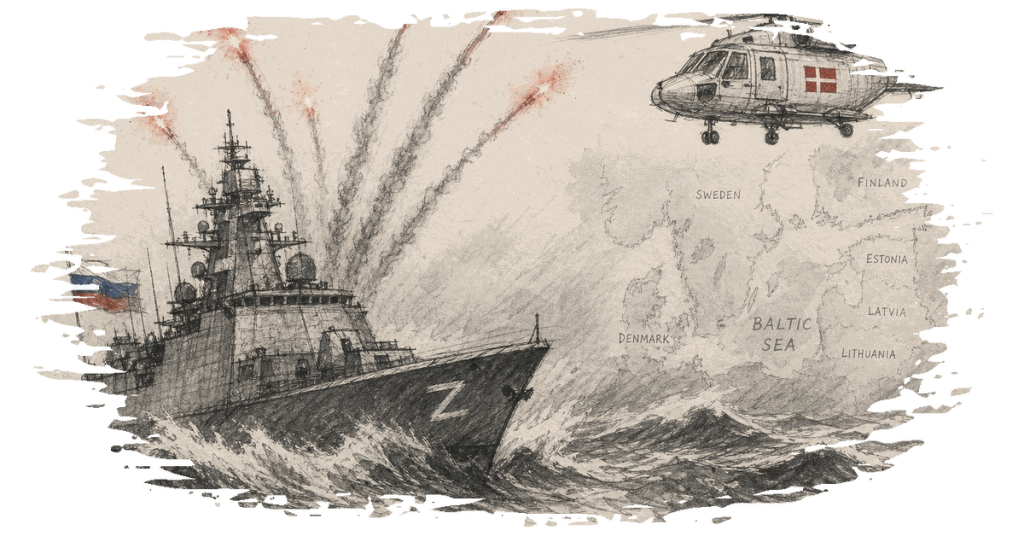
A Russian frigate fired flares at a Danish military helicopter in the Baltic Sea, escalating tensions between Russia and Denmark. This incident, which occurred on Monday, involved a Danish Fennec military helicopter that was monitoring and photographing the Russian vessel. According to Danish military officials, one of the flares passed perilously close to the helicopter, prompting Denmark to summon Russia’s ambassador to Copenhagen for an explanation.
Danish Prime Minister Mette Frederiksen described the incident as serious, framing it as part of Russia’s broader “hybrid campaign” against Europe and NATO. She emphasized the need for European nations to stand united and bolster their defense capabilities in response to such provocations. Denmark’s Foreign Minister Lars Løkke Rasmussen condemned the event for endangering lives and confirmed the summoning of the Russian ambassador. He accused Russia of gradually shifting the boundaries of acceptable behavior in international waters.

Denmark’s Defence Minister Jeppe Bruus also criticized the Russian actions, labeling them as “deeply unprofessional seamanship.” He noted that one of the flares came within mere meters of the Danish helicopter. When questioned about whether Denmark would seek consultations under NATO’s Article 5, which treats an attack on one member as an attack on all, Bruus stated that while the incident was being taken seriously, it had not yet reached that level of escalation.
The Russian ambassador in Copenhagen, Vladimir Barbin, countered by blaming the Danish helicopter for engaging in what he described as “dangerous maneuvers” near the Russian frigate. This incident is part of a pattern of rising tensions in the Baltic region, exacerbated by recent events such as Norway’s seizure of a Russian government expedition vessel earlier this month. Such actions have increased friction between Russia and Scandinavian countries.
The Baltic Sea has been a focal point of military activity, with previous complaints from Russia regarding Danish military aircraft maneuvers near their vessels. This latest episode underscores the fragile state of security in the region and the potential for further escalation. The incident also highlights the ongoing geopolitical tensions between Russia and NATO countries, particularly in light of Russia’s military actions in Ukraine and its broader strategic maneuvers in Europe.
The Danish government’s response to the flare incident reflects its commitment to maintaining the safety and security of its military personnel and assets in international waters. The summoning of the Russian ambassador signals Denmark’s intention to hold Russia accountable for actions perceived as aggressive or threatening. As the situation develops, it remains to be seen how NATO and other European nations will respond to this and similar provocations in the region.