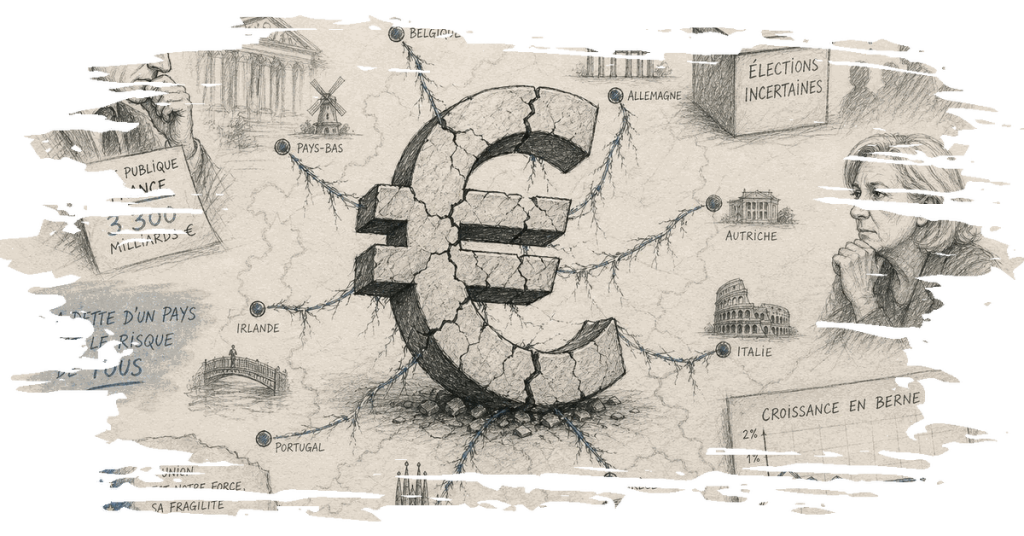
France’s rising public debt, now at approximately 118% of its GDP, is raising concerns about the potential impact on the stability of the European Union. The French economy has shown no growth in the last quarter, and investor confidence is waning, as indicated by the increase in yields on French government bonds to 4.2%, the highest level in 18 years. This situation is drawing parallels to Greece’s financial crisis, which previously threatened the EU’s financial stability.
The European Union’s total public debt stands at around 15.7 trillion euros, and while this is less than that of the United States, which has surpassed 40 trillion dollars, the complexity of individual state debts within the EU poses a significant risk. Unlike the United States, where federal bonds are backed by the entire nation, the EU’s debt is largely issued by its 27 member states, each responsible for its own obligations. This fragmentation means that financial instability in one large member state, such as France, could potentially threaten the stability of the entire Union.

The French political landscape adds to the uncertainty. The Economist highlights France as a focal point of concern due to its fiscal indiscipline. The upcoming elections in 2027 in France, Greece, Italy, and Spain, all countries with high public debt, could exacerbate the situation. Politicians in these nations might prioritize new spending and voter promises over deficit reduction, further complicating efforts to stabilize public finances.
In France, political figures like Marine Le Pen, who has previously advocated for France’s exit from the eurozone, and Jean-Luc Mélenchon, who has suggested radical measures such as “burning” part of France’s public debt, contribute to the uncertainty. The absence of a concrete plan among centrist politicians to reduce the budget deficit to the EU-mandated maximum of 3% of GDP further complicates the fiscal outlook.
The European Central Bank (ECB) has indicated its willingness to intervene if borrowing costs for any member state rise uncontrollably. However, such assistance would likely be contingent on implementing reforms and improving public finances, which could be politically challenging in the current climate.
Comparisons between France and Greece during its debt crisis may be premature, given France’s larger and more developed economy and its significant influence within European institutions. Nonetheless, France’s fiscal challenges are already having repercussions across Europe. The EU aims to strengthen the international role of the euro and create safe assets comparable to U.S. Treasury bonds. One strategy has been the issuance of joint EU bonds, backed by all member states, which began in greater volume in 2021 to finance post-pandemic recovery efforts. There are expectations that this joint borrowing model could be expanded.
As France grapples with its debt issues, the broader implications for the EU remain a topic of concern. The situation underscores the need for coordinated fiscal policies and the potential for reforms to ensure financial stability across the Union. The outcome of upcoming elections and political decisions in France and other high-debt EU countries will be critical in determining the future trajectory of the EU’s economic stability.