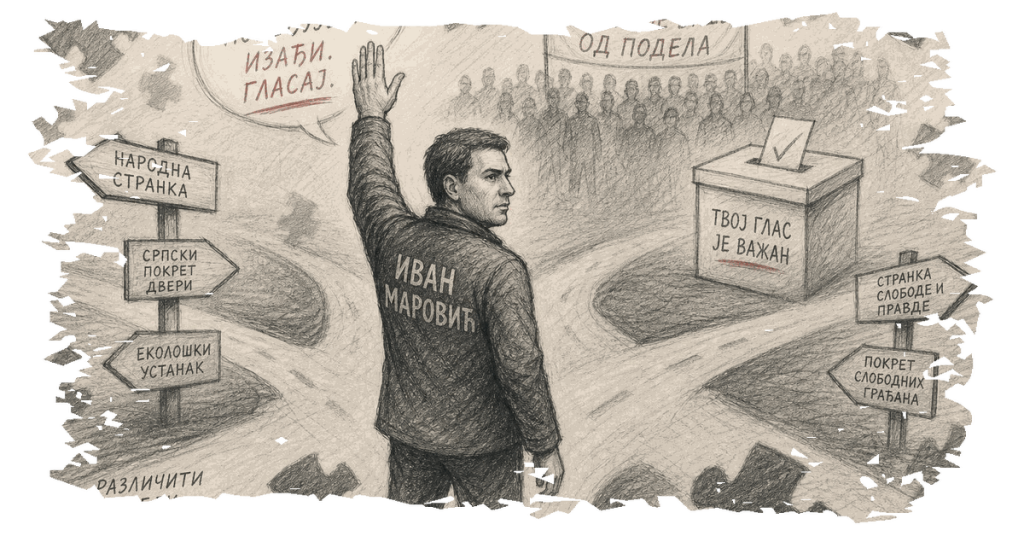
Ivan Marović, a former member of the Serbian youth movement Otpor, has made a public call for increased voter turnout and unity among opposition parties in the upcoming Serbian elections on October 25. Through a series of social media posts, Marović emphasized the importance of voter participation as a means to safeguard electoral integrity and complicate potential fraud.
Reflecting on the pivotal 2000 elections that led to the ousting of Slobodan Milošević, Marović drew parallels between the past and present political climates. He recounted how Otpor, a movement that played a critical role in the 2000 elections, sought to increase voter turnout and unite the opposition despite internal conflicts. Marović noted that back then, the movement aimed to mobilize an additional half a million voters who had previously abstained from voting, believing that the opposition could not succeed due to internal disputes among its leaders.

Marović’s recent statements underscore his belief that higher voter turnout is not only crucial for achieving a favorable election result but also for preparing the public to defend the electoral outcome. He argued that increased participation makes it more challenging to commit electoral fraud and helps ensure that the public is ready to protect their votes.
In his social media messages, Marović highlighted that many opposition-oriented citizens refrained from voting because they perceived the opposition as incapable of winning due to the egos of its leaders. He recalled that during the 2000 elections, Otpor faced a similar situation when the opposition was divided between two candidates: Vojislav Koštunica, representing the Democratic Opposition of Serbia (DOS), and Vojislav Mihailović, from the Serbian Renewal Movement (SPO). Despite the division, Otpor chose to focus on defeating Milošević rather than mediating between the opposition candidates.
Marović’s call for action comes amid a politically charged atmosphere in Serbia, where the ruling Serbian Progressive Party (SNS) led by President Aleksandar Vučić is a dominant force. The upcoming elections are seen as a critical moment for the opposition to challenge the ruling party’s influence. However, the effectiveness of Marović’s appeal remains uncertain, given the historical challenges of achieving unity among Serbia’s opposition parties.
The context of Marović’s statements is rooted in his experience with Otpor, which successfully mobilized the public against Milošević’s regime. The movement’s strategy of focusing on the common goal of defeating Milošević, rather than getting entangled in internal opposition conflicts, proved effective in the past. Marović’s current call for increased voter turnout and opposition unity seeks to replicate this success in the present political landscape.
As Serbia approaches the elections, Marović’s messages may resonate with those who are dissatisfied with the current political situation and are seeking change. His emphasis on the importance of voter engagement and unity among opposition parties highlights the ongoing struggle to overcome internal divisions and present a cohesive front against the ruling party.
While Marović’s influence and the potential impact of his statements on voter turnout are yet to be seen, his call for action reflects a broader sentiment among opposition supporters who are eager to see a shift in Serbia’s political dynamics. The upcoming elections will serve as a test of whether the opposition can galvanize enough support to challenge the entrenched political powers and bring about meaningful change.