

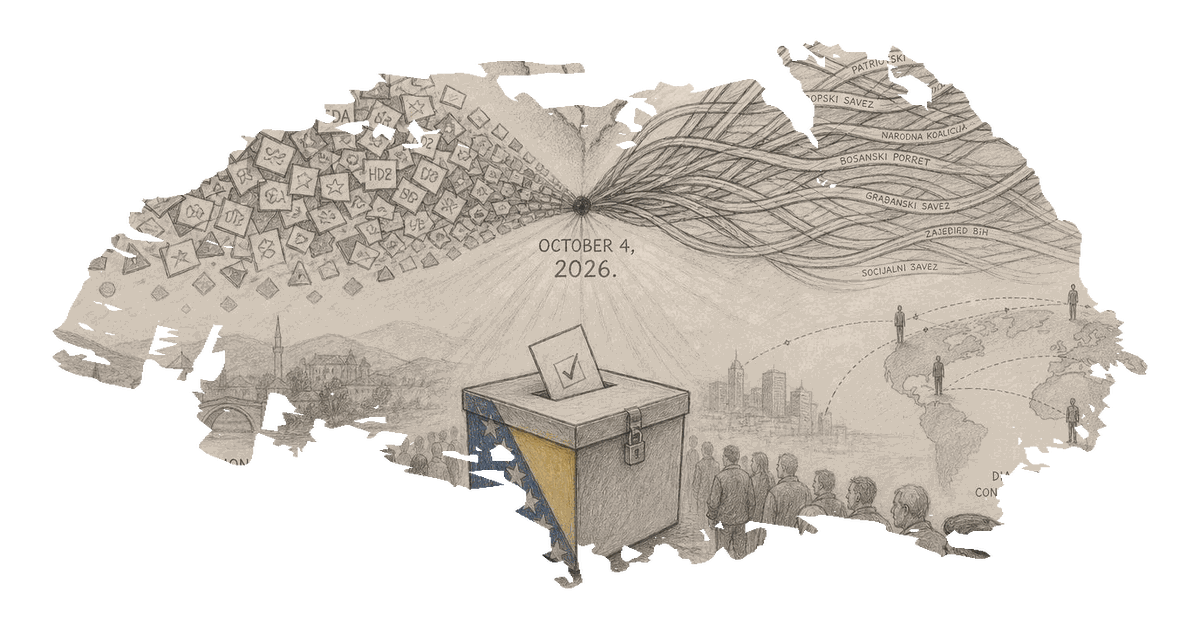
Bosnia and Herzegovina is gearing up for its tenth general elections, scheduled for October 4, 2026. This election cycle sees a substantial number of political entities vying for various governmental positions, reflecting the deeply fragmented nature of the country’s political landscape. A total of 75 political parties, 29 coalitions, and four independent candidates are set to compete for seats in the Presidency of Bosnia and Herzegovina, the House of Representatives of the Parliamentary Assembly of Bosnia and Herzegovina, the House of Representatives of the Federation of Bosnia and Herzegovina, the presidency and vice-presidencies of the Republika Srpska, the National Assembly of Republika Srpska, and the assemblies of the ten cantons in the Federation of Bosnia and Herzegovina.
The elections are taking place amid ongoing concerns about electoral integrity. Despite the introduction of modern electoral technologies aimed at reducing manipulation, the risk of vote-buying remains a significant challenge. The International Institute for Middle East and Balkan Studies (IFIMES) has highlighted these concerns, noting that vote-buying poses a serious threat to the integrity of the electoral process and the credibility of the results.
The voter registry includes 3,414,364 registered voters, with 48,074 of these registered to vote from abroad. This diaspora vote, while relatively small compared to the estimated two million people of Bosnian origin living outside the country, represents a crucial yet underutilized political resource. The Ministry for Human Rights and Refugees of Bosnia and Herzegovina reports that the diaspora includes 1,677,177 individuals born in Bosnia and Herzegovina, with the total number rising when accounting for second and third generations.
One of the notable candidates in this election is Slaven Kovačević, who is running for the Croatian seat in the Presidency of Bosnia and Herzegovina. His candidacy is seen as a test of whether political representation can transcend the traditional monopolies of exclusive national and nationalist structures. Attempts to undermine his political legitimacy based on religious affiliation or attitudes toward state symbols exemplify the dangerous politicization of identity within the country.
The elections are occurring at a critical time for Bosnia and Herzegovina, as the European Union has expressed expectations for concrete results in the country’s European integration process. In March 2024, the European Council gave the green light for opening negotiations and requested the European Commission to prepare a negotiation framework. However, without a stable parliamentary majority and functional executive power post-elections, implementing these reforms will be significantly challenging.
The IFIMES analysis suggests that the upcoming elections will not only be a test of the popularity of individual political parties and candidates but also a test of the Bosnian political system’s ability to produce a government capable of implementing necessary reforms and meeting European demands. The elections are seen as a measure of the country’s political maturity, institutional resilience, and European future. Should responsibility, the rule of law, and a European orientation prevail, the elections could mark the beginning of a new political phase. Conversely, if vote-buying, nepotism, ethnic blockades, and political recycling dominate, Bosnia and Herzegovina may face another term of stagnation.
The broader context of these elections is influenced by historical ethnic divisions that have long shaped electoral outcomes in Bosnia and Herzegovina. Previous elections have been marred by allegations of manipulation and irregularities, which have eroded public trust in the electoral process. The current political climate is further complicated by regional tensions, particularly with neighboring Serbia. Statements from Serbian officials and political figures have occasionally exacerbated these tensions, highlighting the complex interplay between domestic politics and regional stability.
In conclusion, the upcoming elections in Bosnia and Herzegovina are pivotal not only for the country’s internal political dynamics but also for its relationship with the European Union and neighboring countries. The outcome will have significant implications for the country’s ability to navigate its European integration path and address longstanding political challenges.



0 Comments