

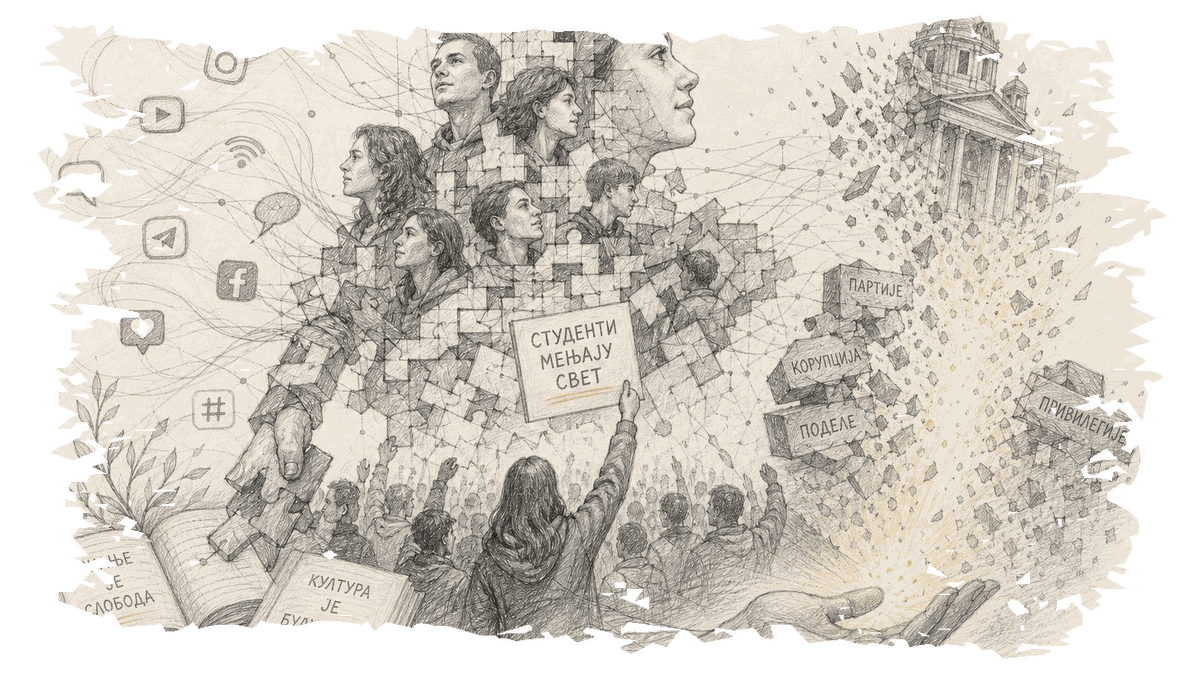
The Students’ List’s victory in the Serbian parliamentary elections on October 25, 2026, has been described as a cultural and political revolution by Barbi Marković, a Serbian author based in Vienna. In her commentary, Marković likens the movement to a ‘Borg’ collective, referencing the interconnected alien species from “Star Trek,” to illustrate the movement’s modern communication strategies and collective approach.
Marković’s reflections, published in a column for The Guardian, emphasize the transformative nature of the Students’ List, which she sees as a departure from previous fragmented student movements in Serbia. She notes the significant mobilization of students and the establishment of horizontal organizational structures, which differ from past protest movements that were more individualistic and less organized. According to Marković, the Students’ List has successfully utilized modern communication methods, such as social media, to engage and mobilize a broad base of support, bypassing traditional media channels that were perceived as biased.
The commentary highlights the cultural implications of the Students’ List’s victory, suggesting that it represents a shift away from the entrenched political practices of the previous regime led by Aleksandar Vučić. Marković describes the former government as a collection of “monsters” reminiscent of characters from the 1990s, whose influence has waned following the electoral defeat. She portrays the new movement as inclusive and collective, contrasting it with the more divisive and hierarchical structures of the past.
Marković’s analysis also touches on the broader social changes accompanying the political shift. She observes that the divisions that were significant during the 1990s, such as those between urban and rural areas or between cosmopolitan and nationalist ideologies, are no longer as relevant. The Students’ List’s approach, she argues, is more cohesive and focused on building a better society, welcoming all who wish to contribute.
Despite the optimism surrounding the Students’ List’s victory, Marković acknowledges the challenges that lie ahead. She notes that while the movement has succeeded in galvanizing support and creating a sense of euphoria, there are still unresolved issues, such as addressing the legacy of the 1990s wars. She expresses hope that these matters will be addressed in a new parliamentary setting and under a different political atmosphere.
The commentary underscores the significance of the Students’ List’s victory as more than just a political change; it is seen as a cultural revolution that has redefined how political movements can operate in Serbia. Marković’s reflections provide insight into the potential for positive change and the challenges of maintaining momentum in a rapidly evolving political landscape.



0 Comments