

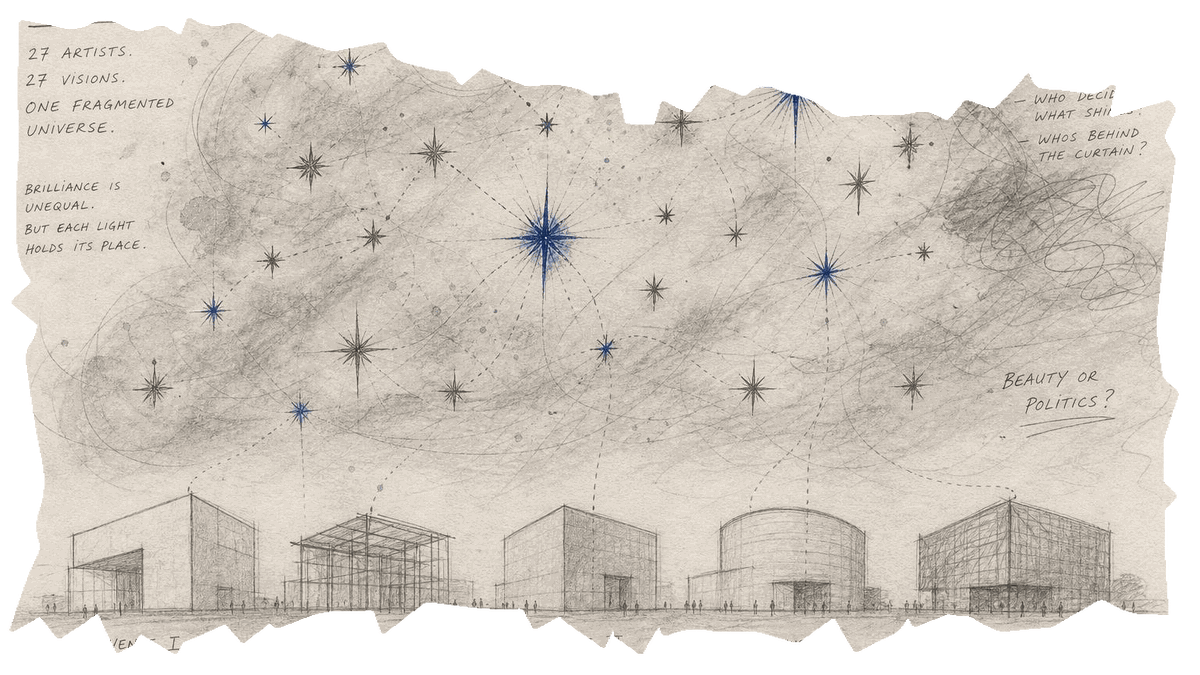
The 61st Oktobarski Salon, a major art exhibition in Serbia, opened in Belgrade on November 7, 2026, amid controversy and criticism over its reduced scale and transparency issues. This year’s edition, titled “Slučajnost Univerzuma” (The Coincidence of the Universe), features works from only 27 artists, a significant decrease from previous years. The exhibition will be held across five venues in the city and will run until December 13, 2026.
The salon’s reduced number of participants has sparked concerns about the event’s scale and quality. In previous editions, such as the 60th Oktobarski Salon, 40 artists exhibited their work across nine galleries. This year, the selection process, led by French curator Numa Hambursin, has been a point of contention. Hambursin, who is also the director of MO.CO. Montpellier Contemporain, aimed to balance the representation of Serbian and international artists. However, several notable Serbian artists, including Ana Knežević, Nikola Marković, Marija Šević, and Damjan Kovačević, publicly declined to participate, citing inequities in working conditions and a lack of transparency regarding artist fees.
The exhibition’s theme and the selection process have prompted discussions about the direction of contemporary Serbian art. Hambursin’s curatorial approach emphasized beauty and sublimity, concepts he argues have been historically integral to art but are often excluded from contemporary creativity. Each of the five exhibition spaces in Belgrade hosts a thematic show, with contributions from artists of diverse backgrounds. For instance, the Gallery of the Belgrade Youth Center features works by artists of Yugoslav origin now residing in France, while the Cultural Center of Belgrade presents a display inspired by an artist’s travels through Iraq.
Despite the controversies, the Oktobarski Salon remains a significant cultural event in Serbia, organized by the City Assembly of Belgrade. However, the announcement of this year’s salon was made just a day before its opening, leading to speculation about the event’s organization and transparency. The lack of detailed information about the opening ceremony and the program has further fueled public criticism.
The participation of only eight Serbian artists, including contemporary figures and legendary names like Veljko Vučković and Vladimir Milivojević Boogie, has also been a topic of discussion. The inclusion of historical works by artists such as Vladimir Veličković and Dado Đurić adds a broader historical context to the exhibition.
As the Oktobarski Salon unfolds, the art community and the public are left to ponder its implications for the future of Serbian art and cultural events. The reduced scale and the controversies surrounding artist participation may influence the reception of the exhibition, raising questions about the management and future direction of one of Serbia’s most prominent art festivals.

0 Comments