

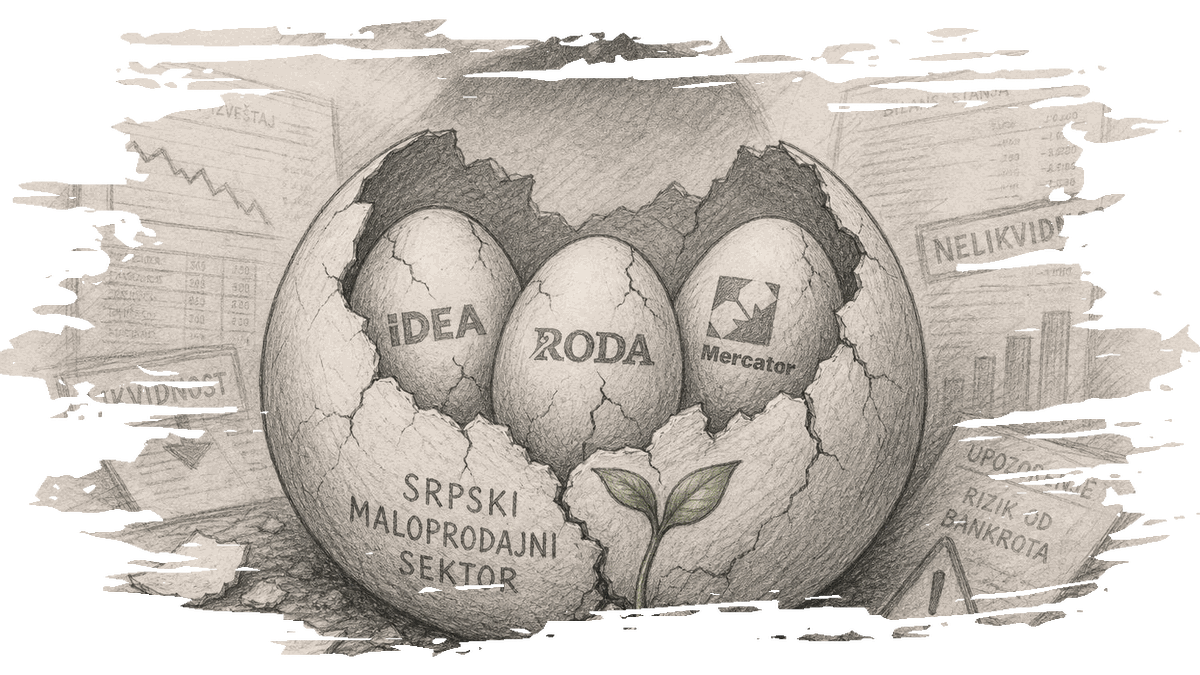
The bankruptcy of Alta Bank, declared on November 3, 2026, is casting a shadow over the financial stability of major Serbian retail chains, including Idea, Roda, and Merkator. These chains, acquired by Alta Retail shortly before the bank’s collapse, are now facing severe financial challenges that could impact thousands of jobs. Idea markets, in particular, reported a net loss of approximately 4.05 billion dinars (around 34.5 million euros) in 2025, exacerbating concerns about their financial health.
Experts warn that the financial ties between these retail chains and Alta Bank could lead to significant liquidity issues. If these companies were reliant on Alta Bank for banking operations, the collapse could affect their ability to pay suppliers and employees. Dejan Gavrilović from the consumer association “Efektiva” noted that the activation of payment claims by suppliers could further strain liquidity, potentially affecting the payment of debts and salaries.
Despite the dire financial situation, experts suggest that the bankruptcy of Alta Bank does not automatically spell the end for the retail chains. Ivana Matić, a former acting director of the Agency for Licensing Bankruptcy Trustees, explained that these are separate legal entities, and the retail chains can continue to operate independently. However, the origin of the funds used for the acquisition of these chains remains a critical concern. If it is determined that the acquisition was financed through a loan from Alta Bank, and if any irregularities are found, the assets could be seized.
The situation presents three potential scenarios for the future of these retail chains: resale, forced administration, or partial sale, depending on their financial connections to Alta Bank. The uncertainty surrounding these scenarios highlights the precarious position of the retail sector in Serbia, with the potential for significant job losses if the chains cannot stabilize their financial footing.
The acquisition of Idea, Roda, and Merkator by Alta Retail was initially seen as a major business success. However, the subsequent financial collapse of Alta Bank has overshadowed this achievement, raising questions about the sustainability of the retail chains’ operations. The decline in profitability and revenue at Idea markets, which saw a 14 percent drop in business income from 2024 to 2025, further underscores the challenges faced by these companies.
The potential impact on suppliers is also a significant concern. Fortenova, the previous owner of the retail chains, confirmed that it has no ongoing business relations with Alta Bank and is unaware of any financial involvement in Alta Retail’s acquisition. Nonetheless, the retail chains’ importance to suppliers, particularly Croatian companies like Podravka and Atlantic Grupa, underscores the broader economic implications of the situation.
In response to the crisis, Idea Marketi issued a statement aiming to reassure stakeholders, emphasizing their commitment to maintaining stable operations and protecting jobs. The company employs over 6,500 people and is focused on safeguarding the interests of its employees and their families.
As the situation unfolds, the retail sector in Serbia faces a critical juncture. The outcome will depend on the resolution of financial uncertainties and the ability of the retail chains to navigate the challenges posed by the bankruptcy of Alta Bank. The developments are being closely monitored by industry experts and stakeholders, who are keenly aware of the potential ramifications for the Serbian economy.


0 Comments