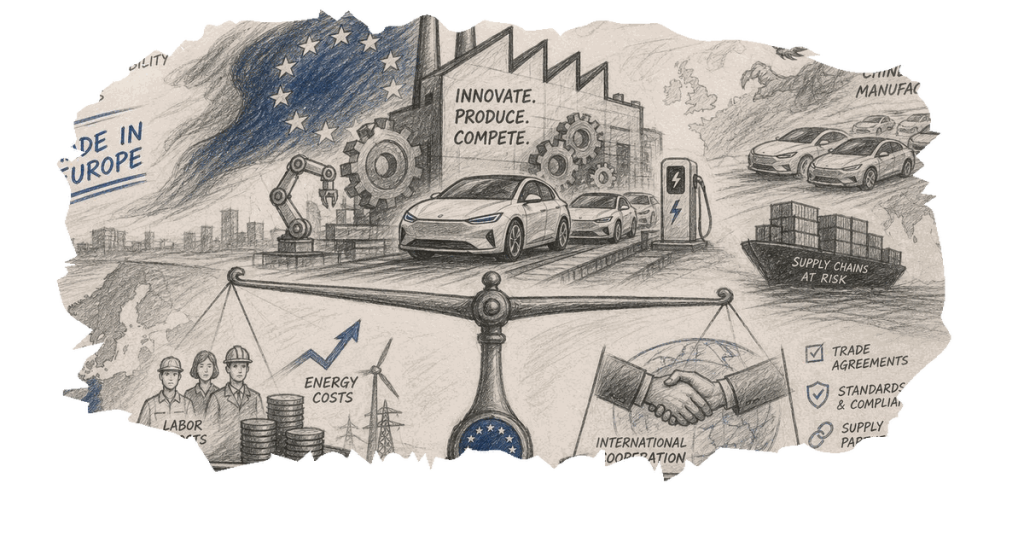
Renault, Volkswagen, and Stellantis are urging the European Union to introduce “Made in Europe” incentives to support local vehicle production amid growing competition from Chinese electric vehicle (EV) manufacturers. The automakers want EU policymakers to prioritize vehicles developed and produced within Europe. This initiative aims to bolster Europe’s automotive industry by encouraging not just car assembly but also the engineering, research, and product development essential to the sector.
This proposal is part of a broader European effort to revitalize industrial competitiveness while transitioning to electric vehicles. The automakers argue that European manufacturers contend with higher labor and energy costs compared to regions like China. They seek incentives for EVs made in Europe to level the playing field.
However, not all international carmakers back these measures. Some are concerned that a strict definition of European content might exclude key suppliers and technology partners from countries such as Japan, the United Kingdom, and Turkey. Critics warn that tighter sourcing requirements could increase compliance costs, potentially raising vehicle prices for consumers.
Battery production remains a significant challenge in this strategy. European manufacturers still rely heavily on supply chains dominated by Chinese companies. Industry leaders advocate for a gradual timeline to develop battery manufacturing capacity within Europe due to its complexity.
This debate reflects a broader shift in the global automotive industry. Chinese carmakers have rapidly expanded internationally, supported by strong domestic scale, advanced battery supply chains, and competitive technology. Meanwhile, European manufacturers face slowing EV demand and rising production costs. As Chinese brands gain market share, Brussels policymakers weigh free trade principles against concerns about industrial competitiveness and economic security.
The call for “Made in Europe” incentives comes at a crucial time for Europe’s automotive sector. With the global market for electric vehicles expanding, competition has intensified, particularly from Chinese manufacturers leveraging domestic advantages. The proposal aims to keep Europe competitive globally by fostering a robust local manufacturing base.
The EU’s response will be pivotal in shaping Europe’s automotive industry’s future. Implementing these incentives could significantly restructure the automotive supply chain within Europe, reducing reliance on external suppliers and boosting industrial autonomy. However, potential trade-offs like higher vehicle costs and possible trade tensions with non-EU countries must be considered.
In conclusion, leading automakers’ push for “Made in Europe” incentives highlights both challenges and opportunities as Europe’s automotive industry transitions to electric vehicles.