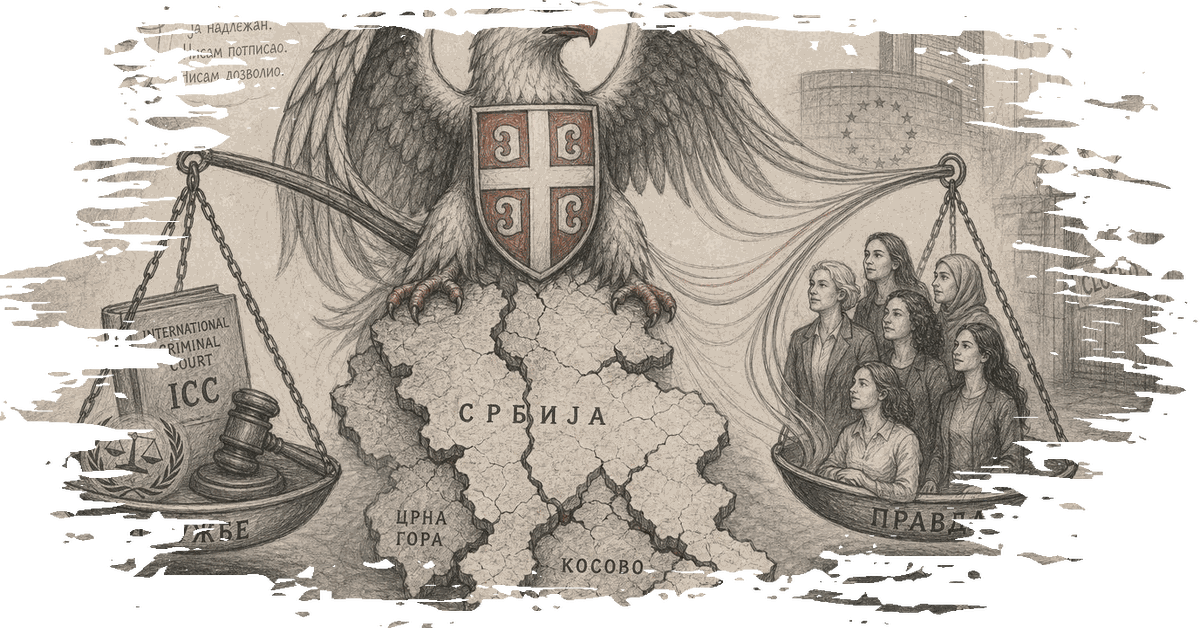
Ursula von der Leyen’s planned visit to Serbia is facing uncertainty due to escalating political and social tensions in the country, heightened by the recent glorification of Ratko Mladić following his death. The European Commission President’s trip is part of her customary October tour of the Western Balkans, but the situation in Serbia has raised questions about whether the visit will proceed as planned.
The controversy surrounding Mladić, who was convicted of war crimes and genocide, has intensified since his death, with public displays of admiration and plans for a mass funeral. This has drawn sharp criticism from the European Union, which reportedly pressured Serbian authorities to refrain from organizing a state funeral. The potential visit by von der Leyen is seen as politically sensitive, given these developments.

Marta Kos, the European Commissioner for Enlargement, canceled her own visit to Serbia, citing the glorification of Mladić as incompatible with EU values. Her decision has further complicated the situation, as it underscores the EU’s disapproval of Serbia’s handling of Mladić’s legacy. Kos’s cancellation came eight days after Mladić’s death, at a time when public displays of support for him were increasing and discussions of a state funeral were underway.
The political climate in Serbia is further complicated by the possibility of early elections, which could pose a significant challenge to President Aleksandar Vučić’s administration. Political analyst Tobi Vogel from the Council for Democratization Policy suggests that von der Leyen should avoid visiting Belgrade at this time, as it could be interpreted as EU support for Vučić during the electoral process. Vogel argues that such a visit could alienate student-led protestors and others opposing the current government, thereby damaging the EU’s credibility in the region.
Vladimir Prebilič, a Member of the European Parliament, also questioned the justification for von der Leyen’s visit, warning that it could create the impression of normal relations with the Serbian government despite ongoing state repression. He emphasized that allowing Vučić to be photographed with high-ranking EU officials amid these tensions would misrepresent the situation and further undermine the EU’s standing in Serbia and the broader region.
The decision by Marta Kos to cancel her visit has raised questions about the timing and principles behind her actions. Her statement highlighted that the glorification of Mladić is incompatible with the values underpinning the EU’s path, which requires confronting the past, genuine reconciliation, and respect for the victims of war crimes. Kos’s stance reflects a broader EU expectation for Serbia to align more closely with European values as it seeks integration into the EU.
The uncertainty surrounding von der Leyen’s visit reflects the complex political landscape in Serbia, where historical issues and current political dynamics intersect. The potential for early elections adds another layer of complexity, as it could influence both domestic politics and Serbia’s relations with the EU. The situation remains fluid, with the possibility that von der Leyen might skip Serbia altogether, potentially impacting her entire Balkan tour.
As the situation develops, the EU’s response to Serbia’s handling of Mladić’s legacy and the broader political context will likely continue to shape relations between Brussels and Belgrade. The outcome of these diplomatic maneuvers could have significant implications for Serbia’s EU aspirations and the region’s political stability.