During his visit to Dublin, United States President Donald Trump made remarks supporting the idea of a unified Ireland, describing it as “fantastic.” His comments have stirred political tensions between the United Kingdom and Ireland, particularly as they come in the wake of British Prime Minister Andy Burnham’s recent statement that a referendum on Northern Ireland leaving the UK is “off the table” due to a lack of popular support. Trump’s remarks were made while he was seated next to Ireland’s Prime Minister, Micheal Martin, who chose not to comment on the issue.
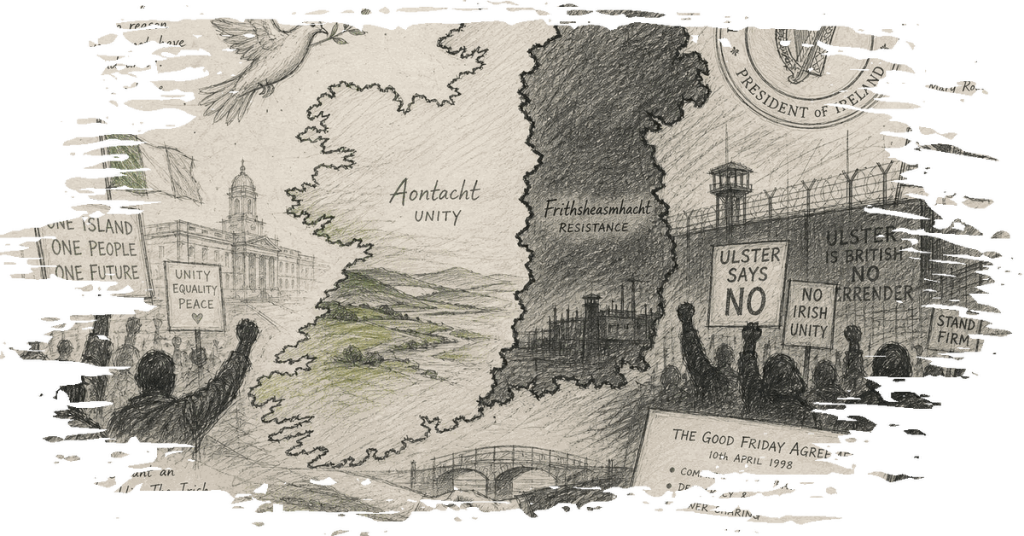
The topic of Irish unification has long been a sensitive issue, rooted in the historical context of the 1998 Good Friday Agreement, which allows for a referendum on Northern Ireland’s status only at the discretion of the British government. This agreement marked the end of The Troubles, a three-decade-long sectarian conflict involving Catholic nationalists, who sought a united Ireland, and Protestant unionists, who wanted to remain part of the UK.

Following Trump’s comments, a spokesperson for Prime Minister Burnham reiterated that his position on Irish unification remains unchanged. Burnham emphasized that he is not aware of majority public support for another referendum on Northern Ireland’s status, and until that changes, no such referendum will be held. The Democratic Unionist Party (DUP), Northern Ireland’s main unionist party, also responded, with leader Gavin Robinson stating that Northern Ireland’s future should be decided by its people, not by external commentary.
Despite Trump’s assertion that a unified Ireland is “going to happen eventually,” public sentiment in Northern Ireland currently shows a comfortable majority favoring remaining in the UK. However, this majority has slightly narrowed since Britain’s exit from the European Union, which has brought the issue of unity higher up the political agenda.
Trump’s visit to Ireland has not been without controversy. Anti-war and anti-Trump protests have taken place in Dublin, with demonstrators expressing a range of grievances against the US president. Many Irish citizens have voiced their disapproval of Trump’s visit, citing his role in global instability and his administration’s policies regarding the Middle East and Israel. The protests highlight the complex relationship between Ireland and the United States, as well as the broader international implications of Trump’s statements on Irish unification.
Irish President Catherine Connolly, known for her left-wing foreign policy views, also met with Trump during his visit. Connolly has previously been critical of US foreign policy, and during Trump’s last visit to Ireland in 2019, she protested at Shannon Airport. This time, some supporters urged her to speak out against US military actions and to advocate for Ireland’s neutrality.
The political ramifications of Trump’s comments on Irish unification are significant, as they touch on longstanding issues of national identity and sovereignty. While Trump’s remarks may not lead to immediate changes in the political landscape, they have certainly added a new dimension to the ongoing discussions about the future of Northern Ireland and its relationship with both the UK and the Republic of Ireland.