

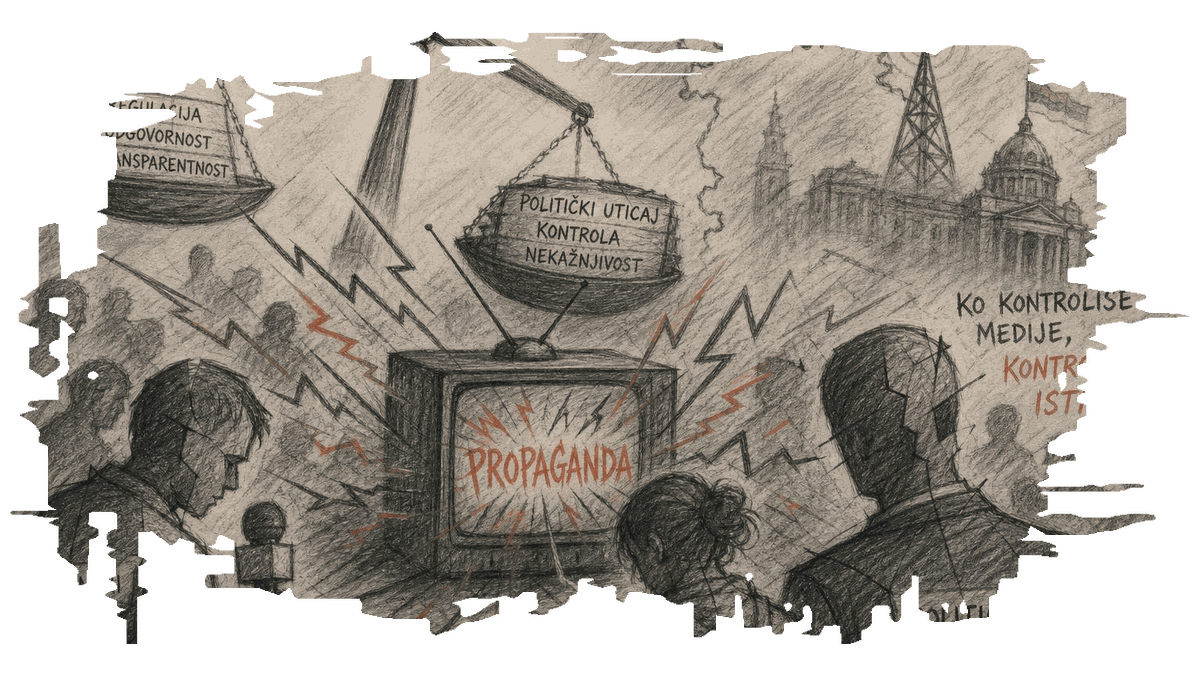
The Regulatory Body for Electronic Media (REM) in Serbia is under pressure to take action against television stations that have broadcast propaganda films targeting journalists, students, and opposition politicians. These films, produced by the Center for Social Stability, have been criticized for spreading hate and misinformation, depicting specific journalists and political figures negatively. Legal actions have been initiated against the Center for Social Stability for defamation and incitement, with calls for accountability extending to the television stations involved.
Rade Đurić of the Independent Journalists’ Association of Serbia (NUNS) has confirmed that criminal complaints have been filed against those responsible for these films, which have been aired on prominent Serbian channels such as Pink, Prva, B92, K1, Hepi, and Informer. These films have been accused of endangering the safety of individuals by targeting them in a manner that incites public hostility. Đurić emphasized the need for accountability, stating that all parties involved in these violations must face legal consequences.
The Center for Social Stability, established in 2012, has been known for producing content that aligns with the interests of the ruling party. Their films, including titles like “(De)blokada,” “Zlo doba,” “Vreme terora,” and “Dosije Vojvodina,” have portrayed journalists and political opponents as threats to state interests. Notable figures targeted in these films include journalists Goran Dimitrijević, Slobodan Georgiev, Jelena Obućina, and opposition politicians Miloš Jovanović and Dragan Đilas. The films have also depicted student protests as attempts to destabilize Serbia.
The legal proceedings against the Center for Social Stability have already seen some developments. In January 2026, the Basic Court in Novi Sad ruled that the Center had damaged the reputation of media outlets N1 and Nova S. Furthermore, a temporary measure was issued in June 2025, prohibiting the Center from using derogatory content against journalists in their productions.
The effectiveness of REM’s response remains uncertain, as the regulatory body is reportedly overwhelmed with numerous cases. There is ongoing scrutiny over how these legal actions will impact the production and airing of such propaganda films in the future. The public’s reaction has been one of concern, with many advocating for stricter enforcement of media regulations to prevent the spread of misinformation and protect the integrity of independent journalism in Serbia.
Slobodan Georgiev, director of news at TV Nova, expressed his concerns about the impact of these films, recalling past instances where similar content led to serious consequences, such as the case involving Oliver Ivanović in 2017. Georgiev highlighted the potential dangers these films pose by inciting public hostility against targeted individuals.
The situation underscores the broader issues of media freedom and regulatory accountability in Serbia. As the legal and regulatory processes unfold, the focus remains on ensuring that media outlets adhere to principles of truthful and objective reporting, while safeguarding the rights and dignity of individuals. The outcome of these proceedings could set a precedent for how propaganda content is managed and regulated in the country.

0 Comments