

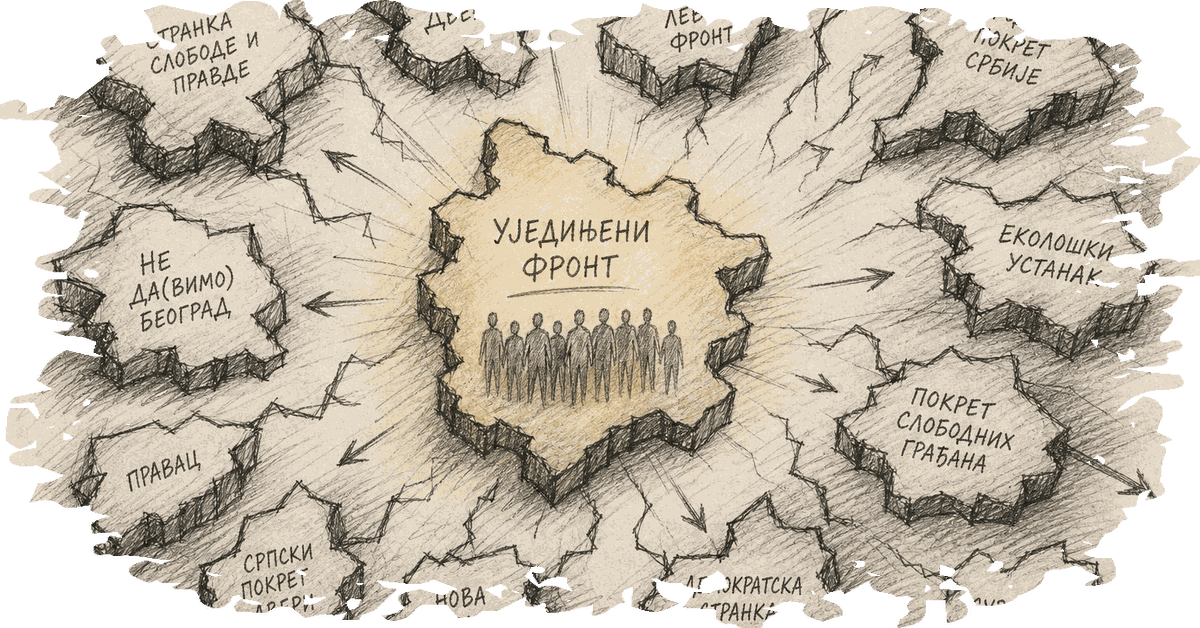
Bojan Pajtić, a professor at the University of Novi Sad, has issued a stark warning to Serbia’s opposition parties, emphasizing the necessity of uniting under a single electoral banner to avoid failure in the upcoming elections. His comments come in response to news of a lack of pre-election cooperation between the Freedom and Justice Party (SSP) and Miki Aleksić’s party. Pajtić took to the social media platform X to convey his message, stating that opposition parties that do not support the Students’ List and choose to run separately risk not surpassing the electoral threshold.
Pajtić highlighted that even if current polls show some opposition parties garnering around 5% of the vote, the dynamics on election day could shift significantly. He noted that a substantial number of voters, who currently remain undecided due to fear of reprisal, are likely anti-Vučić supporters. He drew parallels with historical instances, such as the 2000 elections in Serbia and recent events in Hungary, where fragmented opposition efforts led to failure against authoritarian regimes nearing their end.

The professor stressed that the opposition’s inability to reach a consensus on a unified electoral approach has already cost them some voter support. As the election day approaches, he anticipates a heightened “referendum-like” atmosphere, with anti-regime voters consolidating their support behind the strongest opposition entity, the Students’ List. Pajtić implored his fellow opposition members, stating, “You do not have the right to waste any votes, let alone a percentage, and leave Vučić in power. You do not have the right to go in more than one column.”
His remarks underscore the critical juncture at which Serbia’s opposition finds itself. Despite having the legal right to contest elections independently, Pajtić argues that they lack the moral and political justification to gamble with the country’s future. He advocates for a singular, united front as the only viable strategy to challenge the ruling regime effectively.
The backdrop to Pajtić’s plea is the recent announcement by Dragan Đilas, leader of the SSP, confirming that Miroslav Aleksić, president of the People’s Movement of Serbia (NPS), has decided against forming a coalition. This decision has led to the formation of two distinct opposition blocs: one led by the SSP and its allies, and another by the NPS and its partners. The division reflects a longstanding strategic disagreement, with Đilas advocating for a pro-European coalition and Aleksić favoring a broader opposition list.
This fragmentation poses a significant risk to both blocs, as separate campaigns could reduce their visibility compared to the Students’ List and President Aleksandar Vučić’s list. Despite some polls suggesting that Aleksić’s bloc could secure around 5.6% of the vote and Đilas’s bloc 4.2%, the potential for both to fall short of the electoral threshold remains a concern.
Miroslav Aleksić has also acknowledged the challenges facing the opposition, stating that defeating Vučić’s regime and forming a new government is impossible without a united opposition. He emphasized that the current political climate in Serbia, marked by autocratic tendencies, necessitates a robust electoral strategy and high voter turnout to counter electoral manipulation.
The opposition’s path forward remains fraught with uncertainty. While Pajtić’s call for unity is clear, the practicalities of merging diverse political agendas and overcoming personal rivalries present formidable obstacles. The outcome of these strategic decisions will likely have significant implications for Serbia’s political landscape and the opposition’s ability to challenge the ruling party’s dominance effectively.

0 Comments