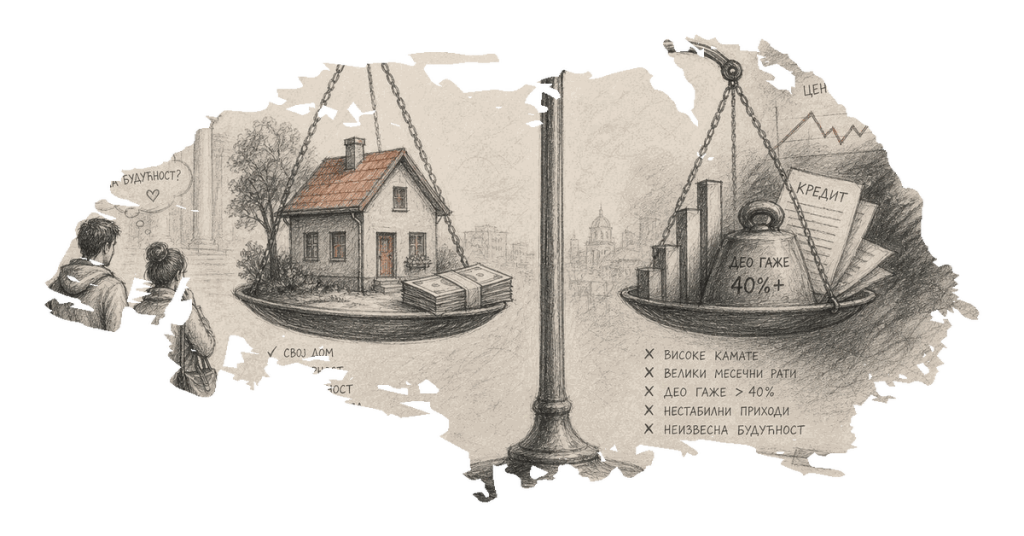
In Serbia, the financial implications of obtaining a housing loan are closely tied to salary levels, with banks enforcing strict debt-to-income ratios. For individuals earning a monthly salary of 100,000 dinars, it is feasible to secure a housing loan of approximately 80,000 euros without breaching the allowed debt-to-income ratio. This calculation is based on the requirement that total monthly debt obligations should not exceed 50-60% of monthly income, a standard applied by most banks in Serbia.
For those contemplating a housing loan of 80,000 euros, the monthly payment typically ranges between 55,000 and 65,000 dinars. Consequently, a minimum salary of 90,000 dinars is necessary if the borrower has no other outstanding debts. This scenario underscores the challenges faced by potential homebuyers in Serbia, where salary levels significantly influence loan accessibility.

The banking sector’s approach to calculating loan eligibility often involves deducting the value of an average consumer basket from the salary, further reducing the amount available for loan repayments. This practice highlights the stringent financial assessments conducted by banks to ensure borrowers do not exceed their financial capacity.
For a housing loan to be considered manageable under the maximum allowed debt load, a borrower with a salary of 100,000 dinars can expect a monthly loan installment of about 46,500 dinars, assuming a 30-year repayment period and an interest rate of approximately 4.35%. This arrangement comfortably fits within the bank’s requirements, as the monthly installment does not surpass 50% of the borrower’s income.
However, existing financial obligations such as overdrafts and credit card limits can significantly impact the loan amount a borrower can secure. Banks consider these as fixed monthly obligations, even if they are not actively utilized. For instance, an authorized overdraft and credit card limit of 80,000 dinars each would be treated as a monthly debt of 8,000 dinars, reducing the amount available for housing loan repayments.
The requirement for a down payment, typically 20% of the property’s value, is another crucial factor in the loan process. However, a new government program allows young first-time homebuyers to make a down payment as low as 1% of the property’s value, easing the financial burden for this demographic. For other first-time buyers, banks may offer a reduced down payment requirement of 10%.
These financial parameters reflect the broader economic landscape in Serbia, where salary levels and regional disparities play a significant role in determining purchasing power and loan accessibility. The average salary in Serbia has experienced fluctuations, with notable differences between regions affecting the affordability of housing loans.
The current banking policies and economic conditions in Serbia present both challenges and opportunities for potential homebuyers. While stringent debt-to-income ratios ensure financial stability for borrowers, they also limit the ability of many individuals to secure adequate housing loans. Future changes in banking policies or economic conditions could further influence loan accessibility and affordability, impacting the housing market dynamics in Serbia.