

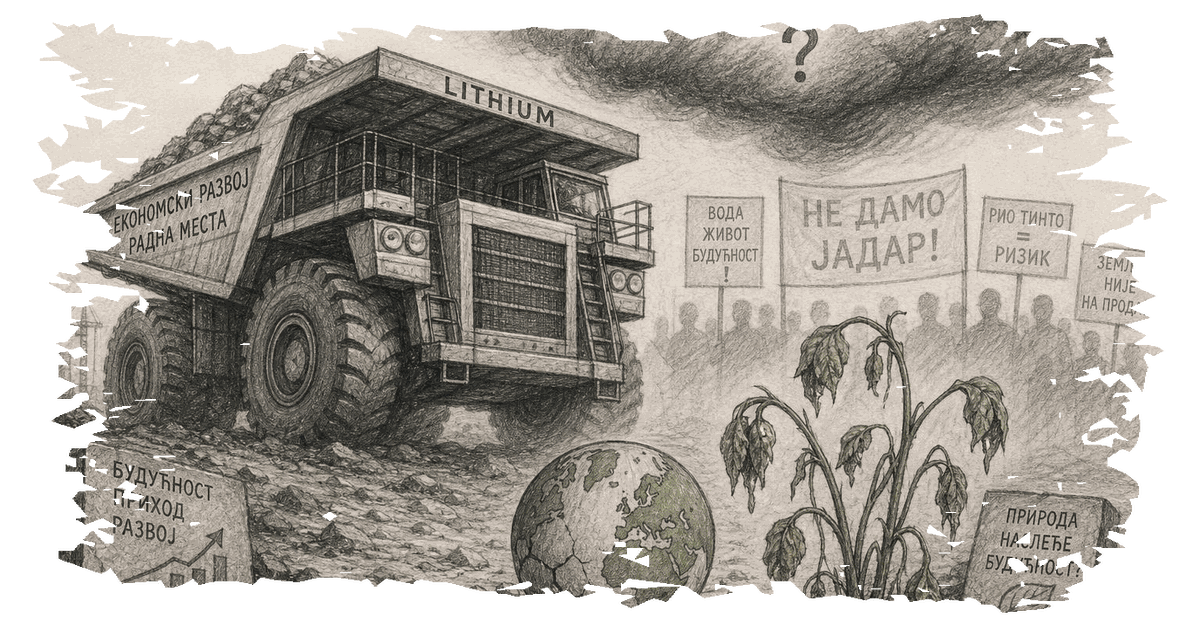
President Aleksandar Vučić of Serbia recently addressed the nation in a televised broadcast, focusing on the contentious issue of lithium mining in the country, particularly the involvement of the multinational corporation Rio Tinto. Vučić defended the potential benefits of lithium mining for Serbia, asserting that it could significantly enhance the national economy. However, he also emphasized that any decision regarding the mining project would be postponed until the completion of a year-long environmental impact study.
During his address, Vučić criticized opposition leader Dragan Đilas, labeling him a “thief” and accusing his previous administration of attempting to transform Serbia into a “lithium valley” a decade ago. Vučić’s remarks were part of a broader narrative in which he accused environmental activists opposing the mining project of being foreign-paid agents. He claimed that these activists were orchestrating road blockades to drive out Rio Tinto and potentially bring in another Western company to exploit Serbia’s lithium resources.
Vučić’s statements come amid ongoing tensions and protests against the Rio Tinto project, which have been significant in Serbia. Environmental activists and local communities have expressed concerns about the potential ecological damage and the impact on their livelihoods. The president’s allegations of foreign influence in these protests have not been independently verified.
In his speech, Vučić assured that the police would not intervene in the protests unless there was a threat to lives or property. He advised protesters against blocking roads and suggested that the public had grown weary of such demonstrations. Vučić also indicated that he would personally visit communities near the proposed mining sites to discuss the project and address any concerns about environmental harm.
The president’s address was broadcast on several national television channels, including RTS, Prva, Happy, and Pink. During the broadcast, Pink TV displayed a chyron referencing police actions in the United Kingdom against demonstrators, seemingly to highlight the restraint shown by Serbian police.
Vučić’s defense of the Rio Tinto project included claims about the economic potential of lithium mining, suggesting that it could lead to Serbia becoming a significant player in the production of batteries and electric vehicles, with projected revenues of 10.3 billion euros annually. However, details about the financial aspects of the project were not entirely clear in his presentation.
The ongoing debate over lithium mining reflects broader political dynamics in Serbia, where accusations of corruption and foreign interference have been prevalent. Vučić’s framing of the issue appears to be part of a strategy to galvanize support ahead of upcoming elections, positioning himself as a defender of national interests against foreign and opposition influences.
As the situation develops, the outcome of the environmental impact study and the government’s subsequent decisions will be crucial in determining the future of lithium mining in Serbia. The controversy highlights the complex interplay between economic development and environmental protection, with significant implications for Serbia’s political landscape and its relationship with international stakeholders.

0 Comments