

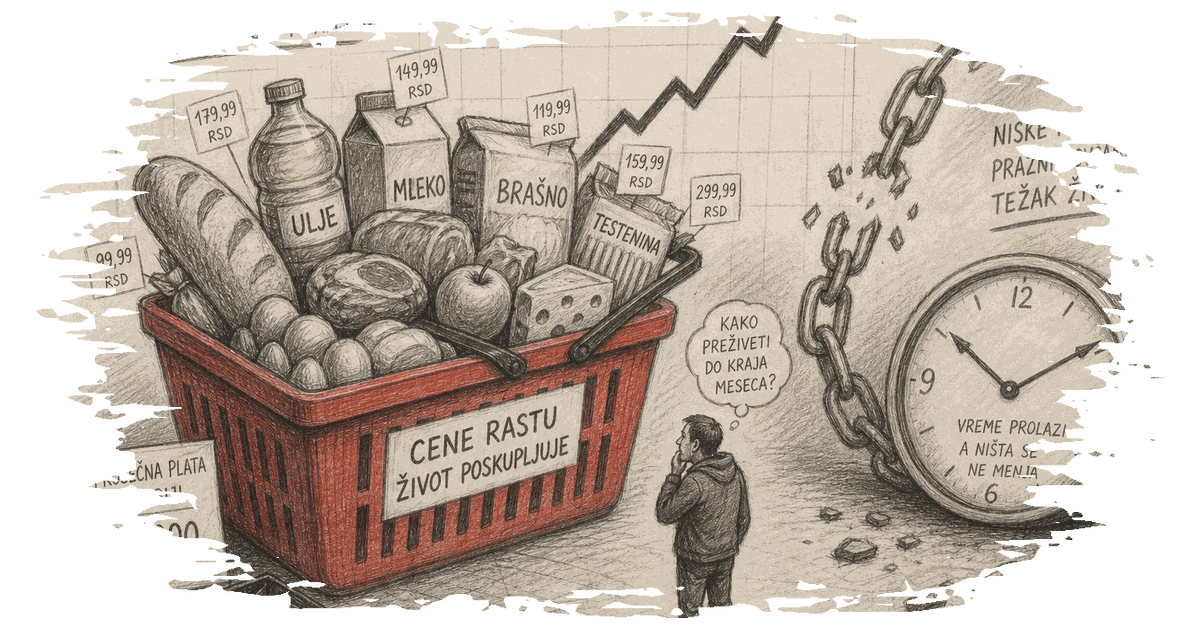
Food prices in Serbia have surged to 96.6% of the European Union average, while the average income in the country remains less than half of the EU average, according to a recent study by the Fiscal Council. This disparity highlights a growing economic challenge for Serbian households, as the cost of essential goods outpaces income growth. The study, titled “Serbia’s Agriculture Between Stagnation and Reform: Production, Prices, and Agricultural Policy,” reveals that food prices in Serbia are increasing more rapidly than those of other consumer goods.
The Fiscal Council’s analysis places Serbia’s food prices among the highest in Central and Eastern Europe, surpassing those in 11 countries, including Bulgaria and Romania. In these neighboring countries, food prices hover around 92% of the EU average, whereas Serbia’s are even higher. This situation is particularly striking given that Bulgaria and Romania are economically less developed EU members, yet their food prices remain lower than Serbia’s.
The report underscores a phenomenon often observed in less developed countries, where prices can catch up with those in more developed nations faster than incomes do. In 2024, the overall price level for personal consumption goods and services in Serbia was about 60% of the EU average, higher than Romania’s 55.1% and Bulgaria’s 55.7%. However, when it comes to income, Serbia fares worse, with average earnings not even reaching half of the EU average. The average income in Serbia is about 15 percentage points lower than in Bulgaria, the EU’s least economically developed member state.
Food and non-alcoholic beverages account for approximately one-third of the average consumer basket in Serbia, meaning that high food prices have direct social consequences. The Fiscal Council’s study points out that in six out of ten food categories, prices in Serbia exceed the EU average. The most significant deviation is seen in oils and fats, which are about 20% above the EU average, followed by sugar, jams, and sweets, which are 15% higher. Processed foods, dairy products, and meat products are also about 8% more expensive compared to the EU average.
Despite these high prices, some food categories in Serbia remain cheaper than in the EU. Vegetables are priced at about 90% of the EU average, while cereals, fruits, and meat are around 85%. However, there is a trend toward convergence with EU prices, as seen in the case of meat, whose price rose from 81.5% of the EU average in 2022 to 88.5% in 2024.
The Fiscal Council identifies several reasons why food prices in Serbia should theoretically be lower, considering the country’s level of development. Serbia, traditionally a net exporter of agricultural and food products, produces more than its domestic market requires. Economic logic would suggest that this surplus should exert downward pressure on prices. Additionally, Serbia has high state subsidies for agriculture, amounting to about 1% of GDP in recent years. However, these investments have not translated into higher productivity, a more stable supply, or reduced price pressures.
The report also highlights that the issue of high food prices begins at the production level. Producer prices in Serbia have reached 87% of the EU average, indicating that price pressures arise early in the supply chain. The Fiscal Council suggests that lower operational costs and substantial fiscal incentives should make domestic raw materials cheaper. Nevertheless, the comparison of producer and retail prices reveals that agriculture is not the sole factor responsible for high prices. Retail food prices from 2022 to 2024 were nearly 95% of the EU average, raising questions about the roles of processing, distribution, and trade margins, as well as low productivity and market concentration in certain segments.
The rapid increase in producer prices is attributed to global disruptions in agricultural inputs during 2021 and 2022. Between 2015 and 2017, primary production prices were about 72% of the EU average. This figure surged to nearly 96% in 2022, with an average of 87% from 2022 to 2024, coinciding with global market disruptions.
The rising food prices in Serbia, coupled with stagnant incomes, pose significant challenges for the average household. The Fiscal Council’s study suggests that addressing these issues requires a comprehensive approach, including improving agricultural productivity and market efficiency, to mitigate the economic impact on Serbian citizens.


0 Comments