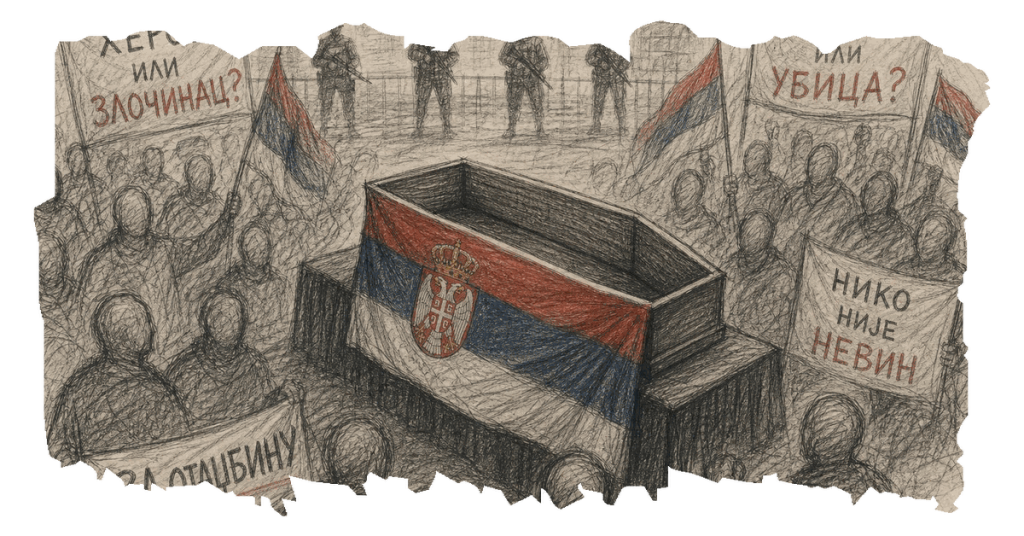
The body of Ratko Mladić, the former Bosnian Serb Army commander convicted of genocide and war crimes, has been returned to Serbia following his death in prison in The Hague. Mladić, who was serving a life sentence for his role in the Srebrenica massacre and other wartime atrocities, will be buried in Belgrade on September 7. The funeral is expected to be attended by large crowds, with state honors anticipated, although President Aleksandar Vučić has stated that the final decision on the nature of the honors will rest with Mladić’s family.
The return of Mladić’s body to Serbia has already sparked public gatherings along the route from the airport to the Military Medical Academy, where his body was taken for an autopsy. Supporters, some holding banners with messages such as “Thank you, General” and “Heroes never die,” have been present, reflecting the divisive nature of Mladić’s legacy in Serbia. Pro-government media have closely followed the developments, often portraying Mladić as a national hero and alleging that he was “murdered in The Hague.”

Security measures are being heightened in anticipation of the funeral, with President Vučić noting that tens of thousands of people are expected to attend. “We will be there to provide all kinds of logistical and transport support and to maintain public peace and safety,” Vučić stated, acknowledging the challenges in ensuring security for such a large gathering.
The international community has reacted to the planned state honors for Mladić, with European Union Enlargement Commissioner Marta Kos warning that glorifying war criminals is contrary to European values. This sentiment underscores the ongoing tension between Serbia’s domestic narratives and its aspirations for European integration.
Jasmina Lazović, executive director of the Humanitarian Law Center, expressed that the glorification of Mladić has been a longstanding issue in Serbia, with murals and public sentiment often portraying him as unjustly convicted. Lazović highlighted the lack of space in media, education, and judicial institutions for discussing the consequences of the wars in the former Yugoslavia and the victims left in their wake.
The funeral is expected to draw significant attention not only from the public but also from political figures. Milorad Dodik, leader of the Alliance of Independent Social Democrats, has announced his attendance, emphasizing the contentious nature of public discourse surrounding Mladić’s legacy. He compared the treatment of Mladić to that of other convicted war criminals, suggesting a double standard in international justice.
As Serbia prepares for the funeral, the event serves as a focal point for the ongoing debate over the country’s wartime past and its implications for present-day politics and society. The security measures and public reactions will be closely watched, as they may influence Serbia’s internal and external political dynamics.