

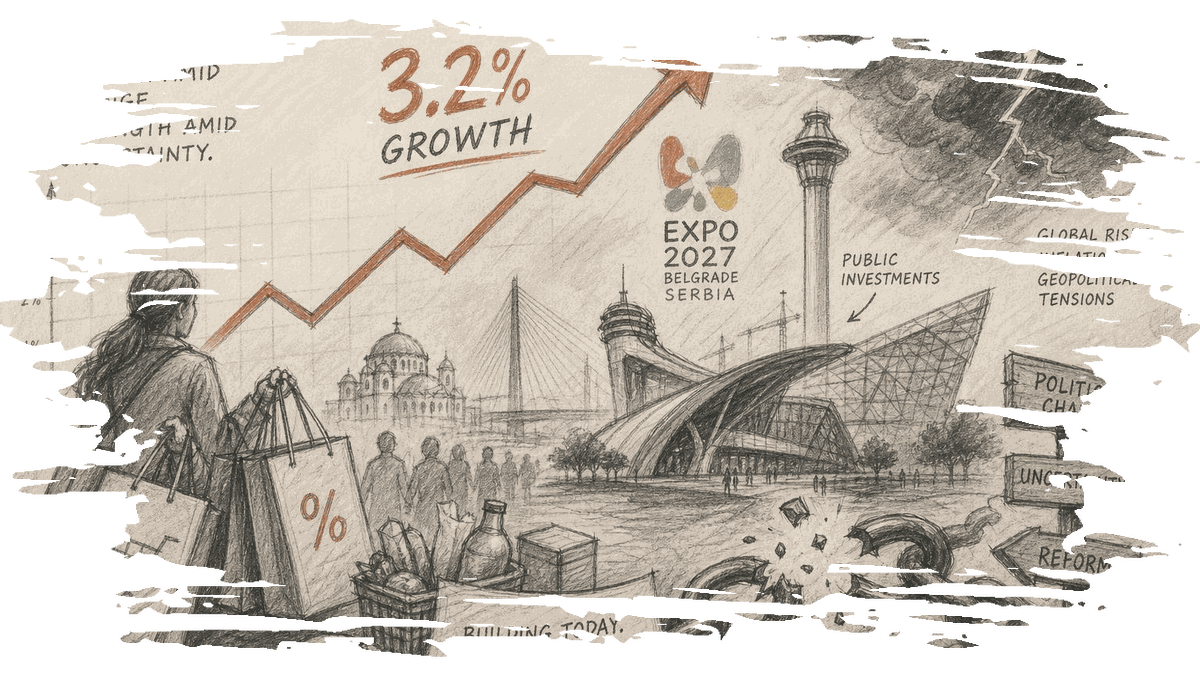
EY has projected Serbia’s economic growth at 3.2% for 2026, with a similar rate expected in 2027, according to its latest Macro Pulse report. This forecast is primarily driven by consumption, but the report highlights significant uncertainties due to the recent political changes in Serbia and the execution of inherited projects. The new government’s economic policies and the intensity of public investments, particularly those related to the upcoming EXPO 2027, are expected to play a crucial role in shaping the country’s economic performance.
The report underscores that the political landscape in Serbia has undergone a complete transformation following the October 2026 elections, which could impact the implementation of economic policies and projects. Public investments linked to EXPO 2027 are anticipated to influence not only investment and consumption but also have a positive effect on service exports. Furthermore, fiscal expansion through increased salaries, pensions, and transfers is likely to sustain household consumption growth.
Despite these projections, the external environment remains unstable. Key central banks are raising interest rates to combat renewed inflationary pressures, while economic growth remains relatively weak among Serbia’s major trade and investment partners, notably Italy and Germany. Additionally, political uncertainty in European countries, with several election cycles expected in EU member states, adds to the unpredictability.
The report also notes that the first half of 2026 saw an acceleration in economic growth to 3.5%, with private consumption increasing by 4.5%, remaining the main driver of overall growth. Fixed investments have risen significantly, largely reflecting activities in preparation for EXPO 2027 and increased defense spending. However, private investment growth has been weak.
State spending has continued to support broader growth, with strong increases in public sector wages and procurement of goods and services, reflecting the government’s growing reliance on deficit financing to drive economic growth. This has enabled a year-on-year growth of nearly 4% in the first half of 2026.
Foreign direct investment (FDI) has stagnated, with new inflows of foreign equity capital significantly slowing down during 2025 and early 2026, affected by global uncertainties and Serbia’s declining competitiveness. Inflows of foreign investments reached only 4% of GDP in 2025 and just 2.8% of GDP in the first eight months of 2026, marking the lowest level in over a decade.
Sector-wise, economic growth is concentrated in a few areas. Trade remains the main driver of gross value added growth, thanks to increased household consumption. The financial sector is also growing strongly, likely driven by household demand for consumer loans. The information and communication technology (ICT) sector continues to contribute positively to overall growth, spurred by external demand. Construction has recorded strong growth rates in the second quarter of 2026 as investment activity strengthens ahead of EXPO 2027.
Agricultural production has improved compared to 2025, largely due to statistical effects from a particularly poor season in 2025, and a relatively abundant harvest of fruits and vegetables this year. On the other hand, the industry is moderately recovering, but its growth is most dependent on the activities of the automotive sector.
The report points out that the closure and downsizing of labor-intensive manufacturing plants further reduce employment, while the IT sector no longer compensates for this decline. Some automotive industry suppliers have closed plants or reduced their workforce due to weaker orders from the European automotive industry and declining cost competitiveness due to rising labor costs.
Additionally, employment growth in the ICT sector has stalled following layoffs in several IT companies. Meanwhile, the minimum wage has increased significantly, by 17% in real terms by mid-2026, with a projected growth of 9.2% in 2027.
In conclusion, while EY’s report projects a steady economic growth rate for Serbia, it highlights several uncertainties that could affect these projections. The political changes, execution of public investments, and external economic conditions remain key factors that will influence Serbia’s economic trajectory in the coming years.


0 Comments