

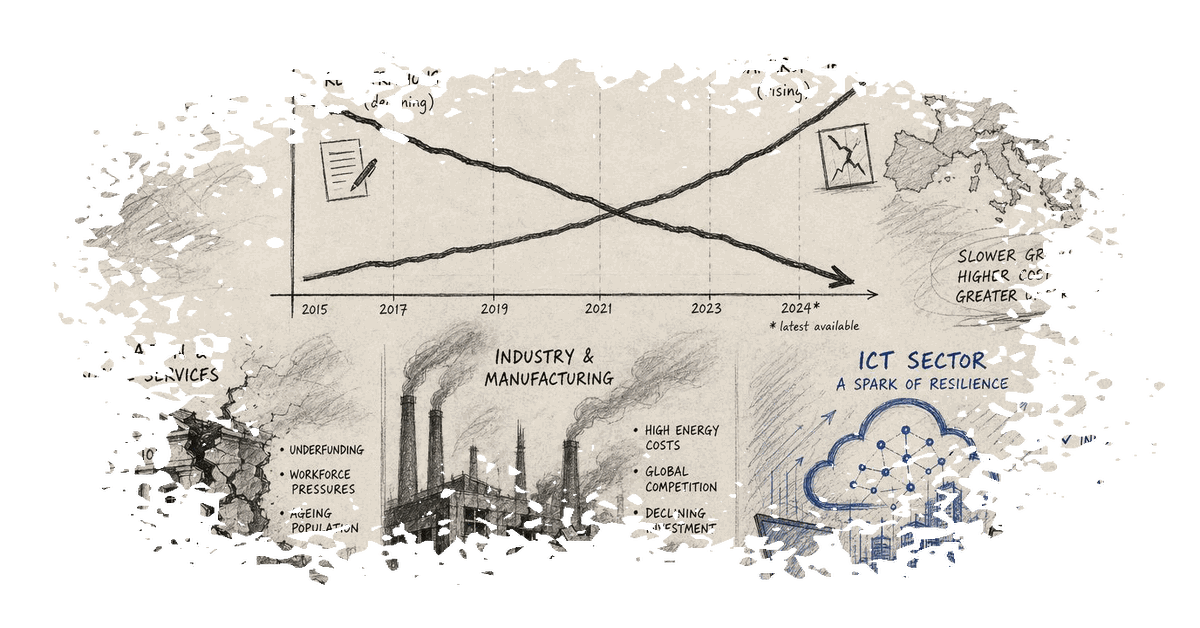
The European Union is experiencing a concerning economic trend as the number of new company registrations has decreased by 0.5% in the second quarter of 2026 compared to the previous quarter, according to recent data published by Eurostat. Concurrently, the number of bankruptcies has risen by 5.7% across the EU, with the education and social services sectors witnessing the most significant increase at 21.1%. This trend indicates broader economic challenges affecting various sectors, including those tied to culture and social life, which may have implications for countries like Serbia.
The report highlights that the decline in new company registrations was observed in five out of eight economic sectors. The industrial sector experienced the most significant drop, with new business registrations falling by 3.6%. Similarly, the hospitality and food services sector saw a decrease of 3.4%, while the education and social services sector recorded a 3.2% decline. On the other hand, the Information and Communication Technology (ICT) sector showed resilience, with an 8.8% increase in new enterprises. The construction sector also saw a modest growth of 1%, while financial services remained stable without any change.

In terms of bankruptcies, the education and social services sectors experienced the largest quarterly increase, with a 21.1% rise in insolvencies. The transportation sector followed with an 11.4% increase, and the financial services sector saw a 6.8% rise in bankruptcies. In contrast, the hospitality and food services sector experienced a 2.6% decline in bankruptcies, while the construction and trade sectors saw decreases of 1.7% and 1.2%, respectively.
While the data from Eurostat does not provide specific figures for Serbia, similar economic trends could potentially affect the country’s cultural and social sectors. The rise in bankruptcies, particularly in education and social services, may have significant repercussions for cultural institutions and community services that rely on stable economic conditions to thrive. The potential impact on Serbia’s cultural landscape could be profound, given the importance of these sectors in fostering community engagement and cultural expression.
The broader European trend of increasing bankruptcies and decreasing new business registrations underscores the challenges faced by economies across the continent. These challenges are likely to influence various sectors, including those integral to cultural and social life, potentially leading to reduced opportunities for cultural expression and community development in affected regions.
As the economic situation continues to evolve, it will be crucial for policymakers and business leaders to address these challenges and support sectors that are vital to cultural and social well-being. The data suggests a need for strategic interventions to stabilize and support industries at risk, ensuring that cultural and social services can continue to contribute to the vibrancy and diversity of European societies.

0 Comments