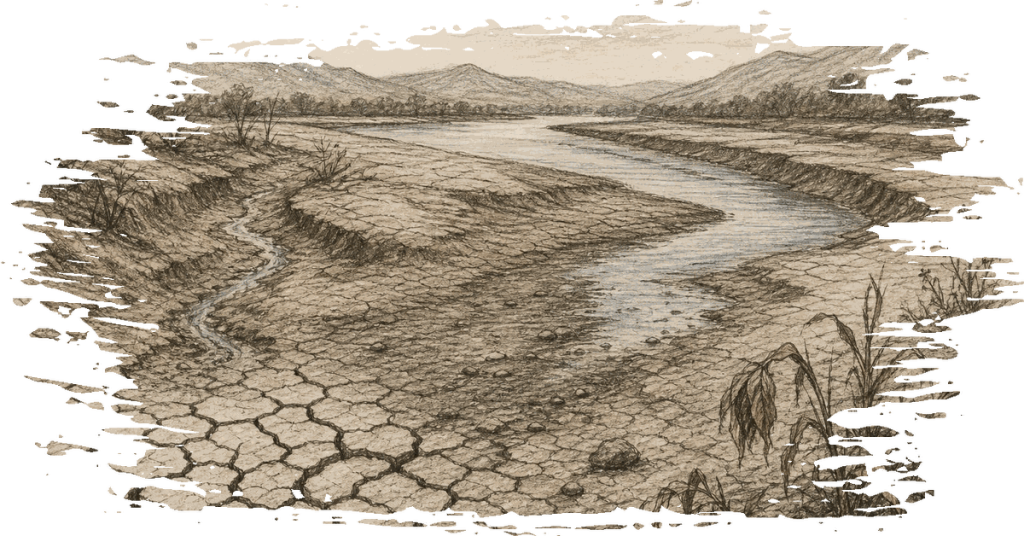
The water levels of the Danube River in Serbia continue to decline, exacerbating concerns about the environmental and water supply impacts amid ongoing drought conditions. As of Wednesday, the water level at Bezdan stood at minus 160 centimeters, marking a continuation of the historic lows recorded in August. The Republic Hydrometeorological Institute (RHMZ) forecasts that the water level will drop by one centimeter daily until the end of the week, with a slight rise expected by Sunday to minus 152 centimeters. These figures underscore the persistent drought affecting Serbia for the third consecutive year, raising significant concerns about future water availability and environmental conditions.
Hydrologists from the RHMZ have issued a hydrological warning in effect until September 16, highlighting the critical state of water levels not only in the Danube but also in other rivers such as the Sava and Tisa near Titel. The warning also extends to tributaries like the Kolubara, Jadar, Toplica, Vlasina, and the tributaries of the Western and Great Morava, as well as the Black and White Timok, where flows are nearing the biological minimum.

Dejan Vladiković, a hydrologist with the RHMZ, explained that the anticipated cooling over the weekend, which is expected to lower temperatures by about 10 degrees Celsius, will not significantly impact hydrological conditions due to the lack of substantial rainfall. He noted that no improvement in the Danube’s water level is forecasted for the next month, despite minor rainfall expected in Slovenia, which may slightly affect the Drava and the upper Sava but not the Danube.
Meteorologist Ana Vuković Vimić emphasized the need for conditions beyond Serbia to improve for a significant rise in water levels. She pointed out that even if rainfall occurs upstream, much of it is absorbed into the soil or evaporates, leaving only a fraction to contribute to surface runoff that feeds the Danube. Vuković Vimić highlighted the complexity of hydrological forecasts, which must consider terrain characteristics and not just atmospheric conditions.
The current situation is reminiscent of early July, with water levels remaining critically low due to insufficient rainfall. The historic low recorded at the end of August, with the Danube at minus 168 centimeters, was the lowest since 1909. The ongoing drought has been exacerbated by a lack of snow in the Alps, absence of major cyclones, and a general deficit in precipitation since May across regions including Austria, the Czech Republic, Slovakia, Hungary, Romania, and Serbia’s Vojvodina.
The environmental implications of these declining water levels are significant, affecting not only water supply but also the ecological health of the river system. The drought conditions have led to a substantial moisture deficit in the soil, with July 2026 marking the lowest flows in the Danube since 1990. This trend aligns with projections of increasing frequency of extreme hydrological droughts as a result of climate change.
The socio-economic impact on communities reliant on the Danube for water supply is also a concern, although specific details on local effects or governmental responses are not provided in the current report. The ongoing drought and its implications highlight the urgent need for sustainable water management solutions in Serbia, a topic that has been the focus of past discussions in light of the country’s struggles with water management and the broader impacts of climate change on water resources.