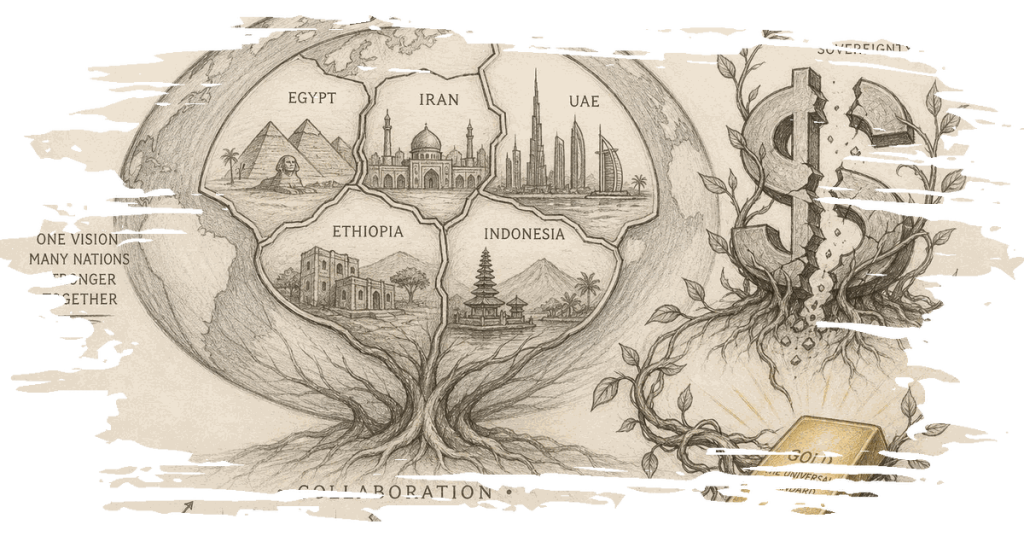
The recent BRICS summit, held in India, has underscored the growing economic clout of the BRICS nations—Brazil, Russia, India, China, and South Africa—now expanded to include Egypt, Iran, Ethiopia, the United Arab Emirates, and Indonesia. These countries collectively generate over 40% of the world’s GDP, a significant increase compared to the 29% produced by the G7 nations. The summit highlighted the potential for BRICS to develop an independent financial model, potentially transforming global economic structures traditionally dominated by Western financial systems.
The discussions at the summit centered around the possibility of creating a new financial architecture that could operate independently of the current global payment systems. This initiative is seen as a move towards reducing reliance on the US dollar, a process often referred to as “dedollarization.” The trade within the BRICS nations has already reached a substantial $1.2 trillion, indicating robust economic interactions among member countries.

One of the key topics at the summit was the potential shift of the Chinese yuan to a gold standard, a move that could have significant implications for global financial markets. As China is a leading economic power, such a shift could accelerate the dedollarization process and alter the dynamics of international trade and finance.
The expansion of BRICS to include new members from Africa and the Middle East reflects its ambition to become a more influential global economic bloc. This expansion is expected to enhance the group’s ability to influence international economic policies and challenge the dominance of Western-led institutions like the International Monetary Fund and the World Bank.
The summit’s outcomes have sparked discussions about the possible transformation of these institutions, which have traditionally been shaped by Western interests, primarily those of the United States. The BRICS nations are exploring ways to establish a financial model that is not contingent upon existing global payment systems, which could lead to significant shifts in how international economic transactions are conducted.
Dr. Budimir Stakić, an expert in international economics, finance, and banking, discussed these developments in a Sputnik Serbia broadcast. He emphasized the potential impact of BRICS’ economic strategies on global financial stability and the possible acceleration of dedollarization. The discussions also touched on the strategic implications of these economic shifts for Western economies and their potential responses.
The BRICS summit’s focus on economic independence and diversification of financial systems highlights the bloc’s strategic intent to reshape global economic governance. As these nations continue to grow economically, their influence on global economic policies is likely to increase, potentially leading to a rebalancing of global economic power.
The expansion and economic strategies of BRICS are particularly significant for regions like Serbia and the Balkans, which could see shifts in trade patterns and economic alliances. The growing economic influence of BRICS may offer new opportunities for these regions to engage with emerging markets and diversify their economic partnerships.
While the summit’s discussions signal a potential shift in global economic dynamics, the actual implementation of these proposed financial models remains uncertain. The global acceptance of such changes will depend on various factors, including the willingness of BRICS nations to collaborate effectively and the responses of established Western economies to these developments. The coming years will be crucial in determining the extent to which BRICS can influence global economic structures and reduce the dominance of Western financial systems.