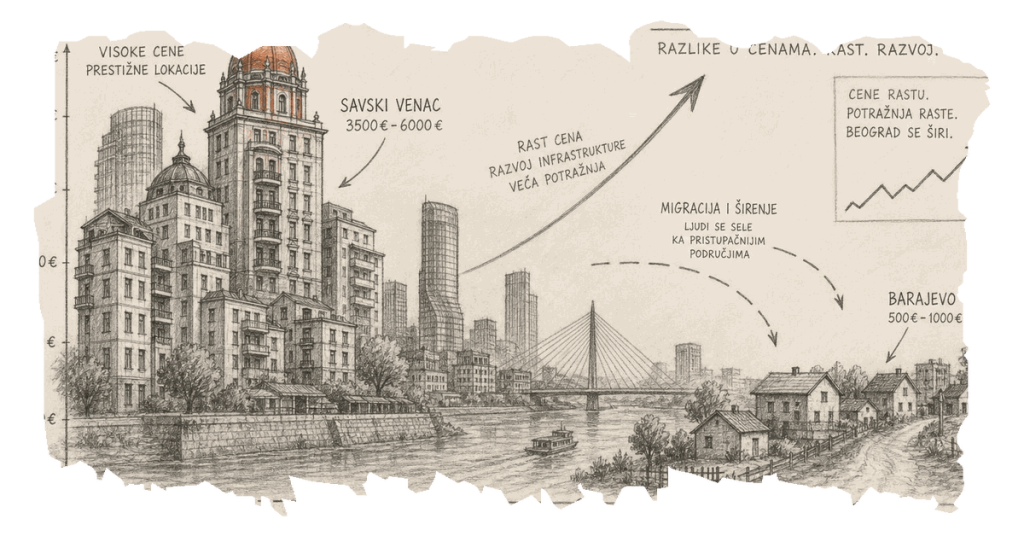
The real estate market in Serbia, particularly in its capital, Belgrade, is experiencing significant disparities in property prices, with predictions of continued increases due to urban development and migration trends. The average price per square meter in Belgrade currently stands at approximately 3,300 euros. However, prices vary widely across different municipalities within the city. For instance, Savski Venac, one of the most expensive areas, averages 4,700 euros per square meter, while Barajevo is considerably cheaper at around 1,250 euros per square meter.
In comparison, other Serbian cities show different price levels. Novi Sad, the second-largest city, has an average price of 2,762 euros per square meter, followed by Niš at 2,008 euros and Kragujevac at 1,887 euros. Sombor presents the most affordable option among the surveyed cities, with an average price of 1,100 euros per square meter.

Real estate expert Nedeljko Malinović anticipates that property prices in certain parts of Belgrade will continue to rise, particularly in areas like Surčin, which is expected to become more attractive due to the upcoming EXPO 2027. Malinović notes that as areas develop and infrastructure improves, both residential and commercial property prices tend to increase. He also predicts a general upward trend in housing prices in the coming months, especially in Belgrade, where unofficial data suggests an influx of approximately 20,000 new residents annually.
The rising property prices reflect broader economic and demographic trends, including urban migration and foreign investments. Previous reports have highlighted a notable increase in Russian investments in Serbian real estate, with Russian nationals not only purchasing properties but also engaging in construction projects. This influx of foreign capital has further influenced the market dynamics, contributing to the rising prices.
These developments have significant implications for local residents and potential buyers, as the increasing prices may affect affordability and accessibility. The disparities in property prices across different regions and municipalities highlight the challenges faced by those looking to enter the housing market. As urban development projects continue, such as the EXPO 2027, areas undergoing significant infrastructure improvements are likely to see further price increases, potentially exacerbating existing disparities.
While expert predictions suggest a continued rise in property prices, the actual market trends will depend on various factors, including economic conditions, foreign investment levels, and urban planning initiatives. As the real estate market evolves, it will be crucial for stakeholders to monitor these developments and consider their impact on both local communities and the broader economic landscape.