

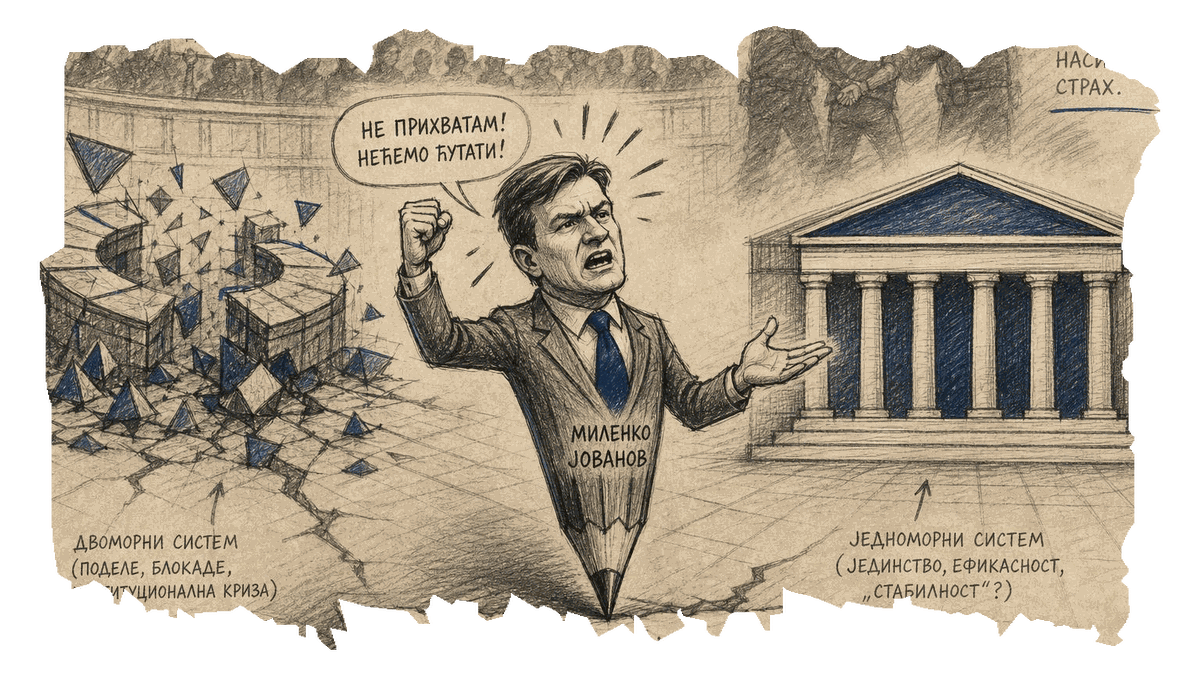
Milenko Jovanov, deputy head of the parliamentary group ‘Aleksandar Vučić – Srbija pobeđuje’, has voiced strong criticism against recent actions in the Serbian National Assembly, describing them as unconstitutional and a departure from established parliamentary practices. Speaking at a press conference in Belgrade on November 25, 2026, Jovanov accused the ruling Students’ List of setting numerous precedents that violate the Constitution and parliamentary norms over the past five days.
Jovanov specifically condemned the introduction of what he termed a “bicameral assembly,” which he claims is unconstitutional for Serbia’s traditionally unicameral parliamentary system. He criticized the presence of students in the assembly gallery, arguing that it undermines the integrity of the National Assembly by effectively creating an “upper house” that oversees the elected representatives.
The deputy head warned that those supporting these changes would eventually face repercussions. “Those who are making and supporting these precedents should be aware that they will one day be affected by them,” Jovanov stated. He further accused the Students’ List of behaving inhumanely and uncivilized, claiming that they have disregarded good practices and the Constitution.
Jovanov also highlighted specific incidents involving the Students’ List, including what he described as “inhumane outbursts” by its members. He referred to an incident where Jovo Bakić, head of the Students’ List parliamentary group, allegedly refrained from causing disturbances during a memorial for the late Bishop Irinej Bulović. Jovanov questioned why such an event would warrant potential disturbances.
Moreover, Jovanov criticized the behavior of Students’ List members during the arrest of Dragan Vučićević, editor-in-chief of Informer, for allegedly causing panic by publishing false news. Jovanov claimed that the assembly applauded Vučićević’s arrest, which he interpreted as an orchestrated action by a plenary session.
The recent developments in the Serbian National Assembly follow the October 2026 elections, where the Students’ List secured a majority, marking a significant shift in the country’s political landscape. The Students’ List’s consolidation of power has been contentious, with opposition parties, including Jovanov’s group, raising concerns about the exclusion of opposition voices and the potential erosion of democratic norms.
Jovanov’s remarks reflect ongoing political tensions in Serbia as the Students’ List transitions from a protest movement to a governing body. His criticisms add to the broader discourse on the Students’ List’s governance approach and its implications for Serbia’s parliamentary practices. The situation continues to evolve, with potential consequences for those involved in the recent parliamentary changes.
0 Comments