

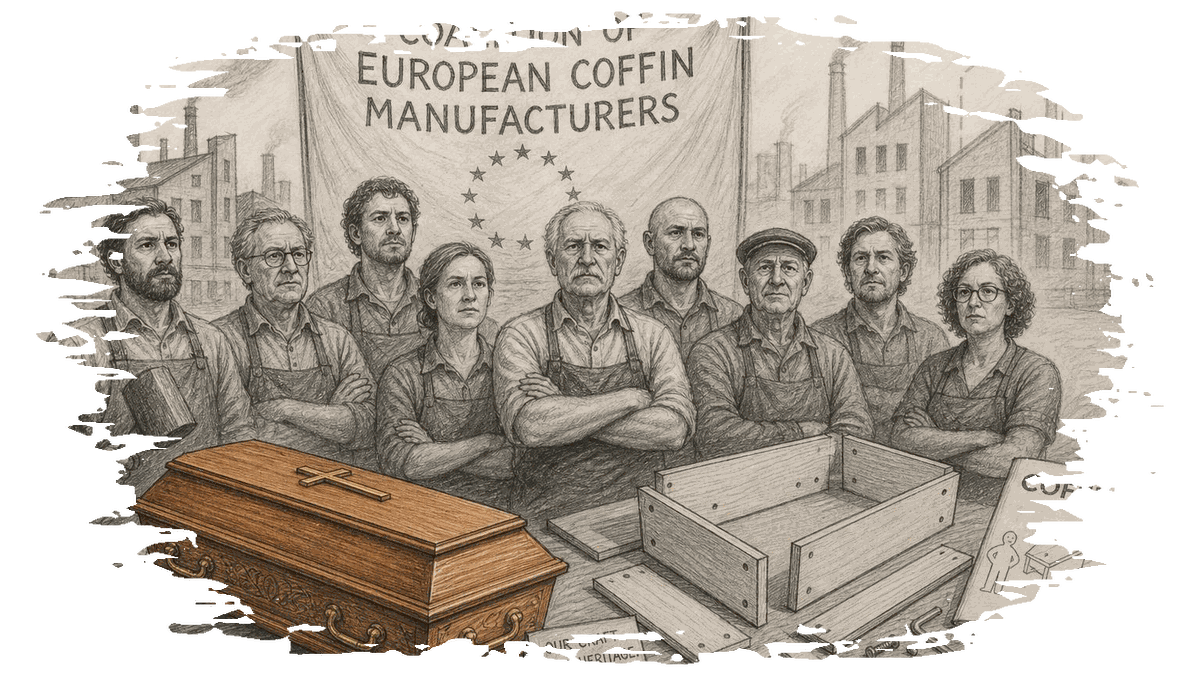
European coffin manufacturers have formed a coalition to urge the European Commission to investigate the import of Chinese coffins, which they claim are being sold at prices significantly lower than those produced within Europe. This disparity, they argue, has led to a substantial decline in the number of European coffin manufacturers, with approximately 25% of such businesses closing over the past five years. The coalition’s concerns highlight ongoing tensions in global trade, particularly between Europe and China.
The coalition, which previously lacked formal representation before European institutions, has initiated discussions with European Commission officials, including those responsible for trade. They are preparing a request for an anti-dumping investigation to determine whether Chinese companies are selling coffins in the European Union at unfairly low prices. According to Folko Čuli, a consultant assisting in coordinating the initiative, the number of coffin manufacturers in Europe has decreased from about 120 to 90 over the last five years. Čuli noted that smaller companies have been unable to withstand the competition from non-European importers, and the remaining manufacturers have only managed to take over half of the production previously handled by the closed businesses.
The primary argument from European manufacturers centers on the significant cost differences in production. They estimate that manufacturing a coffin in China costs roughly a third of what it would in Italy, even when using the same type of wood. The coalition attributes this cost advantage to Chinese companies benefiting from state subsidies, export tax breaks, lower labor costs, and cheaper raw materials. Additionally, they point to more favorable wood supply chains and a shift in Chinese production towards the European market due to higher U.S. tariffs.
Despite these claims, the coalition acknowledges that low prices alone are insufficient grounds for anti-dumping measures. They must demonstrate that Chinese coffins are sold below their usual market value and that such imports are causing significant harm to the European industry.
Another aspect of the issue involves the way Chinese coffins are imported. Some manufacturers suspect that parts of Chinese coffins are entering Europe without being recorded as complete products. Emiliano Ingušo, a mathematician analyzing production and trade data, has identified discrepancies in Italian statistics that correspond to about 30,000 coffins annually. His analysis suggests that the number of coffins available on the market should roughly match domestic production and imports, adjusted for exports and inventory changes. Given that coffin demand is relatively predictable and closely linked to mortality rates, significant deviations could indicate unrecorded imports.
This situation has led to what the manufacturers describe as an “IKEA loophole,” where some coffins from China arrive in Europe in disassembled form, with their components declared at customs as wooden elements rather than finished funeral products. Once inside the EU, these parts are assembled and sold. The European Commission, however, has pointed out that even unassembled goods can be treated as finished products for customs purposes if they possess the essential characteristics of the final item.
The coffin manufacturers’ initiative is part of a broader trade dispute between the European Union and China, which extends beyond traditional sectors like steel and chemicals to include more conventional manufacturing industries. In 2025 alone, the European Commission launched 32 new trade protection investigations, nearly matching the previous year’s record. Similar protective measures have already been implemented for European candle manufacturers, with the Commission imposing anti-dumping duties of 56 to 60 percent on Chinese candle imports earlier this year after an investigation into the damage caused to the European industry.
The coalition’s request for an investigation into Chinese coffin imports underscores the broader economic tensions between Europe and China, as European industries continue to grapple with the influx of cheaper imports. The outcome of this investigation could have significant implications for the European coffin manufacturing sector and its workers, as well as for broader trade relations between the EU and China.



0 Comments