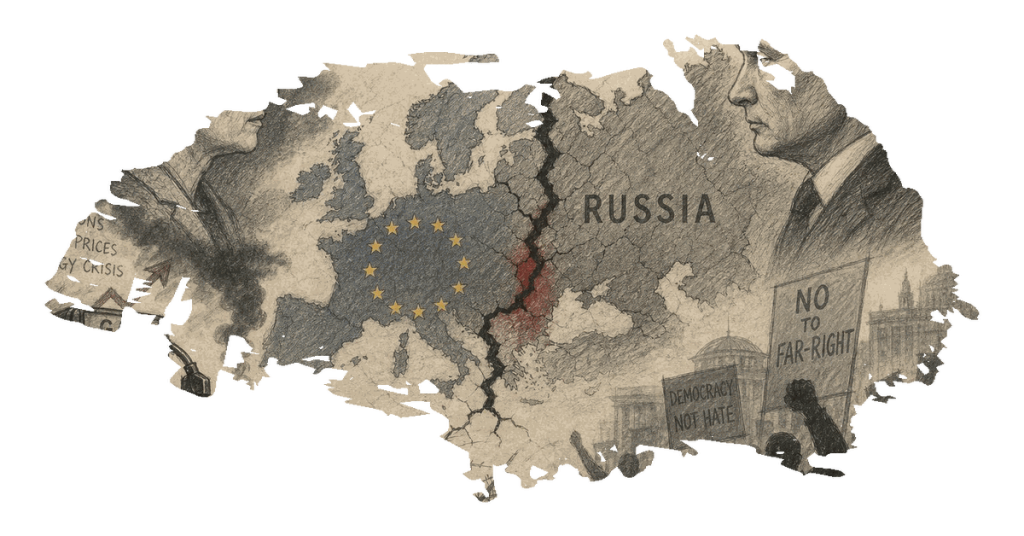
Russian President Vladimir Putin has attributed the recent electoral success of Germany’s Alternative for Germany (AfD) party to what he describes as systemic errors by the European Union. Speaking at the BRICS Summit in Delhi, Putin suggested that the rise of the AfD is a reaction against the EU’s political, security, and economic policies, particularly those related to Russia.
Putin criticized the EU’s sanctions on Russian energy, arguing that they have led to significantly higher gas prices in Europe. He claimed that the EU’s decision to replace long-term gas contracts with Russia with more expensive market-priced imports has resulted in prices nearly ten times higher than before. Additionally, he condemned the EU’s gas storage policies, suggesting they neglect the technical condition and physical volumes of storage facilities, thereby adversely affecting the EU’s economy.

In the political sphere, Putin accused the EU of engaging in anti-Russian fearmongering and criticized the current German government’s policies, which he claims misrepresent the legacy of former Chancellor Helmut Kohl. According to Putin, Kohl had envisioned a strategic alliance with Russia to preserve Europe’s civilization and sovereignty, a vision that he argues has been abandoned by Germany’s current leadership.
On security matters, Putin warned that the deployment of European troops to Ukraine could escalate into war with Russia, a scenario he believes is not supported by average European voters. He also criticized NATO’s eastward expansion and the EU’s support for what he described as Neo-Nazis in Ukraine.
Putin’s comments come in the wake of the AfD’s significant electoral victory in the German state of Saxony-Anhalt, where the party secured nearly 44 percent of the vote. This result has been seen as a major success for the AfD, which has been a controversial political force in Germany, often associated with far-right ideologies. The party’s rise has sparked protests across Germany, with tens of thousands of demonstrators calling for its ban.
While Putin’s remarks suggest that the AfD’s support stems from a desire for pragmatic ties with Russia, he emphasized that this does not imply the party or its supporters are pro-Russian. Instead, he argued that the AfD’s popularity is a response to the unpopularity of current EU policies, which he claims have failed to adequately address issues such as mass migration and economic challenges.
The rise of the AfD has raised concerns about the increasing influence of far-right sentiments in Europe and the potential implications for EU politics and security. Critics of Putin’s statements may view them as part of a broader narrative of Russian propaganda, aiming to exploit divisions within the EU. Nonetheless, the AfD’s electoral success highlights the ongoing political and economic tensions within the EU, as well as the complex motivations of voters who support the party.