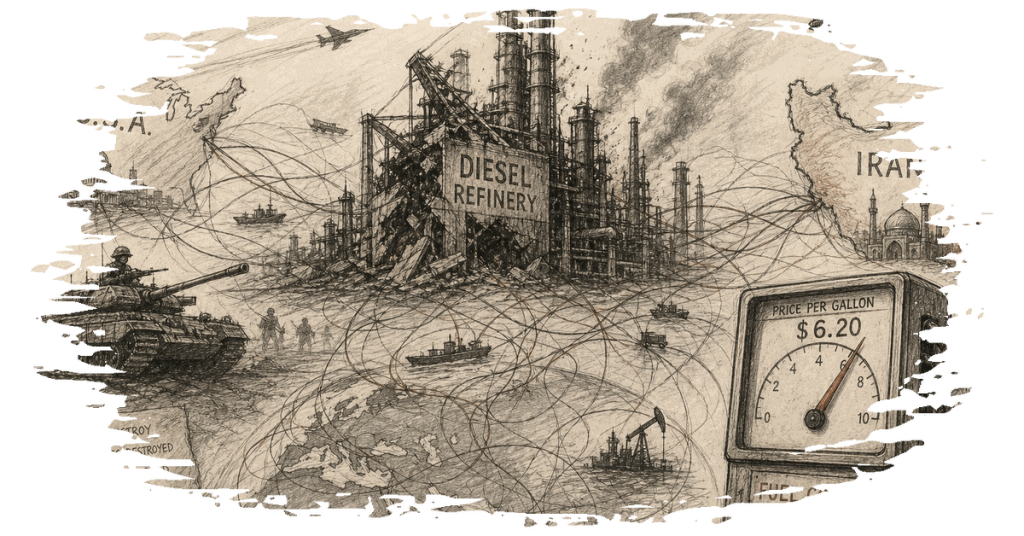
U.S. President Donald Trump has urged Ukrainian President Volodymyr Zelenskyy to cease attacks on Russian diesel refineries, attributing the global diesel shortage to these military actions. Speaking at the Amgen Irish Open held at his golf course in Doonbeg, Ireland, Trump emphasized that the strikes on Russian energy infrastructure were exacerbating the diesel crisis, which he claimed was “hurting the world.” This comes as diesel prices in the United States have surged to unprecedented levels, reaching an average of $6.20 per gallon, according to the American Automobile Association.
The backdrop to Trump’s comments includes the ongoing conflict between Russia and Ukraine, where Ukrainian forces have been targeting Russian oil facilities. These actions have reportedly led to a significant reduction in Russia’s fuel exports, with figures showing a drop from an average of 860,000 barrels per day in 2025 to 591,000 barrels per day in August 2026. The Ukrainian military’s recent strike on the TANECO refinery in Russia’s Tatarstan republic resulted in two civilian casualties, further intensifying the situation.

Trump’s remarks also intersect with the geopolitical tensions involving the United States and Iran. The U.S. and Israel’s military actions against Iran earlier in the year have contributed to volatility in the energy markets. Oil prices, which spiked above $100 a barrel following the initial strikes in February, have continued to rise amidst renewed hostilities, reaching nearly $108 a barrel recently. This escalation has placed additional pressure on the global oil supply, with the Strait of Hormuz—a critical passage for global oil shipments—being a focal point of the conflict.
The implications of Trump’s comments are multifaceted, affecting both U.S.-Ukraine relations and the broader global energy markets. While Trump blames Ukrainian strikes for the diesel shortage, experts like Chris Beauchamp, chief market analyst at IG Group, suggest that these actions are only a minor factor in the larger picture. Beauchamp points to the U.S. military actions in the Middle East as a more significant driver of rising diesel prices. The International Energy Agency supports this view, noting that the damage to Russian refineries and reduced exports from the Gulf region compound the losses caused by the conflict in the Gulf.
Ukraine, for its part, maintains that targeting Russian energy infrastructure is a legitimate military strategy, arguing that Russia’s oil and gas industry is a crucial component of its war efforts. The Ukrainian military’s actions are seen as a means to apply domestic pressure on the Russian government by impacting civilian access to fuel, as evidenced by long queues at petrol stations in Russia and shortages in cities like St. Petersburg.
The rising fuel prices have become a political liability for Trump and his Republican party as the U.S. approaches midterm elections in November. With the economy being a central issue for voters, Trump’s approval rating on economic matters has declined to 17 percent, according to a Financial Times poll. The cost of diesel, which is essential for transportation and affects the price of goods, has become a critical concern for American consumers.
As the situation develops, the interplay between military actions and global energy markets remains complex. While Trump’s directive to Zelenskyy highlights the immediate impact of Ukrainian strikes on Russian refineries, the broader context of U.S.-Iran tensions and their effect on oil prices cannot be overlooked. The ongoing conflicts continue to pose challenges for global energy stability, with potential implications for international relations and economic conditions worldwide.