


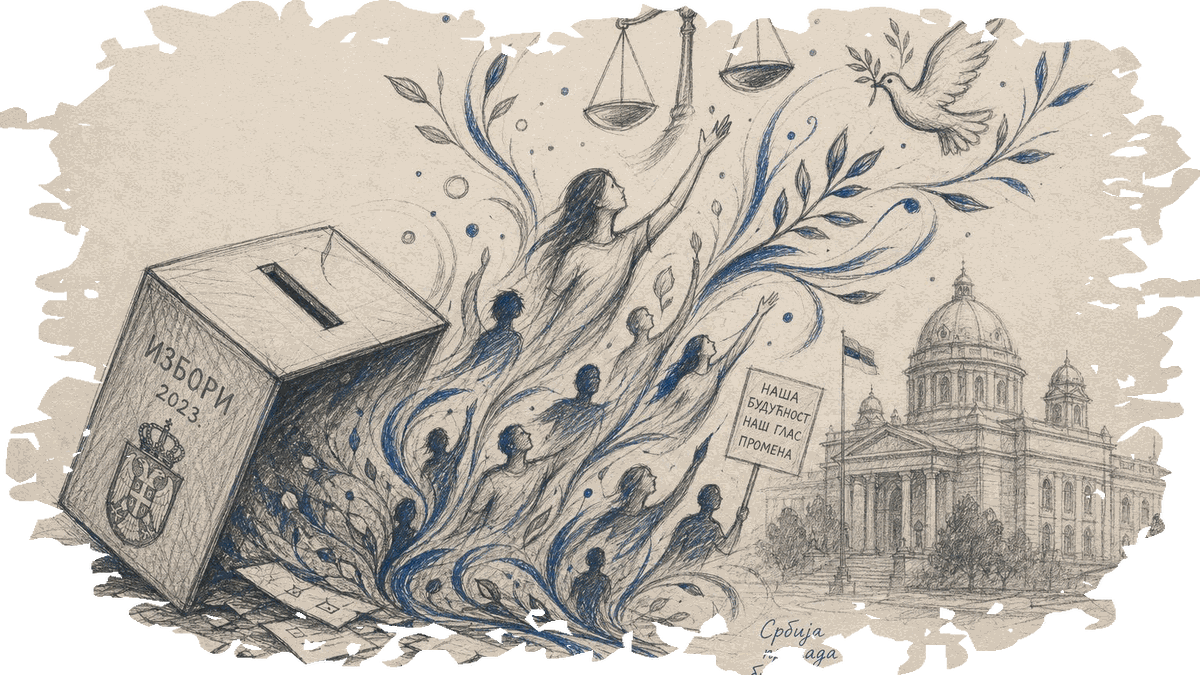
The electoral campaign in Serbia has officially commenced with the Students’ List launching their campaign in Novi Sad, presenting 30 candidates for the upcoming parliamentary elections. The campaign kickoff took place in the center of Novi Sad, Serbia’s second-largest city, a location significant for its role in anti-government protests following a tragic incident in November 2024 that resulted in the deaths of 16 people. These protests have been a catalyst for the students’ movement, which has now evolved into a political organization.
Among the candidates introduced were Nemanja Đurić, president of the Judicial Authority Union, Ilija Srdanović, a professor at the Medical Faculty in Novi Sad, sociologist Jovo Bakić, and Ljubica Oparnica, a professor at the Pedagogical Faculty in Sombor. The event was marked by speeches from the candidates, who emphasized the need for political change and justice in Serbia. Ljubomir Aleksić, speaking at the event, highlighted the urgency of the moment, stating, “This might be our last chance to wake up and make our country better.”

The Students’ List is a response to ongoing protests against the government, particularly focusing on issues of corruption and mismanagement. The protests gained momentum after the November 2024 incident, where a canopy collapse at a railway station led to multiple fatalities. This tragedy has been a rallying point for the student-led movement, which has now transitioned into a formal political entity aiming to contest the elections scheduled for October 25.
The campaign in Novi Sad was characterized by vibrant displays of activism, with attendees wielding whistles, vuvuzelas, and banners. The crowd chanted the names of candidates, with local cardiologist Ilija Srdanović receiving significant applause. Srdanović questioned the accountability of those in power, asking, “Do we have justice in Serbia? Have the institutions responded?” His remarks were met with chants from the crowd, highlighting the public’s demand for accountability and reform.
The Students’ List must gather 10,000 signatures to submit their candidacy to the Republic Electoral Commission. The group, largely composed of university professors and activists, has garnered support from various opposition parties, including the Democratic Party, the Green-Left Front, and the Social Democratic Party, which have offered logistical support.
The origins of the Students’ List can be traced back to a group of 14 individuals, primarily university professors, who founded the citizens’ group “Studentska lista-Studenti pobeđuju,” shortly after Serbian President Aleksandar Vučić announced the extraordinary parliamentary elections. Marija Maruna, a professor at the Faculty of Architecture at the University of Belgrade, confirmed that all signatories are included in the Students’ List.
The campaign’s launch in Novi Sad is a strategic choice, given the city’s central role in the protests and the movement’s growth. The students’ movement has been a significant force in challenging the ruling Serbian Progressive Party (SNS) and President Vučić, who have faced accusations of corruption and abuse of power. The protests represent the most substantial challenge to the SNS since it came to power in 2012.
The effectiveness of the Students’ List in the upcoming elections remains uncertain, given the volatile political landscape in Serbia. However, the movement’s ability to mobilize support and present a unified front against the ruling party could have significant implications for the country’s political future. The students’ campaign is seen as a critical test of the opposition’s ability to unite and challenge the entrenched power structures in Serbia.
As the campaign progresses, the Students’ List will need to navigate the complexities of the electoral process, including gathering the necessary signatures and maintaining momentum in the face of potential challenges. The upcoming elections are pivotal for Serbia, with the potential to reshape the political landscape and address longstanding issues of governance and accountability.


0 Comments