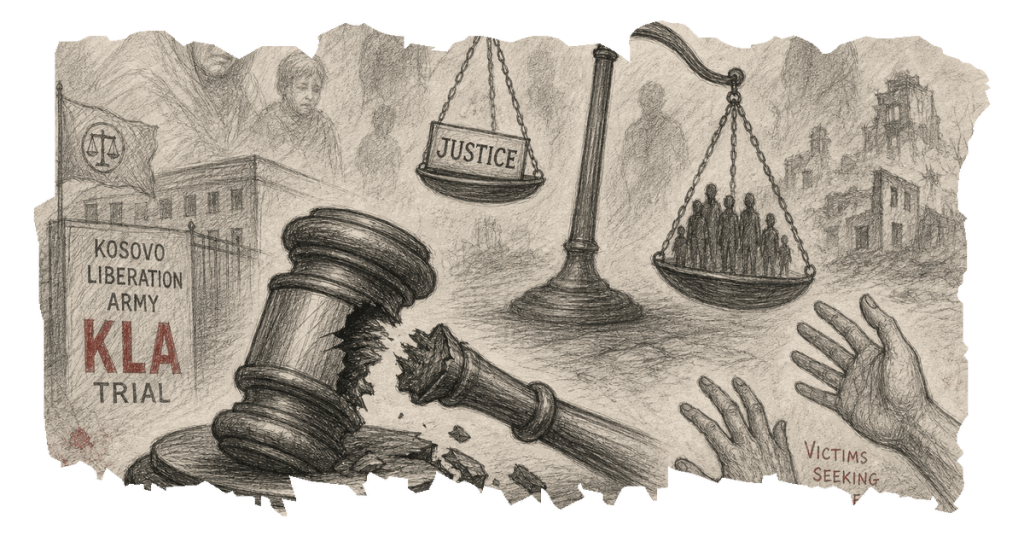
Former Kosovo Liberation Army (KLA) leaders Hashim Thaçi, Kadri Veseli, Rexhep Selimi, and Jakup Krasniqi have been sentenced to a total of 81 years in prison for war crimes by the Kosovo Specialist Chambers in The Hague. The verdict, delivered on September 16, 2026, marks a significant moment in the ongoing efforts to address war crimes committed during the Kosovo conflict from 1998 to 1999. Thaçi and Krasniqi received 25-year sentences each, while Veseli and Selimi were sentenced to 18 and 13 years, respectively.
The convictions are based on extensive evidence, including testimonies from 373 witnesses and 5,467 pieces of evidence. The court found that the accused significantly contributed to the persecution of those considered opponents of the KLA, including ethnic Albanians, Serbs, and Roma. The court’s findings indicate that the accused were involved in the systematic persecution and physical abuse of prisoners in various detention facilities controlled by the KLA.

Legal expert Aleksandar Olenik praised the court’s approach, highlighting it as a progressive step in international criminal law for recognizing victims’ rights. Olenik noted that unlike previous ad hoc tribunals, this court allowed victims to have their own representatives and the right to compensation, rather than being treated merely as witnesses to prove guilt. He explained that the court’s decision not to convict the leaders for crimes against humanity was due to the limited number of victims’ testimonies considered in the trial.
The trial and its verdict are part of broader efforts to bring justice for crimes committed during the Kosovo conflict. However, Olenik pointed out that only the founders of the KLA are accountable under the current court’s jurisdiction, suggesting that the Kosovo judiciary should prosecute other KLA members implicated in crimes, especially those committed after the conflict ended on June 20, 1999.
The verdict has sparked protests in Kosovo, with tensions rising as supporters of the convicted leaders express their discontent. Staša Zajović from the organization Women in Black criticized both the Serbian and Kosovo authorities for using the verdict to fuel conflict rather than to reflect on their roles during the war. Zajović emphasized the importance of international forces in monitoring the situation to prevent the escalation of violence.
Despite the current unrest, Olenik expressed hope that the verdict could lead to a more realistic and less biased understanding of the events in the long term, potentially improving relations between Serbia and Kosovo. However, he acknowledged that this would depend on the political will of both nations’ elites.
The verdict also raises questions about the potential for future prosecutions of other KLA members. While the Specialist Chambers’ mandate covers only the KLA’s founding members, the evidence presented in this trial could serve as a basis for further legal actions by Kosovo’s judiciary. The international community will be closely monitoring how these developments unfold, as they hold significant implications for regional stability and justice in the Balkans.