

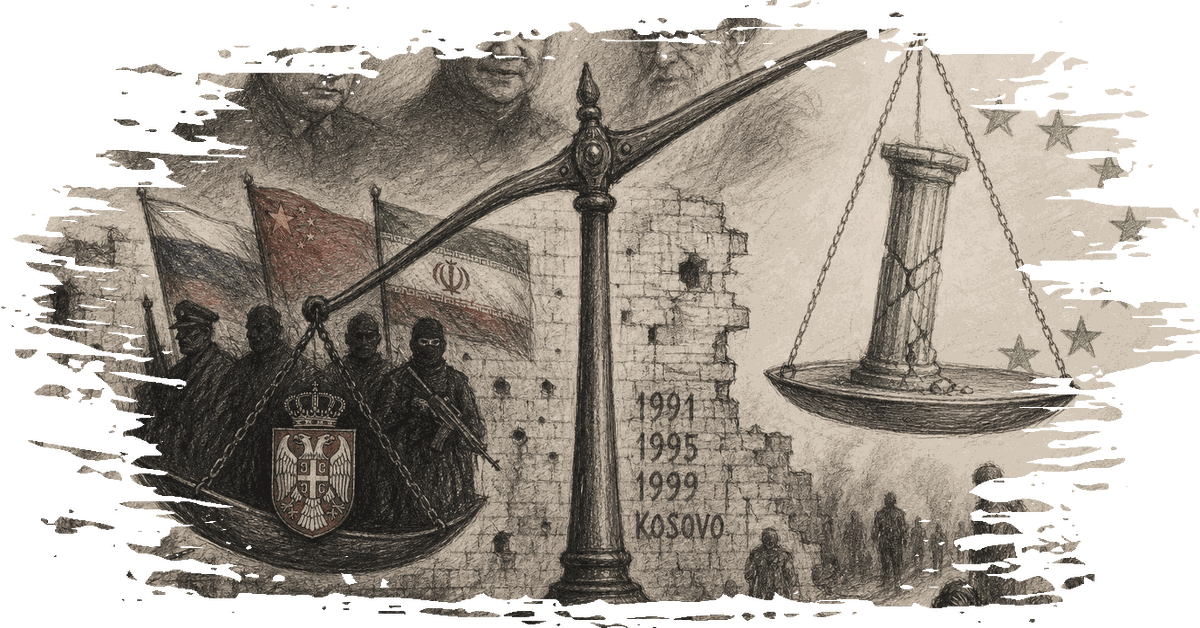
Former Kosovo President Vjosa Osmani has criticized the European Union for its continued financial support to Serbia, despite Serbia’s controversial stance on war criminals and its geopolitical alliances. Osmani’s comments come in the wake of reactions to the death of Ratko Mladić, a convicted war criminal, which have reignited discussions about Serbia’s political climate and its historical actions during the Yugoslav Wars.
Osmani expressed her concerns through social media, questioning why the EU continues to provide Serbia with billions of euros while the country allegedly glorifies war criminals and denies past genocides and crimes against humanity. She accused Serbia of aligning with countries like Russia, China, and Iran, which she claims undermines European security. Osmani argued that Serbia’s actions are inconsistent with the values of a prospective EU member state and suggested that the EU should reconsider its financial support for what she described as a regime behaving like an “enemy of Europe.”

The former president’s remarks highlight ongoing tensions in the Balkans, where historical grievances and geopolitical alliances continue to influence regional dynamics. The controversy surrounding Serbia’s reaction to Mladić’s death underscores the deep-seated divisions that persist in the region. Mladić, known as the “Butcher of Bosnia,” was convicted of genocide, war crimes, and crimes against humanity for his role in the Srebrenica massacre during the Bosnian War, where more than 8,000 Bosniak men and boys were killed.
Osmani’s statements have drawn attention to Serbia’s candidacy for EU membership, a process that has been ongoing for years. The EU’s financial support to Serbia is part of a broader strategy to stabilize the region and promote democratic reforms. However, Osmani’s criticism suggests that Serbia’s internal policies and external alliances may be at odds with the EU’s expectations for candidate countries.
The situation also reflects broader geopolitical concerns, as Serbia’s cooperation with Russia, China, and Iran is viewed by some as a challenge to European interests. Osmani’s call for the EU to “wake up” to Serbia’s true nature suggests a need for a reassessment of the EU’s engagement with the country, particularly in light of its historical and current actions.
The EU has not publicly responded to Osmani’s remarks, and it remains to be seen how her criticisms will influence EU-Serbia relations. The debate over Serbia’s political direction and its compatibility with EU values is likely to continue, especially as the region grapples with the legacy of past conflicts and the complexities of modern geopolitical alignments.

0 Comments