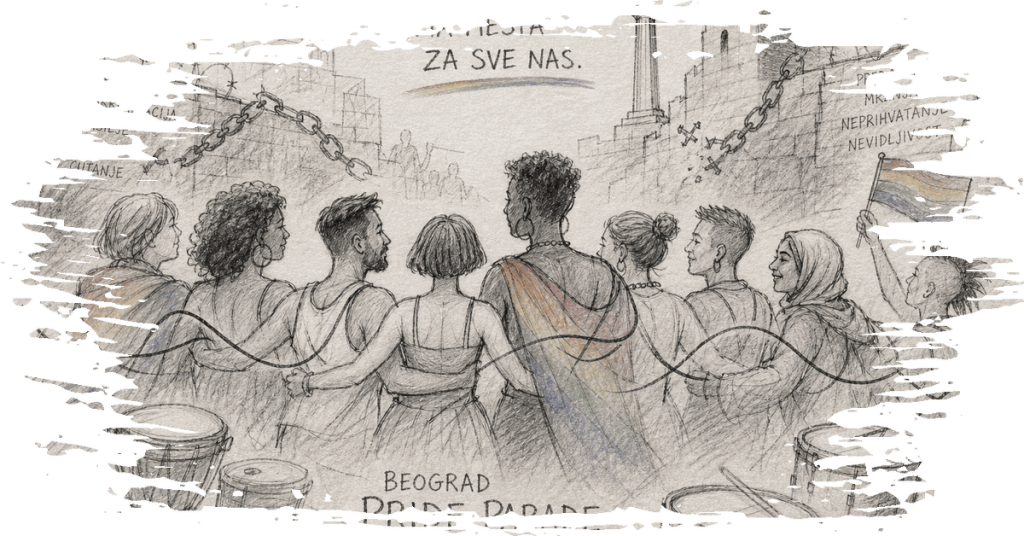
The 2026 Pride Parade in Belgrade is taking place on September 5, under the slogan “There is room for all of us,” echoing the first Pride Parade in Serbia in 2001. This year’s event coincides with a commemoration for Ratko Mladić, a former commander of the Army of Republika Srpska, convicted of war crimes and genocide. Despite the sensitive timing, organizers emphasize that the Pride Parade is primarily a protest against ongoing discrimination and violence faced by the LGBTI+ community in Serbia.
Organizers have highlighted the event as a platform to protest against the lack of legal protections and the discrimination that LGBTI+ individuals continue to face in Serbia. According to the organization Da se zna, there were 110 incidents of hate crimes against LGBTI+ people in the past year, including at least 20 physical assaults, most of which remain unprosecuted. “The numbers are significant for statistics, but it is disheartening that almost all these cases remain unprocessed,” said Bojan Lazić from Da se zna.

The Pride Parade is scheduled to begin at 4 p.m. in Manjež Park, with the march starting an hour later. Participants will walk through central Belgrade, passing significant landmarks such as the National Assembly. The parade will be led by a drumming band and trucks playing music. Danica Vučenić, a journalist known for her advocacy of democratic values and human rights, is the godmother of Belgrade Pride 2026. She represents a symbol of professional integrity and civic courage, according to the organizers.
The event’s timing has raised concerns about potential tensions, as it coincides with the commemoration of Mladić. However, the Pride organizers have stated that the commemoration does not affect their planned program. They have issued safety recommendations for participants, advising them to move in groups, avoid responding to provocations, and conceal Pride symbols when leaving the event. Security will be managed by volunteers, stewards, and police officers.
Historically, Pride events in Serbia have faced significant opposition and violence. The first Pride Parade in 2001, known as the “Bloody Pride,” was marred by violence against participants, and the police failed to provide adequate protection. Since then, Pride events have been held regularly, but always with substantial police presence to ensure the safety of participants.
The Pride Parade also serves as a reminder of the ongoing struggle for LGBTI+ rights in Serbia. The organizers have reiterated demands for the adoption of laws on same-sex unions and gender identity, as well as the rights of intersex individuals. They are also calling for swift governmental responses and public condemnation of hate speech and crimes against the LGBTI+ community. Additionally, they seek an apology for those persecuted before 1994 due to their sexual orientation or gender identity, and advocate for educational programs on these topics.
The concurrent commemoration of Mladić, who died on August 27, adds a layer of complexity to the event. Mladić, a controversial figure, was convicted for his role in the Bosnian War, including the Srebrenica massacre. Commemorations for him have sparked tensions, and in some regions, public gatherings in his honor have been banned due to security concerns.
The Pride Parade in Belgrade is not only a protest but also a demonstration of visibility, courage, and solidarity with those who cannot live freely according to their identity and sexual orientation. It underscores the ongoing challenges and the long road ahead for achieving equality and acceptance for the LGBTI+ community in Serbia.