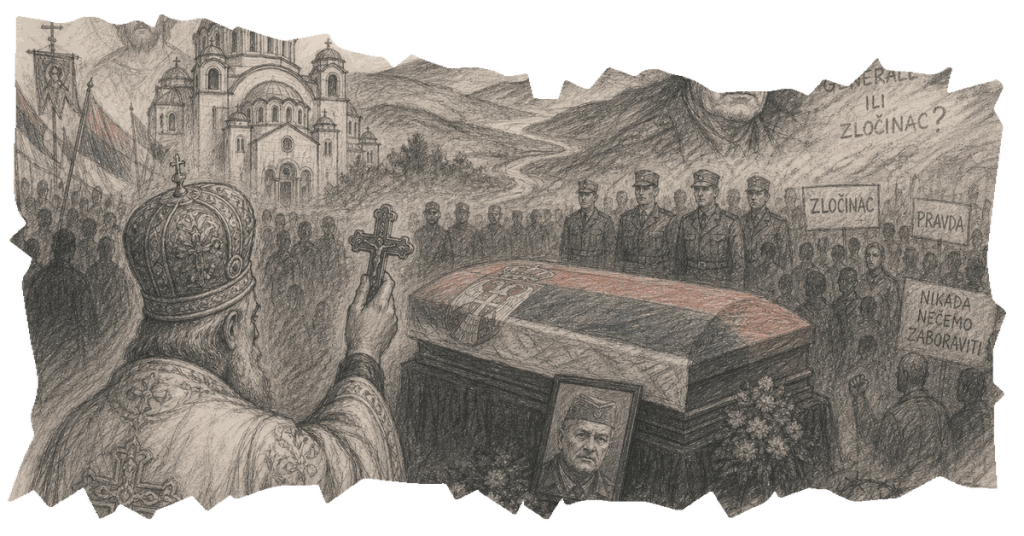
General Ratko Mladić, the former commander of the Bosnian Serb Army, was buried today at Topčidersko groblje in Belgrade. The burial, which included military honors, was attended by a large number of citizens and marked by a significant display of national symbols. The coffin was covered with the flags of Serbia and the Republic of Srpska, reflecting the contentious legacy of Mladić, who was convicted of genocide and war crimes.
The funeral procession began at the Church of Saint Luke on Vidikovac, where Patriarch Porfirije of the Serbian Orthodox Church officiated a memorial service. In his address, Porfirije described Mladić as a soldier and commander who bore significant responsibility and sacrifice during a difficult period. He emphasized that Mladić’s name would remain deeply embedded in the memory of the Serbian Orthodox community, which holds him in high regard for his perceived role in defending the Serbian people.

The procession, which included members of the Serbian military, transported Mladić’s coffin to the family grave at Topčidersko groblje, where he was laid to rest beside his daughter Ana. The event drew a large crowd, with many attendees carrying Serbian flags and photographs of Mladić, indicating the divisive nature of his legacy. The streets leading to the cemetery were closed to traffic, and police were present to manage the large turnout.
The burial has reignited discussions about Mladić’s legacy in Serbia and the broader region. His conviction for genocide and war crimes during the Bosnian War remains a point of contention, with some viewing him as a hero who defended the Serbian nation, while others see him as a war criminal responsible for atrocities. This division was evident in the public reactions to the burial, which included both expressions of reverence and criticism.
The event has also prompted political reactions, with some regional leaders calling for the European Union to impose sanctions on Serbia. These calls reflect ongoing tensions related to Serbia’s handling of its wartime past and its aspirations for EU integration. The burial, attended by a large number of citizens and marked by military honors, underscores the complex and often polarizing legacy of Mladić within Serbian society.
As Serbia continues to grapple with its past, the burial of Ratko Mladić serves as a reminder of the deep-seated divisions that persist in the region. The event highlights the challenges of reconciling historical grievances with contemporary political realities, particularly as Serbia seeks to balance national pride with the demands of international accountability.