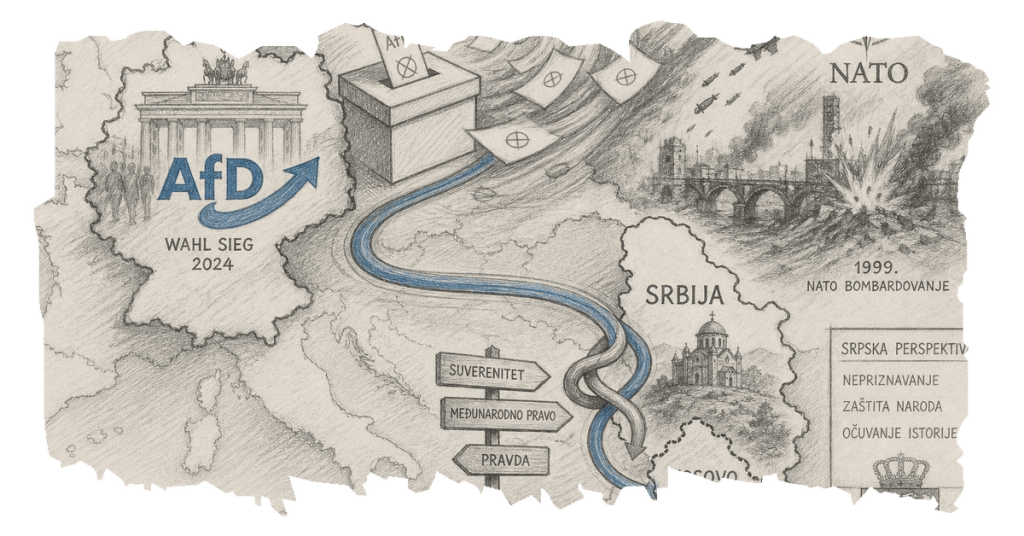
The recent electoral victory of the Alternative for Germany (AfD) party in the Saxony-Anhalt state elections has significant implications for Serbia, particularly concerning the ongoing Kosovo issue. The AfD secured 43.8% of the votes, marking a decisive win in the region. This victory is noteworthy due to the AfD’s longstanding and firm stance on Kosovo, which has been a contentious issue between Serbia and Germany.
The AfD has consistently called for Germany to withdraw its recognition of Kosovo’s independence, a position that aligns with Serbia’s perspective on the matter. The party has also demanded that Germany apologize to Serbia for its involvement in the 1999 NATO bombing, which was a pivotal event in the Kosovo conflict. These demands have been articulated not only by individual politicians but also through official initiatives within the Bundestag, Germany’s federal parliament.

One of the prominent voices within the AfD, Petr Bistron, who served as the party’s foreign policy spokesperson, has been vocal about what he describes as the illegitimacy of Kosovo’s independence. In 2023, Bistron asserted that the NATO-led separation of Kosovo from Yugoslavia was unlawful and urged Berlin to reverse its recognition of Kosovo. He criticized the efforts of the United States and the European Union, claiming they have failed to establish a stable system in Kosovo over the past two decades.
Jens Kestner, another AfD member, has been even more direct in his statements, advocating for the return of Kosovo to Serbia or at least the reintegration of Serb-populated areas under Belgrade’s control. Kestner has described Kosovo as a region plagued by organized crime and Islamist extremism, highlighting the destruction of Serbian Orthodox heritage sites since 1999. He questioned the continued presence of German troops in Kosovo, arguing that the international mission has not resolved fundamental issues.
The AfD’s opposition to the continuation of Germany’s military involvement in Kosovo, particularly within the KFOR mission, has been consistent. On June 11, 2026, 136 AfD parliamentarians voted against extending Germany’s participation in KFOR, with no party members supporting it. This stance reflects the party’s broader skepticism about the efficacy of international interventions in Kosovo.
Alexander Wolf, another AfD representative, criticized Albin Kurti, the Prime Minister of Kosovo’s provisional institutions, labeling him a “left-nationalist” who exacerbates tensions with Serbia. Wolf argued that Kosovo remains unrecognized by many countries and described it as a “failed state.” He called for Germany to cease its military mission and development aid to Kosovo.
Markus Fronmajer, a prominent foreign policy figure within the AfD, has also been critical of the situation in Kosovo. Following clashes between Serbs and KFOR in northern Kosovo in 2023, Fronmajer declared the “Kosovo project” a failure. He pointed to the installation of Albanian mayors in Serb-majority municipalities, which were boycotted by Serb voters, as evidence of a deeply corrupt and politically unstable system left by NATO, the EU, and the UN.
The AfD has not limited its focus to the status of Kosovo alone. The party has raised concerns about attacks on Serbs in Kosovo and Metohija, citing data from Belgrade about 278 ethnically motivated incidents against the Serbian population since 2021. The AfD has questioned the German government about its awareness of these incidents and its actions in response.
While the AfD’s electoral success in Saxony-Anhalt is significant, it remains uncertain how this will translate into policy changes at the national level in Germany. The complexities of coalition politics and the broader landscape of German foreign policy may limit the immediate impact of the AfD’s positions on Kosovo. Nonetheless, the party’s victory has been welcomed in Serbia, where its stance on Kosovo resonates with the government’s long-held views on the region’s status.