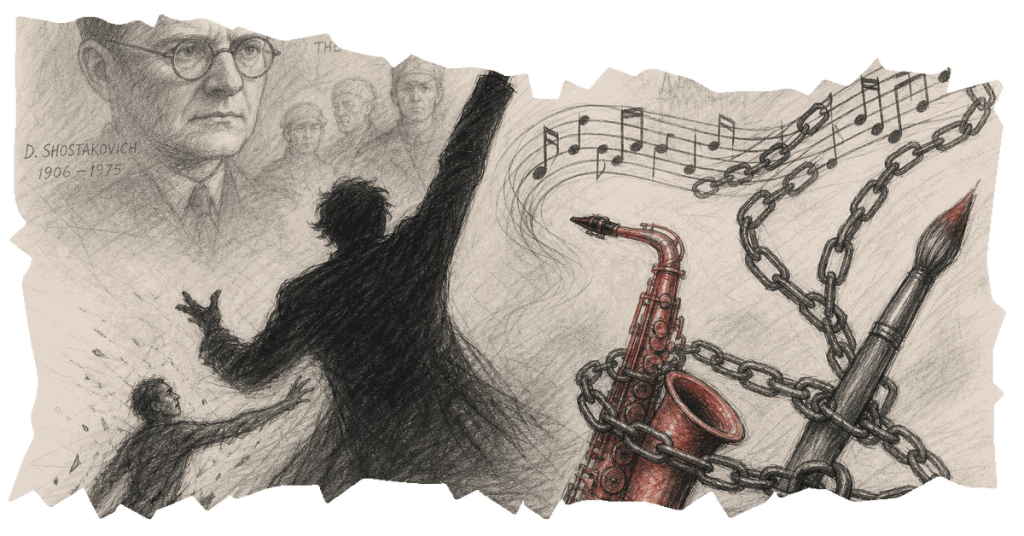
The Serbian government is reportedly attempting to suppress artistic expression, drawing parallels to historical instances of censorship. This development has sparked concerns among artists and cultural commentators, who see echoes of past authoritarian regimes in these actions. The situation has been compared to the censorship faced by composers like Dmitri Shostakovich during Stalin’s rule in the Soviet Union, where artistic expression was heavily monitored and often stifled.
The current climate in Serbia has seen attempts to ban certain forms of music and styles, reminiscent of the Soviet era’s control over art. The saxophone, a symbol of jazz and Western influence, has historically faced suppression, as highlighted by past events in the Soviet Union. In 1948, the Central Committee’s decision on the opera “Great Friendship” by Vano Muradeli indirectly led to the marginalization of jazz and the disappearance of the saxophone from popular orchestras. This instrument, devoid of lyrics and unable to make explicit claims, was nonetheless targeted as a symbol of Western decadence.

The primary source from Vreme details how such historical censorship tactics are being mirrored in Serbia today, with the government allegedly seeking to control artistic expression. The article draws a parallel to Shostakovich’s experience, where his opera “Lady Macbeth of the Mtsensk District” was criticized in an unsigned Pravda article, leading to his Fourth Symphony being withdrawn from rehearsals. The composer later wrote the Fifth Symphony, which was met with approval, showcasing the pressures artists faced to conform.
In the Soviet Union, denunciations were common, and composers were often targeted due to their small numbers and lack of defense mechanisms. The suppression extended beyond music to other forms of cultural expression, including abstract art and even personal appearance, such as hair length and clothing styles. The saxophone, despite its lack of lyrical content, was emblematic of this suppression. Parviz Rustambekov, a saxophonist in Baku, was fired and later arrested in 1949 for allegedly promoting Western decadence, dying in custody under unclear circumstances.
The article also references the “Degenerate Art” exhibition in Munich in 1937, which mocked modern art and attracted over two million visitors. This event, although rooted in racial ideology distinct from the Soviet Union’s, similarly demonstrated the power of state-driven cultural campaigns to influence public perception.
The current situation in Serbia, as reported, suggests a resurgence of such tactics, with the government allegedly attempting to silence dissent and control cultural narratives. The article emphasizes the enduring power of recognition in art, where individuals find solace and solidarity in shared experiences, even without explicit messages. This recognition, which transcends words and direct content, poses a challenge to authoritarian control, as it cannot be easily contested or interpreted.
The broader implications of government control over artistic expression are significant, affecting not only artists but the cultural landscape as a whole. The suppression of art stifles creativity and innovation, limiting the diversity of voices and perspectives that contribute to a vibrant cultural ecosystem. As the situation develops, the response from the artistic community and the public will be crucial in determining the future of artistic freedom in Serbia.