

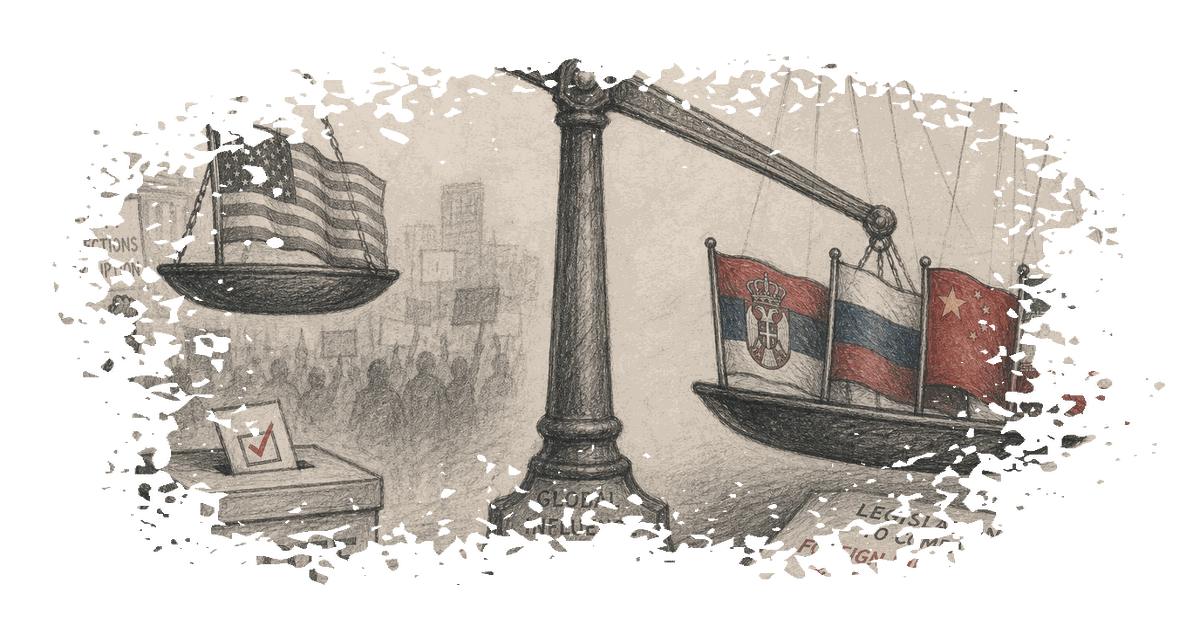
U.S. Congress members Joe Wilson and William Kiting have introduced a bill sharply criticizing the Serbian government for allegedly undermining democracy and cultivating close relationships with Russia, China, and Iran. The proposed legislation, currently in its initial stages, calls for the U.S. to pressure Serbia to ensure free and fair elections, combat corruption, and adjust its foreign policy stance towards Moscow, Beijing, and Tehran. The Serbian Foreign Ministry has not yet provided a response to requests for comment on the proposed legislation.
The bill emphasizes the importance of rule of law and freedom of speech in Serbia, warning that failure to address these issues could lead to a reconsideration of the strategic dialogue between the U.S. and Serbia. Congressman Wilson stated, “The U.S. remains consistent in its policy that Serbia must adhere to the rule of law, cease regional destabilization, and respect freedom of speech and assembly.” The document also requests that U.S. Secretary of State Mark Rubio exert pressure on Belgrade to address these concerns.

The introduction of this bill comes amid ongoing political tensions in Serbia, with President Aleksandar Vučić having announced elections for the end of October. In recent years, Serbian authorities have faced anti-corruption protests and calls for accountability, particularly following a tragic incident in Novi Sad. Vučić has repeatedly dismissed claims that his administration is obstructing judicial processes related to this tragedy.
Internationally, Serbia has maintained a policy of balancing relations with the European Union, the U.S., Russia, and China. Recent events have underscored this approach, such as the visit of Ukrainian President Volodymyr Zelensky to Belgrade and Serbia’s subsequent request for firefighting assistance from Russia. These actions have raised questions about Serbia’s geopolitical orientation, with some observers suggesting that the U.S. Congress members’ bill aims to encourage Serbia to align more closely with Western policies.
The bipartisan nature of the bill, with Wilson being a Republican and Kiting a Democrat, suggests the issue holds significant importance within the U.S. political landscape. Robin Brooks, a former director for the Western Balkans at the National Security Council, noted that the proposal sends a message to both President Vučić and the U.S. executive branch, advocating for a stable democratic Serbia that respects the will of its people and human rights.
The potential impact of the proposed legislation on U.S.-Serbia relations remains uncertain, as the bill is still far from being passed in Congress. However, it raises critical questions about the future of the strategic dialogue between the two nations. The dialogue, which began in mid-July, was seen as a pivotal moment in U.S.-Serbia relations, with President Vučić describing it as a turning point for mutual respect and understanding.
The proposed bill also highlights concerns about Serbia’s foreign policy, particularly its ties with Iran. Criticism was directed at Serbian Minister of Culture Boris Bratina’s attendance at the funeral of Ayatollah Ali Khamenei, who was killed in the U.S.-Israeli conflict with Tehran. Bratina explained that his visit to Tehran was sanctioned by the Serbian government, indicating official approval of his actions.
As Serbia approaches its elections, the proposed U.S. legislation underscores the complexities of its domestic and foreign policy challenges. The international community, particularly the U.S., continues to monitor developments closely, emphasizing the need for Serbia to adhere to democratic principles and align more closely with Western values. The outcome of the proposed bill and its implications for Serbia’s political landscape and foreign relations will be closely watched in the coming months.




0 Comments