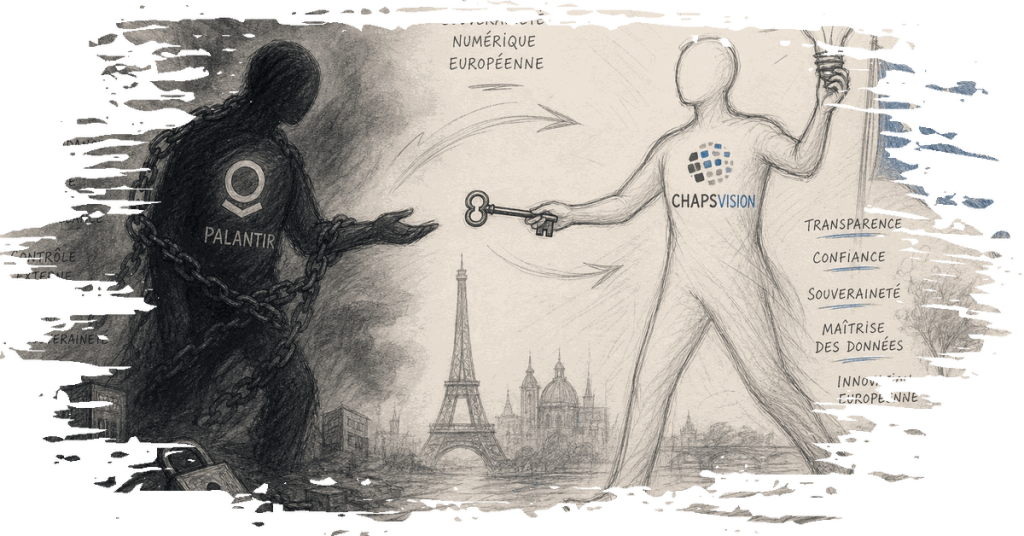
ChapsVision, a French software company, is set to replace Palantir Technologies in handling significant contracts with the French government, marking a strategic shift towards European technological sovereignty. This move comes amid growing concerns among European governments about their reliance on American technology, particularly in sensitive sectors such as defense and national security.
Palantir, known for its software widely used by U.S. defense and intelligence agencies, has been a prominent player in Europe, with its technology employed in countries like the United Kingdom, Germany, France, and others, primarily in defense, security, and data analytics. Despite its success in penetrating the European market, Palantir has faced criticism over its invasive surveillance practices and political connections, which have prompted European governments to reconsider their dependence on the company.

ChapsVision, headquartered in Paris, has rapidly grown since its inception in 2019, reaching approximately 200 million euros in annual revenue, primarily through acquisitions. The company has completed nearly 30 acquisitions, expanding its expertise in areas such as artificial intelligence, defense software, and semantic search. With about half of its business stemming from the public sector, ChapsVision also collaborates with major private companies like Pfizer, LVMH, and Airbus.
The French government has signed a contract with ChapsVision to replace Palantir in the French internal security service. This contract extends beyond the intelligence sector, encompassing data infrastructure development for all state ministries and around 50 public agencies. This transition is seen as a test of whether a sovereign European technological solution can be implemented on such a broad scale. Furthermore, ChapsVision is competing for substantial contracts with German defense and police institutions.
ChapsVision emphasizes transparency in its software and business model, contrasting with Palantir’s approach, which has been criticized for fostering long-term client dependency. Silvano Sansoni, the chief director of ChapsVision, stated that their goal is to transfer knowledge and skills to clients and then move on to the next project, rather than maintaining a prolonged presence with clients.
The shift from Palantir to ChapsVision is perceived as a political decision, aligning with French President Emmanuel Macron’s efforts to promote domestic technological solutions. However, Charles Thibault, a digital transformation and technology expert at the Institute for International and Strategic Relations, questions whether this move is genuinely strategic or merely a populist gesture to quell criticism of the French government’s close ties with major American tech companies.
ChapsVision’s growth and its new role in France’s internal security highlight the broader trend of European governments seeking to bolster their technological independence. As European nations reevaluate their reliance on American tech firms, companies like ChapsVision stand to gain significant opportunities in sectors traditionally dominated by U.S. giants. This shift not only underscores the importance of technological sovereignty but also signals a potential rise of European tech firms in sensitive sectors.