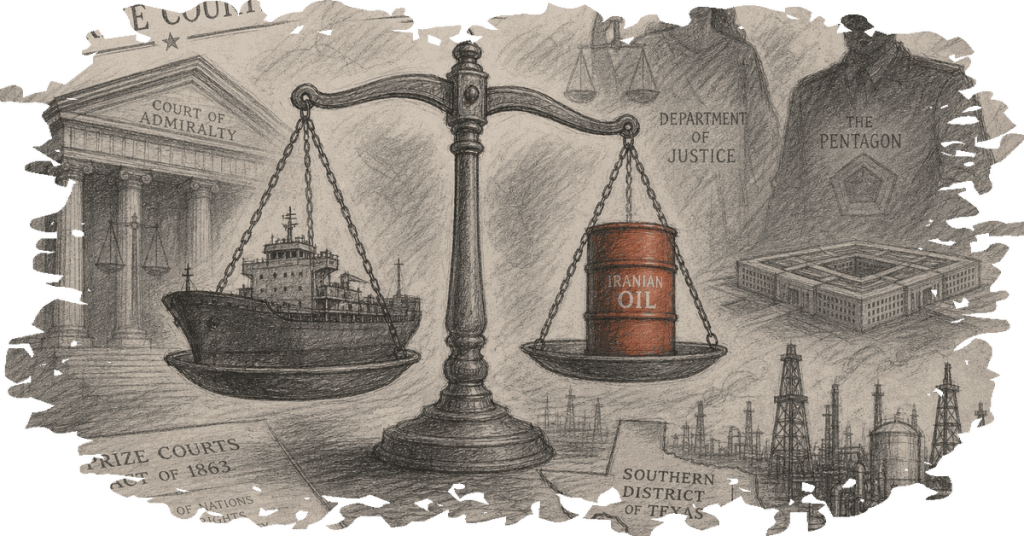
The United States government is considering the revival of an antiquated legal mechanism known as “prize courts” to manage Iranian oil and ships captured under its blockade, according to a recent report. This move, which involves the Justice Department and the Pentagon, aims to streamline the process of claiming vessels and cargo seized during armed conflict. Historically, prize courts were used to determine the legality of captured vessels and cargo, a practice that has largely been dormant since World War II.
The Southern District of Texas is being considered as a potential venue for these cases due to its jurisdiction over a major port and its proximity to the largest concentration of petrochemical infrastructure in the United States. This location could facilitate the handling and storage of substantial quantities of crude oil. U.S. Attorney Aaron Reitz stated that the Department of Justice is “now reviving” prize courts, describing the concept as an “ancient body of maritime law.”

The appeal of using prize law lies in its potential to expedite the legal process compared to the current reliance on civil forfeiture, which can be slow and complicated due to competing claims from shipping companies, creditors, and other parties. A prize proceeding could potentially narrow these disputes, allowing the U.S. government to sell captured oil more quickly, with proceeds going to the U.S. Treasury. This approach is part of a broader strategy to increase economic pressure on Iran, turning captures into a more direct financial tool and reinforcing the seriousness of the U.S. blockade as a wartime measure.
However, there are significant uncertainties regarding how this centuries-old framework would function under modern international law. Maritime attorney Allison Luzwick noted that prize law is a “historical area of law that is not tested in modern times,” raising questions about its applicability given the current geopolitical context and the lack of congressional authorization for hostilities. Additionally, federal judges, prosecutors, and the Navy have little contemporary experience with prize cases, necessitating the development of new procedures for modern shipping and warfare.
Critics warn of broader geopolitical risks, suggesting that normalizing prize law could set a precedent that other nations might use against U.S. or neutral merchant vessels in future conflicts. This proposal, while potentially offering a faster way to convert captured Iranian oil into government revenue, involves reopening an area of wartime law that has been largely untouched for over a century. The effectiveness of this legal strategy in achieving U.S. objectives against Iran remains uncertain, and it may face legal challenges.
This development comes amid ongoing tensions between the U.S. and Iran, with the U.S. seeking additional methods to exert economic pressure on Tehran. The revival of prize courts could serve as a strategic message reinforcing the U.S. blockade as a serious wartime measure, rather than merely a sanctions regime. However, the practical and legal challenges, along with potential international repercussions, underscore the complexity of implementing this approach in the current geopolitical landscape.