

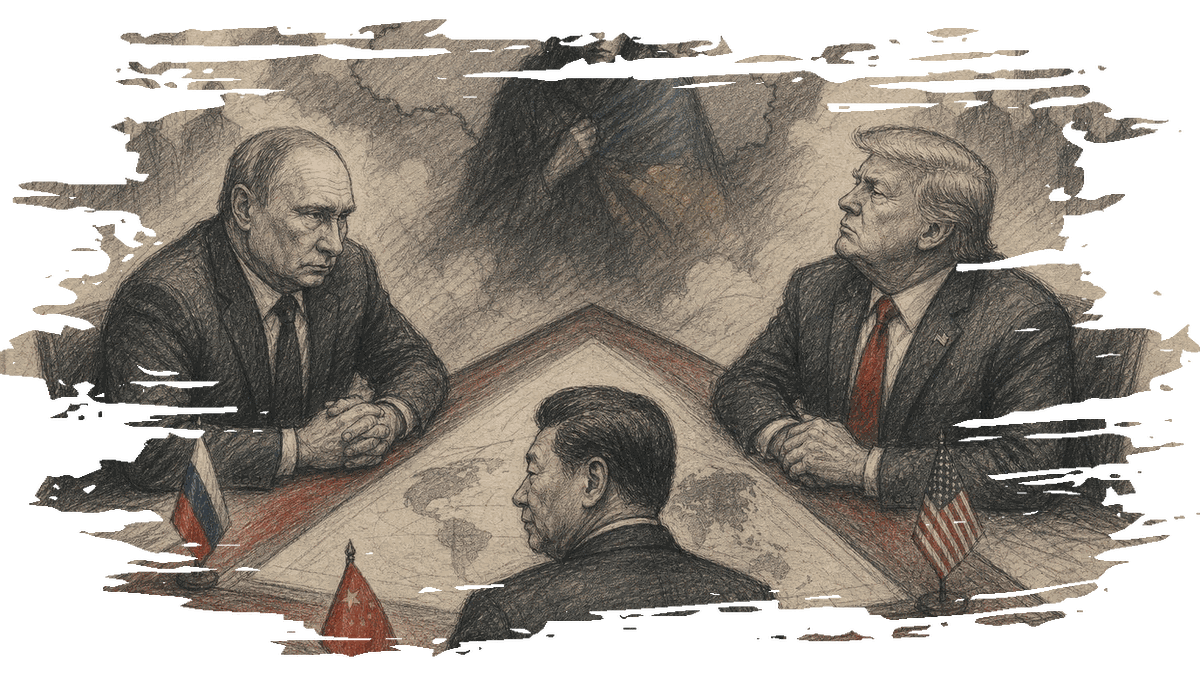
In a significant diplomatic event, Russian President Vladimir Putin met with U.S. President Donald Trump and Chinese President Xi Jinping in Shenzhen, China, during the Asia-Pacific Economic Cooperation (APEC) summit. The 90-minute trilateral meeting, held on November 20, 2026, has sparked discussions about its implications for global security and power dynamics. Analysts have compared the meeting to the historic Yalta Conference of 1945, where post-war European boundaries were decided, raising concerns about the exclusion of other nations from critical global discussions.
Putin, facing an international arrest warrant from the International Criminal Court and limited invitations to diplomatic gatherings, used the meeting to assert Russia’s influence on the global stage. He expressed confidence that Russia, China, and the U.S. could significantly enhance global security through cooperation grounded in mutual respect and equality. This rhetoric aligns with Putin’s longstanding ambition to restore spheres of influence similar to those during the Cold War, where European security decisions were directly negotiated between Washington and Moscow.
The meeting’s atmosphere was described as cordial, with Putin aiming to demonstrate Russia’s status as a superpower. Standing alongside Trump and Xi, Putin sought to convey that attempts to isolate Russia had failed. Temur Umarov, a fellow at the Carnegie Center for Russia and Eurasia, noted that the mere occurrence of the meeting could be seen as a victory for Putin, as it implicitly endorsed his geopolitical ambitions.
Ukrainian President Volodymyr Zelenskyy expressed concern before the meeting, warning against any attempts to resolve the Ukraine conflict without Ukraine’s involvement. This apprehension stems from fears that discussions could mirror the Yalta Conference, where nations affected by the decisions had no representation. Despite Kremlin spokesperson Dmitry Peskov’s dismissal of such comparisons as “political games,” analysts suggest that Russia aims to position itself as a security guarantor in Europe, seeking public acknowledgment from Trump and Xi.
The meeting’s outcomes remain largely symbolic, with no concrete agreements reached. However, the discussions have highlighted Russia’s desire for a comprehensive resolution to its security concerns, potentially involving a reconfiguration of Europe’s security architecture. Mikhail Troitskiy, deputy director of the Russia and Eurasia Program at Tufts University’s Fletcher School, stated that Russia is testing whether Trump or Xi would publicly support such a new architecture that aligns with Russian demands.
Recent actions by the Trump administration, such as a controversial diesel purchase agreement with Russia and exemptions from sanctions, have been perceived as favorable to Putin. Additionally, discussions in Abu Dhabi suggested a U.S. willingness to negotiate not only a ceasefire in Ukraine but also an end to the war, which could lead to significant changes in Europe’s security framework.
The meeting in Shenzhen underscores the ongoing geopolitical tensions and the complex interplay of global powers. While the event was rich in symbolic gestures, its long-term implications for U.S.-Russia relations and the Ukraine conflict remain uncertain. As the international community continues to navigate these challenges, the potential reshaping of global security architecture will be closely watched.




0 Comments