

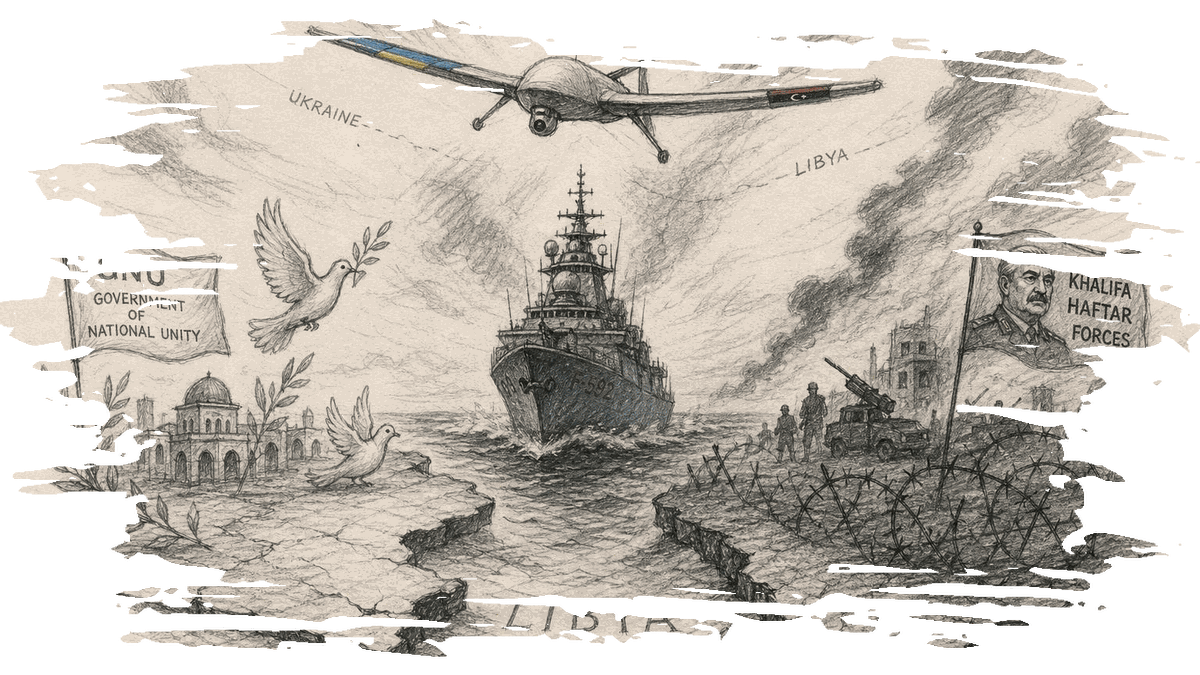
Ukrainian President Volodymyr Zelenskyy has taken responsibility for a drone strike on a Russian warship docked in the Libyan port of Benghazi, an action that has escalated tensions and drawn condemnation from both sides of Libya’s divided political landscape. The attack, which occurred on November 23, 2026, has raised fears among Libyan officials that it could undermine the fragile reconciliation process in the country, which has been ongoing since 2025.
The drone strike targeted a Russian vessel, marking a significant escalation in Ukraine’s military actions in Libya. This development has been met with strong reactions from Libyan political factions, including the internationally recognized Government of National Unity (GNU) based in Tripoli and forces loyal to Khalifa Haftar in the east. Both sides have expressed concerns that this incident could derail efforts to unify Libya’s political, military, and economic institutions after more than a decade of division and conflict following the fall of Muammar Gaddafi in 2011.
Libya has been split between the GNU, led by interim Prime Minister Abdul Hamid Dbeibah, and Haftar’s forces, who have historically received support from Russia. Moscow’s involvement in Libya has included providing weapons, mercenaries, and diplomatic backing to Haftar’s self-described Libyan National Army (LNA), which has helped him consolidate control over eastern Libya. Russia’s military presence in Libya is part of a broader strategy to maintain its influence across the Sahel and Central Africa, using Libya as a logistical hub.
Ukraine’s involvement in Libya, on the other hand, has been characterized by its support for the GNU. The Tripoli-based government has aligned itself with Ukraine, condemning Russia’s invasion of Ukraine in 2022 and voting to suspend Russia’s participation in the United Nations Human Rights Council. This partnership has included military cooperation, with Ukrainian forces providing training and technical support to GNU forces.
The acknowledgment of the attack by Zelenskyy has left no ambiguity about Ukraine’s role in the strike, which is part of a series of suspected attacks on Russian-linked vessels in the Mediterranean. These actions have been perceived as part of Ukraine’s efforts to counter Russian influence in the region. However, it remains unclear whether the drone strike was launched from Libyan territory, a factor that could influence international perceptions and responses.
The reconciliation process in Libya has seen some progress, including the adoption of a unified national budget in April 2026. However, the political landscape remains fragile, and incidents like the recent drone strike threaten to exacerbate existing tensions. The potential for renewed conflict poses a significant risk to the ongoing efforts to bridge the divide between Libya’s eastern and western authorities.
Libyan officials have voiced their concerns about the impact of the drone strike on the reconciliation process. The attack has highlighted the complexities of Libya’s political situation, where external powers have long played a significant role in the country’s internal affairs. As the situation develops, the long-term implications of Ukraine’s direct involvement in Libya remain uncertain, with the potential to affect not only Libya’s political landscape but also the broader geopolitical dynamics in the region.




0 Comments