

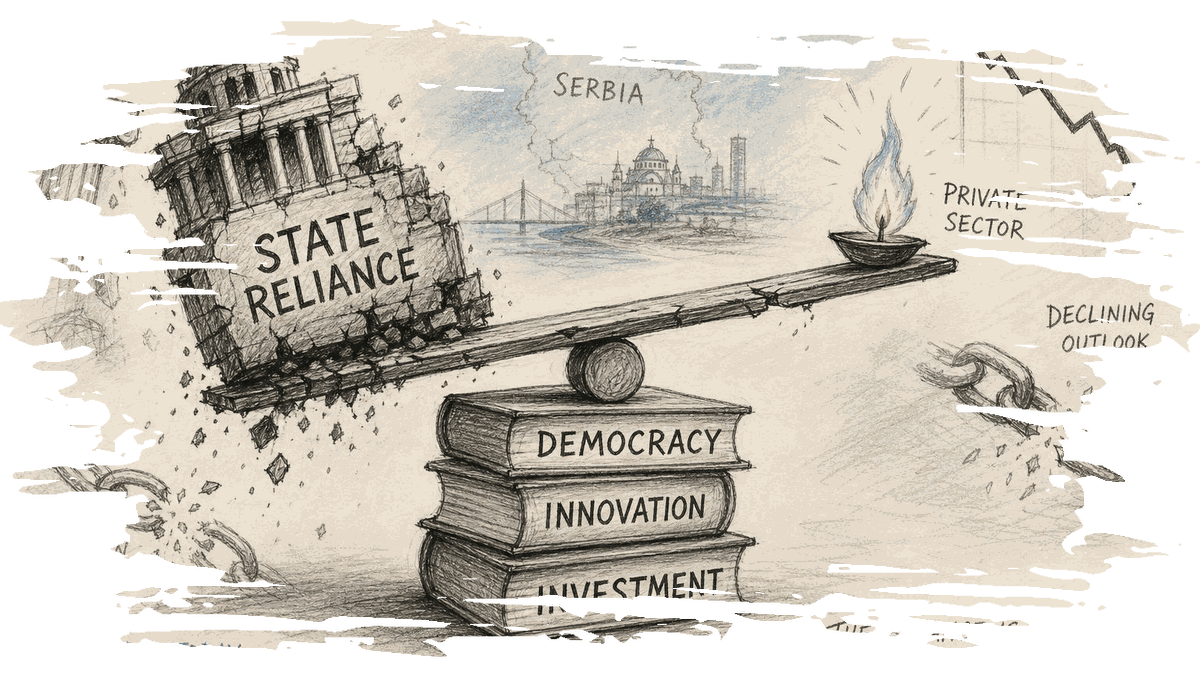
An analysis presented at the Institute of Social Sciences in Serbia warns that the country’s economic growth is at risk due to the erosion of democratic institutions, drawing parallels with Hungary’s recent economic stagnation. The study, conducted by economists Pavle Petrović, Danko Brčerević, and Slobodan Minić, underscores that without significant institutional reforms, Serbia could face long-term economic stagnation akin to Hungary’s experience.
The report highlights that Serbia’s growth model, heavily reliant on state investments, foreign capital, and employment increases, is unsustainable in the absence of robust democratic institutions. The economists point out that the weakening of these institutions hampers the development of the domestic private sector and technological advancement, which are crucial for sustainable growth. Petrović emphasized that Serbia is following a similar path to Hungary, where economic growth has slowed significantly after a period of rapid expansion.
According to the analysis, Serbia’s GDP growth, which averaged 3.8% annually from 2018 to 2024, is projected to slow to 2.8% in 2025 and 2026. This slowdown is accompanied by a decline in employment rates, with a 1% decrease in total employment recorded in 2025, followed by a further 1.7% drop in the first half of 2026. The report also notes a significant reduction in net foreign direct investments, which fell from 5.5% of GDP in 2024 to 2.6% in 2025, maintaining a similar level into 2026.
The analysis draws on data from the international research project V-Dem, which shows a dramatic decline in Serbia’s liberal democracy index by 58.5% from 2012 to 2025. The deterioration is even more pronounced in the area of free and fair elections, with a 66.7% drop. Media freedom and judicial constraints on executive power have also weakened significantly, by 50.9% and 34.1%, respectively.
The economists argue that these political changes have direct economic consequences. The lack of effective legal constraints and independent judiciary erodes business confidence, as entrepreneurs fear for the security of their assets and profits. The analysis indicates that both Serbia and Hungary have experienced periods of relatively high economic growth, primarily driven by increased capital and labor inputs rather than productivity gains, innovation, or new technologies.
In Hungary, the GDP growth rate, which averaged 3.9% annually between 2013 and 2019, slowed to an average of 0.5% from 2023 to 2026. The report warns that Serbia is showing early signs of a similar trajectory. The concentration of economic growth in sectors like mining, construction, and information and communication, which grew by an average of 9.7% annually from 2018 to 2024, has also slowed to 1.8% in 2025 and 2026.
The most pressing structural issue identified is the insufficient investment by Serbia’s domestic private sector, which accounted for only about 4% of GDP in 2024, significantly lower than state investments. The lack of legal certainty and independent institutions that guarantee property rights is cited as a key reason for this investment shortfall. In such an environment, investments are often directed towards politically favored actors, leaving many domestic entrepreneurs without sufficient incentives to invest in new technologies, production, and innovation.
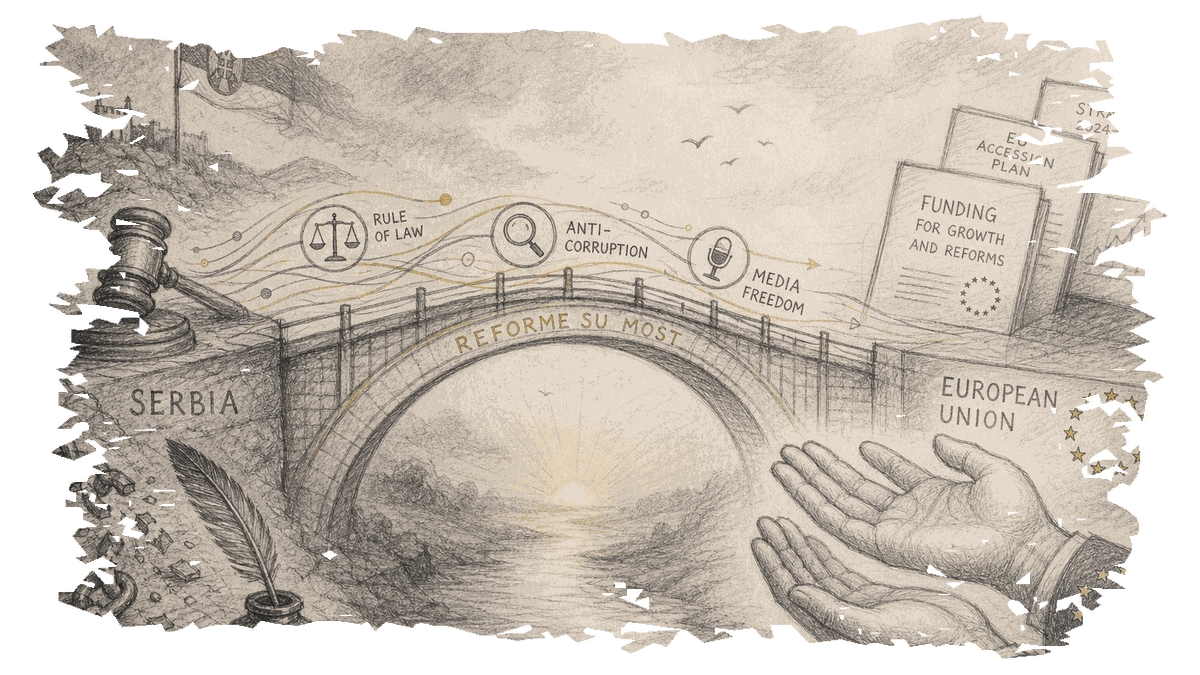
The analysis concludes that populist regimes, by weakening democratic and economic institutions, slow down long-term economic growth. It calls for fundamental institutional reforms to prevent prolonged economic stagnation, stressing that the current growth model cannot sustain high growth rates indefinitely as opportunities for increasing employment and investments become exhausted.


0 Comments