

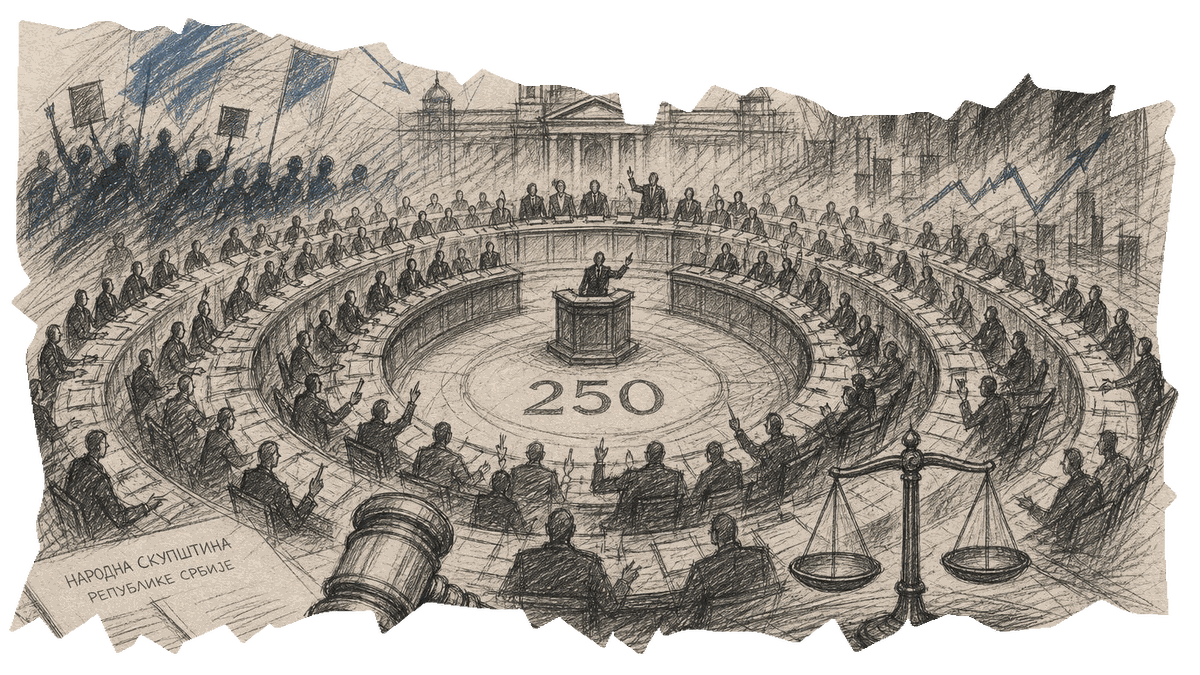
The Serbian National Assembly convened on November 17, 2026, to confirm the mandates of its 250 members and propose candidates for the presidency of the parliament, amidst significant political tensions. The Students’ List, which emerged victorious in the October elections, put forward Aleksandar Čupić as their candidate for the presidency. In contrast, the ‘Aleksandar Vučić – United Serbia’ list nominated Stojan Radenović for the same position.
The session, which marked the constitution of the new assembly, was characterized by disputes, particularly concerning the exclusion of opposition members from preparatory discussions. This exclusion was highlighted by Milenko Jovanov, deputy head of the ‘Aleksandar Vučić – United Serbia’ parliamentary group, who criticized the Students’ List for organizing what he described as a “lynch mob” against opposition members and for excluding them from the session’s preparations. Jovanov argued that this exclusion violated democratic norms and accused the Students’ List of attempting to control parliamentary committees by determining who is qualified to lead them.
The assembly’s session began with the confirmation of all 250 members’ mandates, followed by their oath-taking. The day’s proceedings concluded with a decision to resume the session the following day, where the election of the parliamentary president and vice-presidents is expected to take place. The session’s agenda also includes the appointment of a general secretary and the selection of members for parliamentary committees and permanent delegations to international institutions.
Petar Mitov, a member of the Students’ List, requested a vote on a procedural violation concerning Aleksandar Vučić’s speech, which he claimed deviated from the session’s agenda. Mitov argued that Vučić’s remarks, which included references to various unrelated topics, demonstrated disrespect towards Radenović, the candidate Vučić was supposed to endorse. Vučić, in his response, refuted Mitov’s claims and defended his speech content.
The session’s tensions reflect broader political dynamics in Serbia following the Students’ List’s electoral victory, which ended the Serbian Progressive Party’s 14-year rule. The Students’ List, originating from a protest movement, now faces the challenge of transitioning to a governing body amidst criticism of their governance approach and handling of opposition relations. The proposed leadership candidates, Čupić and Radenović, are set to navigate these tensions as they vie for the parliamentary presidency, a role crucial in shaping the legislative agenda and political discourse in Serbia.
As the assembly reconvenes, the outcome of the leadership elections and the subsequent formation of parliamentary committees will be pivotal in determining the new government’s direction and its relationship with opposition parties. The session’s developments underscore the complexities of Serbia’s current political landscape, where new governance models and traditional political practices intersect.


0 Comments