

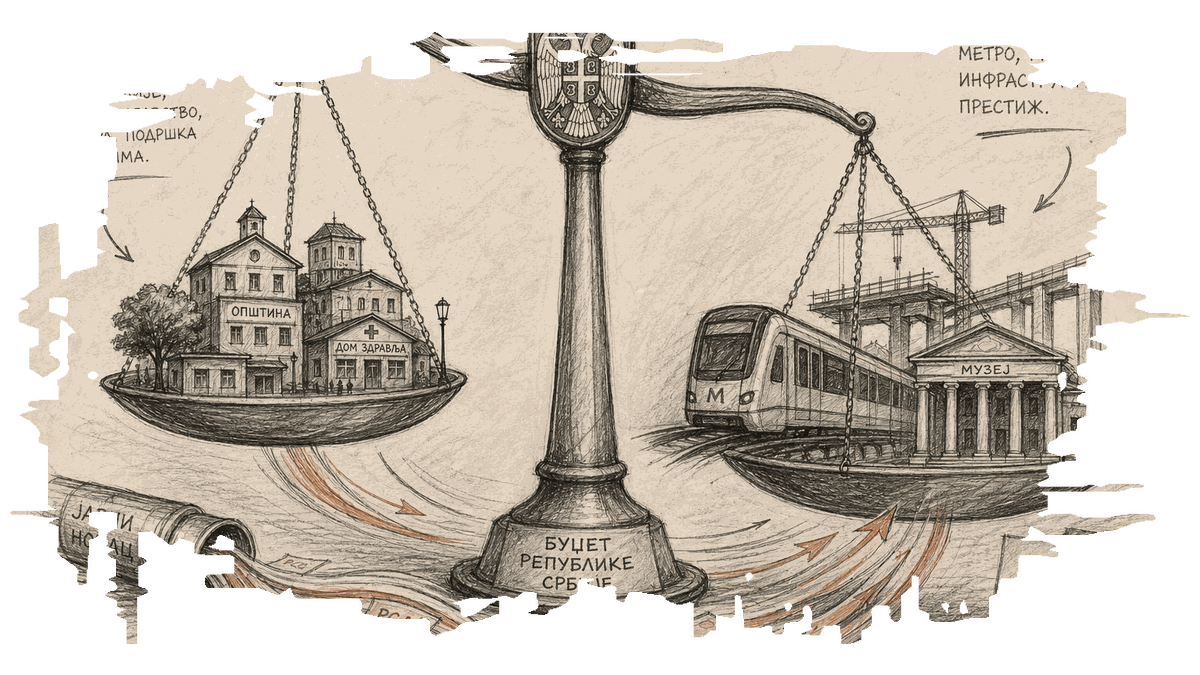
The Serbian government has announced a significant reallocation of budgetary funds, redirecting nearly 5 billion dinars from capital projects to support local municipalities. This decision, outlined in three separate government resolutions, aims to address the financial liquidity needs of 74 local governments and cover losses in electricity transmission. The move has seen substantial sums diverted from major infrastructure projects, including the construction of the Belgrade metro and the new Natural History Museum.
According to the resolutions published in the Official Gazette, the Ministry of Finance has reallocated 3.43 billion dinars from capital projects to bolster municipal budgets. The largest portion, 2.05 billion dinars, was taken from the budget allocated for the new Natural History Museum, while 1.38 billion dinars were redirected from funds earmarked for land expropriation for capital projects. This reallocation is intended to help municipalities manage unforeseen obligations that were not accounted for in the original budget, which could threaten their financial stability.
The cities of Belgrade and Niš received the largest allocations, with 259.6 million dinars and 250 million dinars, respectively. Other significant recipients include Vranje and Pirot, each receiving 200 million dinars. Smaller amounts, ranging from 15 to 50 million dinars, were distributed among other local governments.
In addition to supporting municipalities, the government has also redirected funds within the Ministry of Mining and Energy. A total of 1.32 billion dinars was reallocated, with 567 million dinars taken from the project documentation for the Đerdap 3 reversible hydroelectric power plant. These funds are intended to compensate Elektromreža Srbije and Elektrodistribucija Srbije for electricity transmission losses.
Furthermore, 240 million dinars were shifted from the Belgrade metro project to support Serbia Cargo’s rail and intermodal transport programs. This reallocation is aimed at ensuring the stability of Serbia’s economy by prioritizing critical transport needs.
The reallocation of funds has been signed off by Siniša Mali, the Minister of Finance, who is currently serving in a technical mandate. The decision reflects a shift in the government’s immediate financial priorities, emphasizing local governance and energy sector needs over long-term infrastructure projects.
While the reallocation addresses pressing financial issues for local governments, it raises questions about the future of Serbia’s infrastructure development. The diversion of funds from significant projects like the Belgrade metro could have long-term implications, potentially delaying or scaling back these initiatives. The decision may also spark public debate over the prioritization of local liquidity over major capital investments, especially in the context of Serbia’s broader economic and infrastructural goals.




0 Comments